
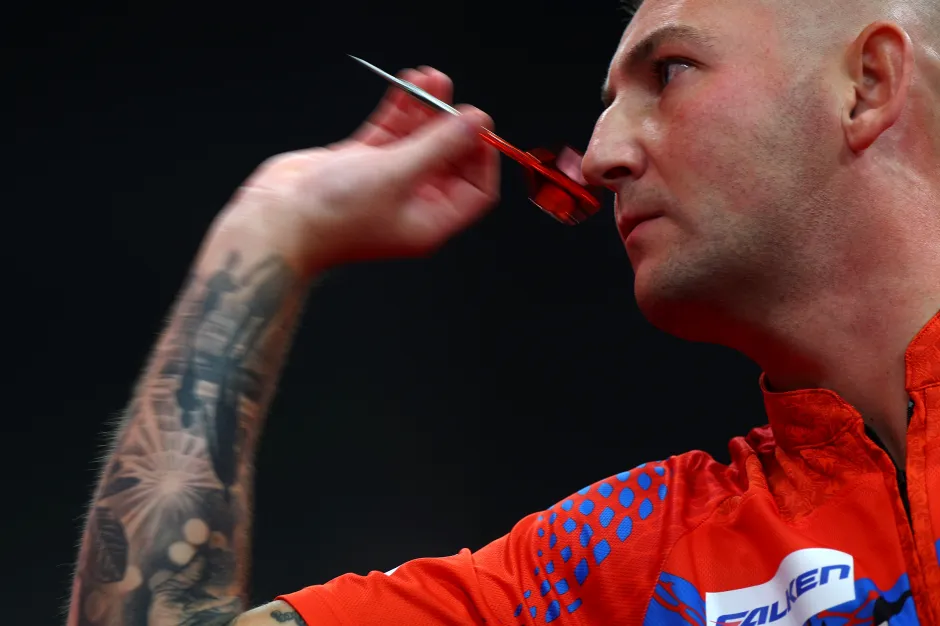
Some players hide how they feel until the cameras are off. Nathan Aspinall does the opposite.
On Friday night in Amsterdam he was 4-1 down to Raymond Smith, feeling physically off, and thinking about leaving the World Series of Darts Finals before the first round was even finished. Then he won 6-4 and talked about it like a man who had just talked himself out of an early flight home.
That is the story. Not a miracle 180. Not a nine-darter. A 35-year-old world No.16 deciding the discomfort was not a good enough reason to stop.
“Yeah, it’s a big win, you know, there’s so many parts in that game that I just wanted to quit and not win. Just go home because I feel pretty rubbish.”
He said the quiet part out loud. That is why it stuck.
Feeling Rubbish and Still Finding a Way
Aspinall called himself a hypochondriac in the same breath. He suspected it was not as bad as it felt. That does not make the admission smaller. Plenty of players would have given you the score and a polite line about a tough opponent. He gave you the moment when winning stopped feeling worth it.
“But, you know, I’m a hypochondriac, it’s probably not that bad, let’s be honest with you.”
The support around him mattered. His mates were in the crowd. His wife Kirsty had travelled with him. He knew she did not want to turn around and go home the next day. So he did the thing he always claims he does when a match starts sliding.
“I know she didn’t want to go home tomorrow, so I did what I always do, I dig deep in a battle.”
Smith was not at his best. Aspinall saw it. He told himself that if he could break back from 4-1, the other man might go. Smith faded over the last two legs. Aspinall finished it without a late collapse and called it a gutsy performance.
The Money Argument He Made to Himself
Then came the part that sounds like a dressing-room pep talk and a family budget meeting at the same time.
“And it’s like, I played one game here for £10,000, sort your head out, it’s half an hour.
“And, you know, sometimes I think what my family could do with that and what holidays I could book. And, yeah, it just kind of gives me determination, you know.”
That is the professional talking. Half an hour. Ten thousand pounds. A wife and kids who benefit if he stays on stage. Darts likes to sell the walk-ons and the pyrotechnics. Aspinall sold the calculation underneath them.
He also admitted he had spent the day feeling sorry for himself. The shackles came off once he was 4-1 down because nobody expected him to win from there. That is a strange kind of freedom, but it is a real one. Pressure drops. Pride takes over.
What the Win Was Really For
The result put him into the second round against Luke Littler. Aspinall did not pretend that was the draw he wanted.
“I’m playing Littler in the second round at the moment. Probably not ideal. You know what I mean? So I need to get up them rankings.”
Vincent van der Voort had pointed out on Dutch television that he is 16th in the world. Aspinall did not duck it.
“I’m better than 16th in the world, you know, even with my bit of flaw in my throw. I’m a top ten player all day and I need to start proving that.”
He wants Minehead. He has floor events to play, including Den Bosch. He wants the Premier League nights and World Series appearances that come with climbing again. He said he has been playing for four weeks after a break and that management of his schedule has been tight. The message was simple enough. Play more. Win more. Stop living at 16.
Saturday showed both sides of that argument. Littler beat him 10-9 in a last-leg decider. Aspinall led 9-8 and was one hold from ending Littler’s 329-day run without a loss in a premier event. The Amsterdam crowd spent the night on Littler. Referee Charlie Costorphine had to intervene. Aspinall even asked for the whistling to stop.
He still lost. That does not wipe out Friday. It frames it. A player who felt bad enough to consider quitting still took the world number one the distance 24 hours later.
Why This Version of Aspinall Matters
Aspinall has never been a mystery. When he is struggling, he says so. When the body is talking, he does not pretend it is silent. That honesty can wear people out if they want only the highlight package. It is also why a lot of fans stay with him.
This was not a grand statement about walking away from the sport. It was a mid-match thought from a man who felt physically off and still finished the job. That distinction matters. Quitting a game in your head and then winning it is different from packing the case.
It also says something about the circuit. These events look loud and simple from the sofa. They are not. Players travel, sit in hotels, feel under the weather, and then have to produce in front of a crowd that may not care how they woke up. Aspinall put that gap on the record.
Going Forward
He leaves Amsterdam with a win he had to scrape for and a defeat that will sting because it was so close. The ranking problem is still there. So is the belief that he is a top-ten player with a throw that is not always pretty.
The next test is whether the determination he talked about on Friday survives the floor events and the weeks when nobody is writing about a comeback from 4-1 down. Talking about family, holidays and ten grand works in the moment. Repeating that standard when the body feels ordinary again is the harder bit.
For one night in Amsterdam, it was enough. He felt rubbish. He thought about going home. He stayed. He won. Then he made Littler work until the last dart.
That is a player worth watching, discomfort and all.
Was this just Aspinall being Aspinall, or is this the start of him forcing his way back up the list the hard way?