
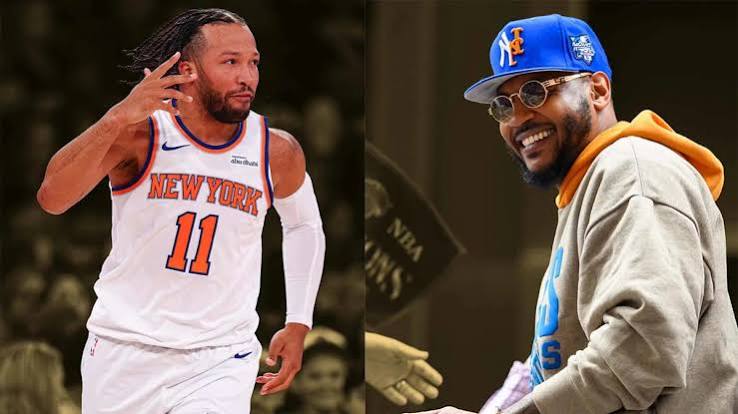
Carmelo Anthony Gets Honest About How Jalen Brunson’s Pay Cut Set a Bad Precedent
Jalen Brunson made a sacrifice that helped change the New York Knicks’ fortunes, but former Knicks superstar Carmelo Anthony believes that decision may now be creating an uncomfortable problem for the franchise.
Brunson chose a contract worth significantly less than what he potentially could have earned by waiting another year. The move gave New York greater financial flexibility as it tried to build a championship-caliber roster. Now, with contract negotiations involving Karl-Anthony Towns reportedly hitting a difficult point, Anthony believes Brunson’s generosity has created expectations that could put another star in an unfair position.
And his message is worth paying attention to: one player’s willingness to sacrifice money should not automatically become the standard everyone else is expected to follow.
Carmelo Anthony Explains the Problem With Brunson’s Decision
Anthony recently addressed the issue while discussing the situation surrounding Towns and the Knicks. His concern is not necessarily that Brunson made the wrong decision. Instead, it is that the franchise could use Brunson’s sacrifice as a reason to expect similar concessions from other players.
“This is where the JB situation…because that was a great thing he did, for him, in his situation,” Anthony said. “And at the end of the day it panned out, and the Knicks won. So that is the golden child of somebody taking less to go win, right?”
Anthony then delivered the line that has made this discussion particularly interesting.
“It set a bad precedent. Not that he shouldn’t do it. That’s his situation. He set a precedent, where now, that precedent is being asked of the next person, and it’s two different situations.” <Cite refs={[“turn929385search0”]}/>
That distinction matters. Brunson made a decision based on his own circumstances, his confidence in the Knicks’ direction and what he believed could be achieved by keeping the roster competitive. Anthony’s argument is that another player should not be pressured into copying that decision simply because Brunson’s gamble worked.
It is a reasonable concern, especially when the financial stakes involve hundreds of millions of dollars.
Why Brunson’s Pay Cut Became Such a Big Deal
In 2024, Brunson signed a four-year contract extension worth approximately $156.5 million. Had he waited until 2025 to enter free agency, he potentially could have qualified for a five-year deal worth around $269 million.
That difference is why the story is often described as Brunson leaving approximately $113 million on the table. However, that headline comparison is between two different contracts, with different lengths and risks. The larger figure was a potential future contract, not money Brunson had already been guaranteed and then surrendered.
Still, the decision represented a significant opportunity cost. By committing to the Knicks earlier, Brunson gave the organization greater flexibility than it might have enjoyed had he pursued the larger contract available through a later free-agency decision. <Cite refs={[“turn929385search1″,”turn929385search11”]}/>
The move also carried risk. No player can guarantee that a team-friendly contract will result in a championship. Injuries, roster changes and unexpected playoff defeats can derail even the most promising plans.
Brunson accepted that uncertainty because he believed the Knicks could build something special.
That is what makes the debate so fascinating. His decision was not simply about taking less money. It was a bet on the organization, the players around him and the possibility of achieving something that would mean more to him than maximizing his next contract.
The Knicks ultimately won the 2026 NBA championship, making Brunson’s decision look even more significant in hindsight. But the fact that it worked does not mean every player should be expected to take the same gamble.
Karl-Anthony Towns Now Faces a Difficult Situation
The immediate concern is Towns, whose contract extension discussions with New York have reportedly stalled over the financial terms.
According to the recent report from Basketball Network, the Knicks have been reluctant to cross the NBA’s second-apron threshold, while Towns has expressed a willingness to consider a reasonable pay cut. The report also mentioned an alleged $200 million offer, but that figure has not been independently confirmed and should not be treated as an established final offer. <Cite refs={[“turn929385search0”]}/>
That uncertainty makes the situation even more complicated.
Towns is not Brunson. He has his own career, financial priorities and expectations about his value to the team. Even if both players want to keep the Knicks competitive, they do not necessarily have to reach the same conclusion about how much money they should accept.
There is also a bigger question for the organization: if Brunson already made a substantial financial concession, how much more should the franchise expect from its stars?
A championship team still needs to manage its salary cap carefully. The NBA’s financial rules can make it difficult to retain a deep roster, especially when several important players command major contracts. But those challenges are the responsibility of the front office to manage, not a reason to assume every star will voluntarily accept less.
Why Anthony’s Argument Deserves Consideration
It would be easy to dismiss Anthony’s comments as an old-school star defending the idea that players should maximize their earnings. But his argument is more nuanced than that.
He specifically acknowledged that Brunson’s decision was right for Brunson. His objection is to turning that individual choice into an expectation for the next player.
That is an important difference.
Players have limited careers in a physically demanding profession. They face injury risks, uncertainty about future performance and the possibility that their earning power could change quickly. A contract is not just a number on a salary sheet; it is compensation for years of work and a guarantee of financial security.
At the same time, Brunson’s approach deserves respect. Superstars often talk about wanting to win championships, but building a championship roster sometimes requires difficult compromises. Brunson was willing to make one, and his decision helped create greater flexibility for the Knicks.
Both arguments can be true. Brunson deserves credit for his commitment to winning, and Towns deserves the freedom to negotiate a deal that reflects his own priorities.
The danger is when praise for one player’s sacrifice becomes criticism of another player for refusing to make an identical sacrifice.
The Knicks Must Find Their Own Solution
New York’s front office now has to balance its championship ambitions with the financial realities of keeping its roster together.
Brunson’s contract decision provided an advantage, but it cannot solve every future salary-cap problem. The Knicks still need to decide which players they can afford, how much they are willing to spend and whether their proposed contracts reflect the value those players bring.
That is where smart roster management becomes essential.
A team cannot rely indefinitely on stars taking less than they might otherwise earn. If that becomes the plan, the organization risks creating tension between players who have made financial concessions and those who prefer to secure the strongest contracts available.
It could also undermine the very team culture the Knicks are trying to preserve.
Brunson’s sacrifice should be celebrated as his personal decision, not turned into a financial obligation for his teammates. If the Knicks want Towns to stay, they need to present a compelling agreement rather than simply pointing to what their captain was willing to accept.
Ultimately, that is the challenge facing a team that has reached the top: sustaining success requires more than asking everyone to make the same sacrifice.
The Final Verdict
Carmelo Anthony has raised an uncomfortable but important question about the legacy of Brunson’s team-friendly deal. A decision that helped the Knicks pursue—and ultimately win—a championship could now complicate negotiations with another key player if the organization treats it as the new standard.
Brunson deserves enormous credit for putting the team’s ambitions ahead of maximizing his potential contract. But Anthony is right that one player’s decision should not dictate how another player handles his career.
The Knicks have a championship to defend, and keeping their roster competitive will require difficult decisions. Whether Towns and the organization can find common ground remains to be seen.
What do you think? Was Brunson right to leave so much potential money on the table, or is Carmelo Anthony right that his sacrifice has created unfair expectations for the Knicks’ next star?