
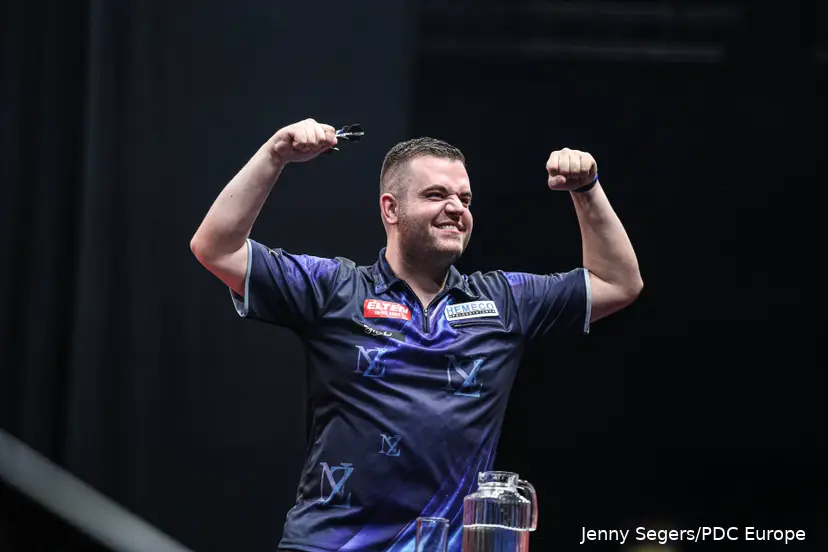
Luke Littler was nowhere to be seen in Maastricht, but the Dutch Darts Championship still had a fascinating story to tell. While the world number one watched from the sidelines, Dutchman Niels Zonneveld produced the biggest moment of his career, defeating Danny Noppert 8–5 to lift the trophy and collect £35,000.
It was a brilliant achievement for Zonneveld, who claimed his first senior PDC title on Sunday. However, there is another side to this story that darts fans cannot ignore. Why was one of the sport’s biggest attractions absent from such an important European Tour event, and has the treatment he received from sections of the Dutch crowd helped create a problem the sport can no longer brush aside?
For Littler’s supporters, this is about much more than one missed tournament.
Zonneveld Gets His Moment in the Spotlight
First, credit where it is due. Zonneveld deserves enormous respect for what he accomplished in Maastricht.
The Dutchman defeated Noppert 8–5 in an all-Dutch final at the MECC, completing a memorable weekend in front of his home supporters. His reward was £35,000 from the tournament’s £230,000 prize fund, alongside a major boost to his confidence and ranking ambitions.
Zonneveld’s victory was particularly significant because it was his maiden European Tour title. This was not simply another weekend cheque for an established superstar. It was a breakthrough moment for a player who had worked his way through the professional circuit and finally delivered a title-winning performance.
Noppert also deserves recognition for reaching the final, although he had to settle for £15,000 as runner-up.
But while Zonneveld was celebrating, Littler’s absence remained an unavoidable talking point. And that is precisely what makes this tournament so interesting from a fan’s perspective.
Why Was Luke Littler Missing?
Littler’s absence did not come out of nowhere.
The teenage sensation had previously expressed frustration after receiving hostile reactions from sections of the Dutch crowd during the World Series of Darts Finals in Amsterdam in September. He subsequently withdrew from the Dutch Darts Championship and had also pulled out of two Players Championship events in the Netherlands.
His message was clear: he wants to compete, entertain supporters and enjoy playing darts without feeling that the atmosphere is working against him.
That is where the debate becomes uncomfortable.
Some fans will argue that booing is part of professional sport. Players in football, boxing and other major competitions routinely face hostile audiences, and darts has always had a lively atmosphere.
Fair enough. Littler cannot expect every supporter to cheer for him.
However, there is a difference between passionate rivalry and creating an environment in which a player questions whether travelling to compete is worthwhile. If a crowd wants to see the best players in the world, it should also consider how its behaviour affects the spectacle.
Littler is not asking every Dutch supporter to become his biggest fan. The reasonable expectation is that he should be able to play his game without persistent hostility becoming the main story.
The £35,000 Question Littler Fans Will Ask
Let’s be honest: a £35,000 winner’s cheque is a serious reward, and Zonneveld earned every penny of it.
But Littler’s supporters will naturally wonder what the tournament might have looked like had the world number one been in the draw.
His presence brings attention, anticipation and an additional layer of pressure for every opponent. Whenever Littler enters a competition, fans want to know whether somebody can stop him, whether he can produce another spectacular performance and whether another trophy is heading his way.
Without him, the tournament still delivered quality darts and a worthy champion. Zonneveld’s achievement should never be diminished simply because a superstar was missing.
Nevertheless, the sport loses a potential blockbuster whenever its biggest names are absent. That is an uncomfortable commercial reality, not an insult to the players who competed.
And there is an important distinction here: Littler was not guaranteed to win £35,000 even if he had participated. He would have needed to navigate a difficult field and win the tournament. Nobody can say with certainty how he would have performed.
What can be said is that his absence removed one of the most compelling possible storylines from the weekend.
Is Littler Right to Stand His Ground?
Personally, it is difficult to blame Littler for wanting to have a say over where he plays.
The 19-year-old has already established himself as one of darts’ leading attractions, and his demanding schedule makes decisions about rest and tournament selection increasingly important. He has previously defended his right to choose which events he enters.
Of course, there is another side to the argument. Professional darts depends on tournaments, sponsors, broadcasters and supporters. Organisers need their biggest stars to appear, and repeated withdrawals can create legitimate concerns about the sport’s long-term structure.
Those concerns deserve discussion.
But the answer cannot simply be to tell Littler to ignore every hostile reception and turn up regardless. If the PDC wants its biggest stars to participate consistently, it must also consider the conditions in which they compete.
That does not mean banning criticism or demanding that crowds behave like silent theatre audiences. Darts should retain its personality. Rivalries, noise and pressure are part of its appeal.
The challenge is finding the line between atmosphere that makes the sport exciting and behaviour that risks driving its biggest attractions away.
Littler’s absence has made that question harder to avoid.
What Happens Next for Luke Littler?
The good news for Littler supporters is that his season is far from over.
He has already secured his place in the European Championship in Dortmund, which begins on October 22. That gives him another opportunity to return to competitive action and remind everyone why he remains such a significant figure in the sport.
His absence from Maastricht should not automatically be interpreted as a sporting setback. Taking breaks, managing a schedule and choosing events carefully can all form part of a long-term approach to remaining competitive.
The real test will be what he does when he returns to the oche.
If Littler produces another major performance in Dortmund, the conversation could quickly shift from the tournaments he missed to the trophies he is still capable of winning.
And that is exactly why his rivals cannot afford to assume that his absence makes their jobs easier forever.
Zonneveld deserves his moment, and his £35,000 triumph will be remembered as a career-defining achievement. But the Dutch Darts Championship also highlighted a bigger issue for the sport.
Darts needs its champions, its rising stars and its passionate crowds. It should not have to choose between them.
Littler has every right to make decisions about his schedule, while fans have every right to debate those decisions. But if the sport wants its biggest star competing at every opportunity, creating an atmosphere in which he feels welcome would be a sensible place to start.