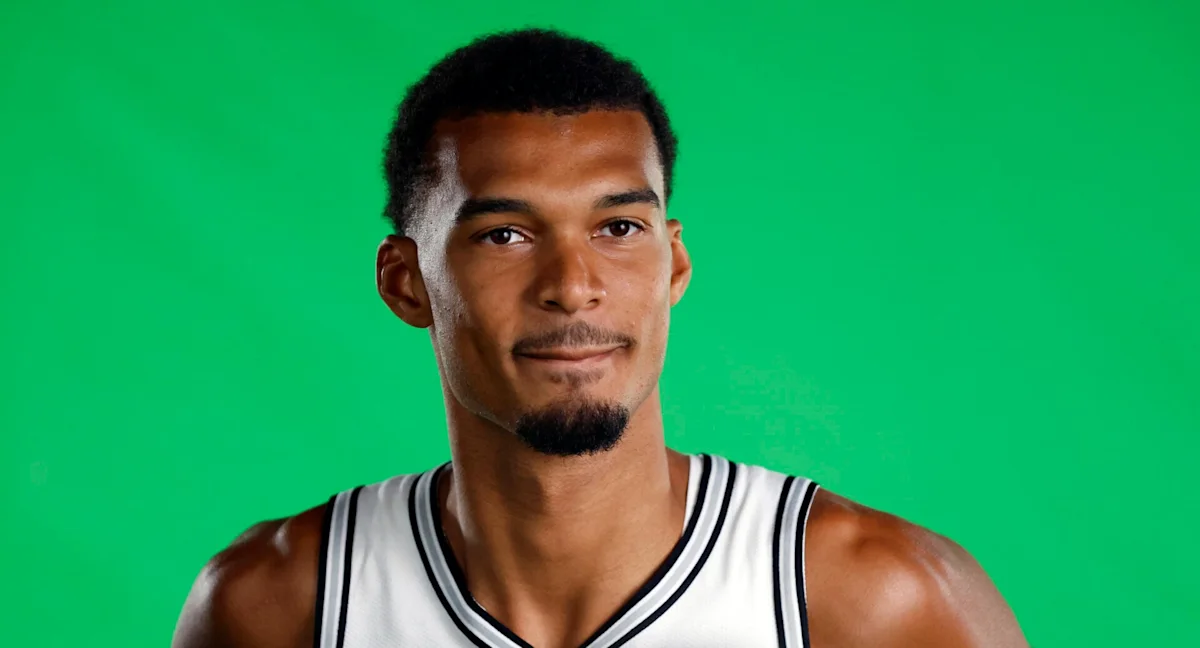
Victor Wembanyama has spent the past few years establishing himself as one of basketball’s most exciting young superstars, but the San Antonio Spurs center is now facing a controversy that has nothing to do with his performances on the court.
The French basketball sensation has been publicly criticised by Nice mayor Éric Ciotti after a social media post was interpreted as support for unrest in France. Ciotti’s response was particularly forceful, calling for the condemnation of Wembanyama and other celebrities he believes encouraged the violence.
But there is an important distinction at the heart of this story: supporting young people who want their voices heard is not necessarily the same as supporting riots. That distinction matters enormously, especially when a public figure’s social media activity becomes the subject of a political dispute.
What Actually Happened Between Wembanyama and the Nice Mayor?
The controversy began on Friday, October 16, when Wembanyama posted an image on X showing a rabbit pointing towards a clock. The picture appeared to suggest that a particular moment was approaching, but the post did not explicitly identify what he was waiting for.
That ambiguity quickly became the centre of the dispute. Some observers interpreted the image as a countdown to the upcoming NBA season, while others connected it to the demonstrations scheduled for October 17 across France.
The timing was certainly enough to generate speculation, but speculation is not proof of intent. Wembanyama did not explicitly state in the post that he supported violence, property destruction or looting.
That is the crucial detail that deserves more attention than the political outrage surrounding the situation.
Why Éric Ciotti Wants Wembanyama Condemned
On Saturday, Nice mayor Éric Ciotti made his position clear, accusing prominent French figures of encouraging the unrest.
“French celebrities like the basketball player Victor Wembanyama, who called for supporting the riots of October 17, bear a historic responsibility,” Ciotti wrote on X.
He followed that statement with an even stronger demand: “They must be condemned.”
Those are serious words, particularly when directed at an athlete whose international reputation continues to grow. Ciotti’s argument is that celebrities have a responsibility to consider the consequences of their public statements, especially during a period of social tension.
There is a reasonable principle behind that argument. Athletes with enormous audiences should understand that their words and actions can carry considerable weight, and nobody should treat violence against people or businesses as an acceptable form of protest.
However, the evidence presented in this particular controversy does not establish that Wembanyama encouraged the violence Ciotti attributed to him. The mayor’s interpretation of an ambiguous image is not the same as a direct statement from the player endorsing riots.
That distinction should matter regardless of someone’s political views.
Wembanyama Had Already Expressed Support for Students
To understand why the controversy developed, it is important to look beyond the rabbit image.
Earlier in October, Wembanyama had openly expressed support for French students who were mobilising over wider social and economic concerns. He spoke about the inequalities facing younger generations and explained why their decision to make themselves heard resonated with him.
“Ce sont des situations dont j’ai la chance d’avoir pu m’extraire. Ce sont des problèmes que j’ai la chance de ne plus vivre, ou de ne pas vivre. Mais ce sont des réalités, des inégalités systémiques et des problèmes tellement profonds. (…) Je suis content que les jeunes lycéens et les jeunes générations se rassemblent parce que moi je les entends et je les soutiens”, he said.
His comments reflected empathy for young people dealing with problems he said he was fortunate to have moved beyond. They also demonstrated that his interest in events back home extended beyond basketball.
Supporting students who want their concerns heard, however, does not automatically mean supporting every action committed during a demonstration.
That is where the criticism of Wembanyama becomes difficult to justify without clearer evidence. His earlier remarks established support for the students’ movement, but they do not establish that he endorsed the subsequent violence.
France’s Demonstrations Add Another Layer to the Debate
The events of October 17 were not without serious incidents. Demonstrations took place in multiple French cities, while reports documented damage to businesses, looting and other acts of destruction. The town hall in Limoges was also reported to have been set on fire.
Those incidents deserve to be treated seriously. People who own shops, work in affected areas or simply want to go about their daily lives should not have to bear the consequences of violent disorder.
At the same time, it is important to distinguish between the demonstrators who participate peacefully and those who commit criminal acts. A large public gathering can include people with different motivations, and the actions of some participants should not automatically be attributed to everyone associated with the wider movement.
The same standard should apply to Wembanyama.
If a public figure explicitly encourages violence, there is a legitimate basis for questioning that conduct. But if the evidence consists of a cryptic social media image that can reasonably be interpreted in different ways, a more measured response is appropriate.
In my view, that is the weakness in Ciotti’s criticism. He has made a serious accusation, yet the available information does not demonstrate that Wembanyama intended to encourage the violence that followed.
Wembanyama Has Never Been Afraid to Speak His Mind
This controversy also highlights a broader aspect of Wembanyama’s public identity.
The Spurs star is not simply an emerging basketball talent who avoids discussing events outside his sport. He has previously expressed views on social issues, joining other prominent French athletes who have spoken publicly about political developments in their country.
That willingness to speak can be refreshing. Professional athletes have experiences and perspectives that may resonate with people who rarely feel represented in public debate.
Of course, fame does not make somebody’s political opinions automatically correct. Wembanyama should face reasonable questions about his statements, just as any other public figure should.
But there is a difference between challenging someone’s position and demanding condemnation based on an interpretation that remains disputed.
The best approach is to examine what was actually said, consider the surrounding circumstances and avoid treating assumptions as established facts.
For Wembanyama, the controversy also arrives at a significant moment in his basketball career. As the NBA season approaches, attention should naturally be turning towards what he can achieve with San Antonio. Instead, an ambiguous post has drawn him into a political argument that could overshadow his sporting ambitions.
What Happens Next for Wembanyama?
As of October 19, Wembanyama had not publicly responded to Ciotti’s demand. His silence does not establish guilt, nor does it tell us what he intended when he shared the image.
He may eventually decide to clarify the post, but he should not have to accept another person’s interpretation as the definitive account of his intentions.
The situation also serves as a reminder that social media has become an increasingly complicated space for international sports stars. A single image can reach millions of people, acquire meanings its creator may not have intended and become the centre of a debate far removed from the original post.
That does not mean athletes should stop expressing themselves. It means both public figures and those criticising them should be careful about the claims they make.
Wembanyama’s influence is undeniable, and with that influence comes a responsibility to communicate thoughtfully. Yet responsibility must be accompanied by fairness: accusations should be supported by evidence, not simply by timing or political disagreement.
Ultimately, the question is not whether the violence in France should be condemned. It should. The more difficult question is whether Wembanyama actually encouraged that violence, and the available information does not establish that he did.
Ciotti is entitled to criticise the Spurs superstar, but the public should be equally entitled to question whether that criticism is justified.
What do you think? Was Éric Ciotti right to call out Victor Wembanyama, or has the Nice mayor jumped to conclusions over an ambiguous social media post?