
LeBron James has spent more than two decades figuring out how to beat the best players in basketball. Now, in a new chapter with the Philadelphia 76ers, the four-time NBA champion has already shown that his basketball intelligence could become one of the team’s biggest weapons.
The New York Knicks found that out the hard way on opening night. Philadelphia walked away from Madison Square Garden with a 106-100 victory, spoiling the Knicks’ championship celebrations and delivering an early warning to the rest of the Eastern Conference.
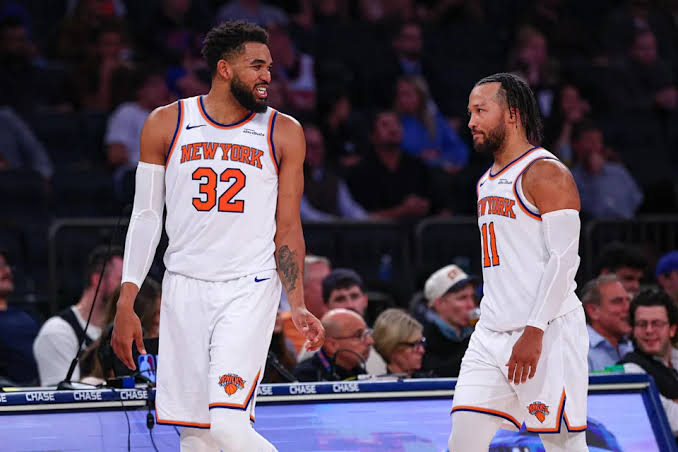
But the most interesting part of the contest was not simply the result. It was how LeBron and the 76ers figured out a way to disrupt Jalen Brunson and Karl-Anthony Towns, two of the most important pieces of New York’s championship-winning team.
For a team hoping to challenge for another title, that defensive adjustment could prove more significant than anyone initially expected.
LeBron James Explains the Problem With Defending Jalen Brunson and Karl-Anthony Towns
The Knicks have built a dangerous offensive combination around Brunson’s ability to create shots and Towns’ ability to punish defenders from the perimeter.
When Brunson handles the ball and Towns sets a screen before moving into shooting position, opposing defenses face a difficult decision. Give Brunson room to attack, or leave Towns enough space to receive the ball and fire away from three-point range.
Neither option is particularly attractive.
LeBron recognised the danger and explained the challenge after Philadelphia’s victory.
“Obviously, KAT is very dangerous when he has space. Anytime JB is handling the ball with KAT popping, it creates a long closeout for guys trying to get to that shot,” James said.
That assessment explains why New York’s pick-and-pop action can be so difficult to contain. Brunson forces defenders to react to his movement, while Towns can punish even a slight defensive mistake.
LeBron continued to emphasise the importance of closing down Towns quickly when he catches the ball in a position to shoot.
The key is not simply getting a hand up. Defenders must arrive before Towns has enough time and space to comfortably rise into his shooting motion.
It sounds straightforward, but executing that plan against two elite offensive players requires communication, anticipation and discipline.
And that is where LeBron’s experience becomes valuable.
Why Philadelphia’s Defensive Adjustment Worked
Philadelphia did not rely on one player trying to solve every problem. Instead, the 76ers adjusted their matchups to give themselves more options against the Knicks’ preferred offensive action.
One of the biggest changes involved putting LeBron on Towns after halftime, allowing Joel Embiid to take on a different defensive responsibility.
Embiid explained that he suggested the switch after picking up his third foul. Rather than risk becoming overly cautious while guarding Towns, he believed a change could help the team defend more effectively.
The adjustment allowed Embiid to play a roaming role while LeBron took on the challenge of defending Towns more directly.
That was an important tactical decision. Philadelphia could use LeBron’s mobility to challenge Towns away from the basket while keeping Embiid available to help elsewhere.
The results became increasingly noticeable as the game progressed.
The Knicks scored just 18 points in the third quarter, and Philadelphia gradually seized control of a contest that had been closely fought during the opening half.
LeBron also played a role in a crucial late-game defensive sequence that helped the 76ers protect their advantage.
When Brunson and Towns attempted to reconnect through their familiar two-man action, James moved out toward the perimeter and disrupted the passing option to Towns. The Knicks had to redirect the ball, giving Philadelphia’s defense time to rotate.
Tyrese Maxey eventually intercepted an OG Anunoby pass and converted the opportunity into a fast-break dunk.
It was the kind of possession that can change the momentum of a close game.
Brunson and Towns were not suddenly incapable of scoring. Philadelphia simply made their preferred offensive approach more difficult to execute.
That distinction matters because the best defensive teams do not necessarily eliminate every scoring opportunity. They force opponents into uncomfortable decisions.
The Knicks Still Have Plenty to Offer
Despite the defeat, it would be a mistake to assume that Philadelphia has discovered a permanent solution to New York’s offense.
Brunson remains one of the NBA’s most dangerous guards when games reach the decisive stages. His ability to create separation, control the tempo and score against different defensive coverages makes him difficult to contain for an entire game.
Towns presents a different problem. His shooting ability forces opposing centers to defend farther from the basket, potentially opening driving lanes for Brunson and other Knicks players.
The opening-night result showed what can happen when Philadelphia successfully disrupts that connection. It did not prove that the strategy will work every time.
New York can respond by moving the ball more quickly, using different screen angles or finding opportunities for other players when defenses concentrate on its two leading offensive options.
Josh Hart, OG Anunoby and Mikal Bridges could all become important parts of that adjustment.
If the Knicks become too predictable, opponents will have more opportunities to anticipate their movements. If they remain patient and exploit the space created by defensive rotations, they can make those same defensive schemes dangerous for the opposition.
That is the tactical battle worth watching as the season develops.
LeBron’s Experience Could Make Philadelphia Dangerous
There is another reason Philadelphia’s victory deserves attention: LeBron does not need to dominate the scoring charts to influence a game.
His understanding of offensive spacing, defensive rotations and opponents’ tendencies can help teammates recognise opportunities before they fully develop.
Against New York, his contribution extended beyond his 14 points. He finished with nine rebounds and seven assists, while his defensive awareness helped Philadelphia execute an important second-half adjustment.
At this stage of his career, that ability to read the game could be just as valuable as his scoring.
The 76ers also have significant talent elsewhere. Maxey finished with a game-high 28 points, while Jaylen Brown contributed 19. Embiid added 13 points alongside 11 rebounds, three blocks and six assists.
Philadelphia did not win simply because LeBron found an answer to the Knicks’ offense. Its overall talent and execution mattered, too.
Nevertheless, James provided something that does not always show up in a box score: the ability to recognise what an opponent wants to do and help find a way to disrupt it.
For a team with championship ambitions, that quality is worth its weight in gold.
One Victory Does Not Settle the Rivalry
The Knicks will have every reason to study the film from this defeat, particularly the possessions in which Philadelphia successfully disrupted their pick-and-pop action.
They should also remember that opening night is only one game. Defensive adjustments can look brilliant against one opponent before being exposed by another, and Philadelphia still has plenty of work to do before it can be considered a serious championship favourite.
The 76ers will need to maintain their defensive intensity, improve their offensive consistency and ensure their new pieces develop the chemistry required to compete over a long season.
But this was an encouraging first step.
For the Knicks, the challenge is to prove that their offense can adapt when opponents take away their favourite options. For Philadelphia, the opportunity is to build on a performance that showed how much difference smart defensive decisions can make.
And for LeBron, it was another reminder that basketball intelligence does not disappear with age.
The big question now is whether other teams can copy Philadelphia’s approach or whether Brunson and Towns will find ways to punish those adjustments.
What do you think? Have LeBron James and the 76ers exposed a weakness in the Knicks’ offense, or will Jalen Brunson and Karl-Anthony Towns quickly find an answer?