
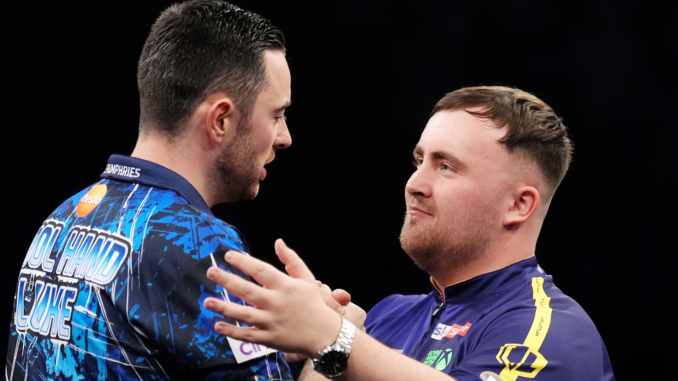
There was supposed to be no stopping England when Luke Humphries and Luke Littler joined forces for the World Cup of Darts. With the two biggest names in the sport representing their country, expectations were understandably enormous.
However, before the tournament even got underway, Humphries revealed something that raised eyebrows among darts supporters. Despite being paired with the teenage sensation, the former world champion had no intention of changing his preparation routine to accommodate his new teammate.
In fact, Humphries made it clear that he did not believe the pair needed to practise together before their World Cup campaign.
And while some supporters might see that as confidence, others could reasonably question whether England were taking their preparations seriously enough.
Humphries refuses to change his preparation routine
Humphries was preparing to defend the World Cup title he had won alongside Michael Smith the previous year.
This time, however, he had a different partner. Littler had established himself as one of the most dangerous players in professional darts, and bringing him together with Humphries appeared to give England an almost unbeatable combination on paper.
But Humphries was not interested in making unnecessary changes.
Explaining his thinking, he told Sportsboom: “When you’ve got two of the best players in the world, we’re not going to need to start practising together.”
It was a remarkably confident statement.
Rather than spending additional time developing their partnership, Humphries believed their individual abilities would be enough to carry them through the competition.
He also pointed out that he had not needed to practise with Michael Smith before their successful campaign in the previous year.
There is certainly logic behind his argument. Both players spend countless hours competing against the best professionals in the world. They understand the pressure of major tournaments and know what it takes to perform when the cameras are watching.
But doubles darts is not simply about having two brilliant individual players.
It requires communication, understanding and the ability to support your teammate when things become difficult.
Is Humphries underestimating the importance of teamwork?
This is where the controversy begins.
Humphries might be one of the most accomplished players in the sport, but refusing to practise together raises an interesting question about how seriously England were approaching the partnership.
Individual brilliance does not automatically translate into team success.
Darts supporters have witnessed plenty of occasions when talented combinations have struggled because they could not find the necessary rhythm together.
The World Cup is particularly different from individual competitions because players are not simply representing themselves. They are carrying the expectations of an entire nation.
A missed double, a poor leg or a difficult spell can affect both players.
Surely spending some time together to understand each other’s approach would not have been a bad idea?
Nobody is suggesting Humphries and Littler needed to spend every waking hour practising together. However, dismissing the need for preparation altogether could be seen as unnecessary confidence.
There is a fine line between believing in your abilities and assuming talent will solve every problem.
Littler and Humphries were already fierce rivals
Another fascinating aspect of this partnership was the relationship between the two players.
Humphries and Littler had developed one of the biggest rivalries in modern darts, regularly meeting in major finals and competing for the biggest titles.
Their battles had become must-watch television, with Littler frequently getting the better of his older rival while Humphries continued to demonstrate that he could compete with the teenage superstar.
They were effectively being asked to put their individual ambitions aside and work together.
That sounds straightforward, but there is an obvious psychological challenge involved.
When you spend most of the season trying to beat someone, suddenly having to depend on that same person requires a different mindset.
However, Humphries insisted there was no reason to worry.
He also praised Michael Smith, describing him as an excellent partner during their previous World Cup triumph, and made it clear he believed Littler could offer similar qualities.
The pressure was always going to be enormous
There was another reason why this partnership attracted so much attention.
England were not simply sending two talented players to the tournament. They were sending the world No. 1 and world No. 2, creating expectations that perhaps no other pairing could match.
Anything short of winning would inevitably be considered disappointing by sections of the darts community.
Humphries acknowledged the pressure but insisted that he and Littler were accustomed to competing in major finals.
He explained that they did not approach the tournament believing they absolutely had to win. Instead, they understood they had the ability to lift the trophy.
That is a sensible mentality, but it also highlights the danger of the situation.
When supporters see two superstars playing together, they sometimes forget that doubles competitions can produce completely different challenges.
A team ranked among the favourites can still lose to opponents who understand each other better and perform more effectively under pressure.
The Germany defeat proved that talent is not everything
Interestingly, the eventual outcome of the 2025 tournament provided a reminder of precisely that danger.
England suffered a shock 8-4 defeat against hosts Germany in the second round, with Martin Schindler and Ricardo Pietreczko producing an excellent performance to eliminate the favourites.
The result was a huge disappointment, particularly considering the expectations surrounding Humphries and Littler.
It also gave critics plenty of ammunition to question whether England’s supposedly unbeatable partnership had been overhyped.
However, blaming their lack of joint practice alone would be unfair. Germany played brilliantly, and the hostile atmosphere in Frankfurt made the challenge even more difficult.
Still, the defeat demonstrated that individual rankings and reputations mean very little once the match begins.
England needed more than two superstars
Ultimately, Humphries had every right to trust his preparation methods. He had already experienced World Cup success and understood what was required to win the competition.
Littler also possessed the ability to change matches with his extraordinary scoring power.
But there is a difference between being brilliant individually and becoming a successful team.
The biggest question was never whether Humphries and Littler had enough talent. Nobody seriously doubted that.
It was whether they could put their rivalry aside, develop the necessary understanding and deliver when England needed them most.
Their eventual disappointment in 2025 showed that even the most talented partnership can be vulnerable.
And perhaps that is the biggest lesson from Humphries’ comments: in darts, two superstars do not automatically make a dream team.
Sometimes, even the best players in the world need to work together.