
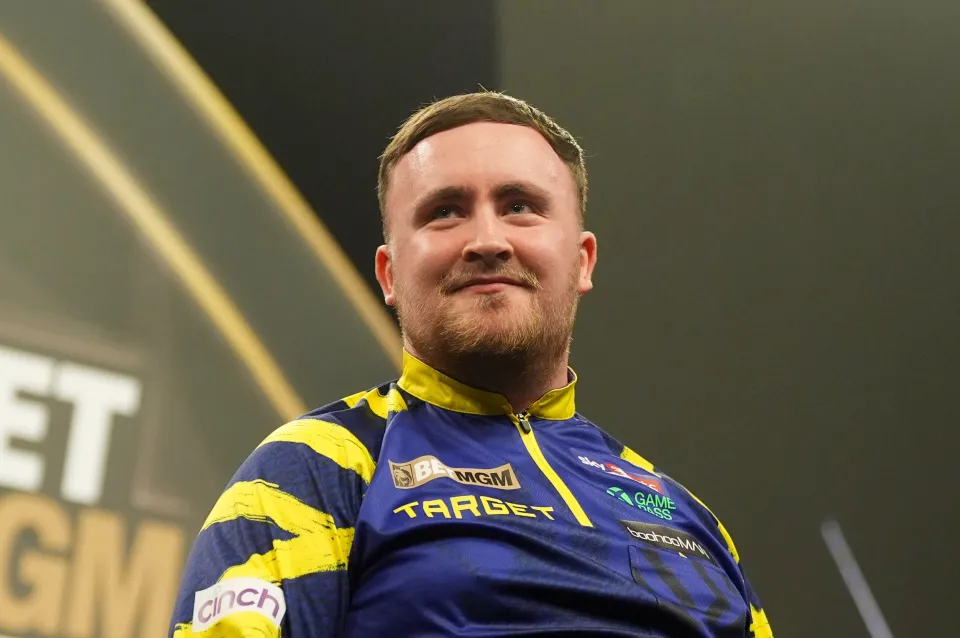
In the lively, unpretentious setting of Riley’s club in Chester, where the air hummed with the familiar rhythm of darts thumping into boards and the low murmur of local competitors, Dan Stapleton experienced a moment that would forever stand out in his playing days. It was 2023, and a 16-year-old Luke Littler—already generating serious buzz on the regional scene—was making waves with his prodigious talent. To Stapleton, a dedicated amateur from North Wales who had made the short journey across the border, the teenager was about to deliver a memorable lesson in natural ability and composure under pressure.
Stapleton had unknowingly crossed paths with Littler roughly a year earlier in the same tournament circuit. “I’d actually unknowingly played in the same tournament as him about a year before as well,” he recalled. “Actually I was practising with him before that 2022 tournament—I didn’t interact with him or anything because, you know, I’m not being funny, it was a 15-year-old boy—why would I go up to him?” At that stage, Littler was already known in darts circles for landing nine-darters on the WDF tour at a remarkably young age, but he remained just another promising face in the grassroots scene.
The 2023 encounter felt ordinary at first. The venue, conveniently located roughly 20-25 minutes from both players’ homes, hosted a standard local event with a group-stage format. Stapleton arrived and began his preparations the way he always did—putting in serious work to sharpen his game. Like many committed amateurs, he would often dedicate three full hours to practice before important matches, focusing on technique, consistency, and mental readiness. Darts at this level rewards persistence and grind, and Stapleton invested the time willingly.
Littler, by contrast, operated with striking nonchalance. “I remember we literally turned up at the same time,” Stapleton said. “He must have been dropped off or he got the train like I had.” The young prodigy would casually arrive just five minutes early, showing no signs of extended warm-ups or intense rituals. He simply stepped onto the oche when his name was called and performed at an elite level. This difference in approach became the heart of the story that Stapleton would later share with a mix of humor and admiration: “I’d practice for 3 hours before games, he’d rock up 5 mins early & smash me.”
Both advanced from their respective groups—Littler as the winner of his, Stapleton in second place. When the draw for the last 16 paired them together, Stapleton approached the organizer with a wry smile. “I remember going up to the guy running it and saying, like, ‘Cheers for that. How has that happened?'” Normally, the group winner would face a lower-placed qualifier, but fate had other plans. Despite the early matchup against the hot favorite, Stapleton felt a surge of excitement mixed with realism—this was a rare chance to test himself against someone clearly destined for bigger things.
The match unfolded as a showcase of Littler’s efficiency and finishing power. He took the first leg comfortably on his throw. In the second, Stapleton held throw and fought back valiantly, even creating a genuine opportunity to level the score. “I actually missed two darts to make it one-all,” he admitted openly. “I missed double 16 and double 8 because obviously I just bottled it, to be honest with you.” Nerves played their part in that crucial moment, as the pressure of facing a rising star took its toll. Stapleton had further chances with nine more darts at the leg, but Littler capitalized ruthlessly on the missed opportunities and closed it out.
The third leg saw Littler produce a stunning 11-darter, a display of clinical finishing that left his opponent appreciative rather than demoralized. The final score was a 3-0 whitewash in Littler’s favor. His match average reached 88.41—the highest in that round apart from perhaps the final—while his first-nine darts average hovered impressively around 110-111. For Stapleton, reviewing the stats afterward only heightened the respect: “It was his best average that day… It’s just like ‘Cheers. I’m just some amateur player trying to get by and you’ve produced this against me.'”
Despite the defeat, Stapleton walked away impressed by Littler’s demeanor. The teenager didn’t treat the event as beneath him; he relished competing even in smaller tournaments. “He completely relishes [even the smaller tournaments],” Stapleton noted. “Even when he played me, I think he must have known he was almost certain to win it that day, even though there was a really good standard of players there.”
This local clash captured the essence of what made Littler special from an early age. While others his age balanced typical teenage life, he demonstrated laser-like focus and maturity. His casual arrival and devastating performance weren’t signs of disrespect but reflections of extraordinary talent paired with quiet, purposeful preparation away from the spotlight. Stories from his youth described a boy who took to darts naturally and honed his skills relentlessly, including long hours during the 2020 lockdown when the world slowed down.
Stapleton had sensed the potential early on. “I always thought he’d be a world champion eventually because like, no one could be that good at such a young age without…” The implication was clear. Just months later, Littler exploded onto the PDC stage at the 2024 World Championship as a 16-year-old debutant, reaching the final in a captivating run that captured global attention.
His ascent continued at breathtaking speed. In January 2025, at just 17 years and 347 days old, Littler defeated three-time world champion Michael van Gerwen in the final to become the youngest PDC World Darts Champion in history—a record many believe will stand for generations. He followed that up by defending his title successfully in 2026, securing back-to-back world crowns at the tender age of 18 and cementing his status as “The Nuke,” a player capable of filling arenas and inspiring a new wave of enthusiasts.
For Stapleton, the memory remains a point of pride rather than regret. Facing Littler offered a close-up view of sporting genius in its formative stages. The contrast between the dedicated grinder putting in long practice sessions and the prodigy who could turn up with minimal fuss and still dominate highlighted the rare blend of talent and temperament that defines true champions. In the darts world, where mental strength and consistency separate the good from the great, Littler’s ability to perform so effortlessly on any stage—grand or humble—set him apart.
Today, as Littler continues to rewrite record books with powerful scoring and clinical checkouts, anecdotes like this one add rich color to his legend. They remind fans that behind the television glamour and major titles lies a journey that began in modest venues like Riley’s in Chester, under ordinary lights with a small but knowledgeable crowd. For amateur players everywhere, it’s a humbling yet motivating tale: while talent like Littler’s is exceptional, the willingness to show up, compete, and learn from every encounter keeps the sport thriving at every level.
Darts has long celebrated such stories—the veteran or amateur crossing paths with a future superstar. In this case, the young phenom delivered a decisive 3-0 victory, but the man on the receiving end gained something lasting: a front-row seat to the early chapters of a remarkable career and a story he can proudly recount for years to come. As Littler collects trophies and thrills crowds worldwide, players like Stapleton can say with a smile that they were there when the world was still catching up to “The Nuke.”
Leave a Reply