
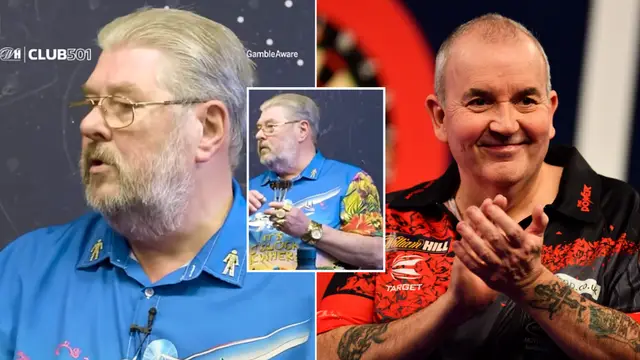
In the hushed tension of Blackpool’s iconic Winter Gardens, beneath the sharp glare of spotlights and the expectant buzz of a nostalgic crowd, two legends of darts clashed once again. It was 2023, and the World Seniors’ Champion of Champions tournament crackled with the electricity of old rivalries. On one side stood Phil “The Power” Taylor, the 63-year-old titan whose 16 world titles and staggering career earnings had made him the most successful darts player in history. Facing him was Martin “Wolfie” Adams, the evergreen BDO icon whose smooth left-handed action and unflappable temperament had defined an era.
The match lived up to its billing—a pulsating, back-and-forth battle that ended with Adams claiming a dramatic 10-9 victory. As the applause echoed through the hall and the two men embraced, Taylor could not hide a deeper reflection. In a parallel universe, he mused, Adams might not have been merely a respected rival from the other side of the divide. He could have been a fellow superstar in the glittering, high-stakes world of the Professional Darts Corporation (PDC), rewriting not just his own legacy but the financial landscape of the entire sport.
The roots of this enduring divide stretch back more than thirty years, to the smoky pubs and boisterous halls of 1990s Britain. For decades, the British Darts Organisation (BDO) had been the undisputed custodian of the game. Yet by the early 1990s, many top players felt the organisation had become complacent. Prize money remained modest, television exposure limited, and bureaucratic decisions often stifled growth. Frustrated by the lack of ambition, a group of elite players—including Taylor, the fiery Eric Bristow, and Dennis Priestley—decided to break away in 1993. They formed the World Darts Council (WDC), later rebranded as the PDC after a bitter legal battle with the BDO. The move promised bigger audiences, lucrative sponsorships, and prize funds that could transform darts from a weekend hobby into a professional career.
The split forced every player to make an agonising choice: remain loyal to the BDO’s traditional, grassroots roots or embrace the PDC’s bold vision of commercial success. Taylor wasted no time. He threw his lot in with the rebels and never looked back. What followed was one of the most dominant dynasties in sporting history. Taylor captured 14 PDC world championships, including an unprecedented eight in succession between 1995 and 2002. His total career earnings exceeded £12 million, turning him into a household name and a wealthy man. More importantly, his charismatic, theatrical style helped drag darts out of the shadows of smoky pubs and into packed arenas and living rooms across the globe.
Yet while Taylor built an empire, one formidable figure chose to remain on the other side of the great divide. Martin Adams, born in Sutton, Surrey, in 1956, had earned his nickname “Wolfie” from a childhood love of the animal’s cunning and toughness. He emerged in 1988 as a tall, lanky left-hander whose rhythmic, effortless throwing action made the game look deceptively simple. Over the next three decades, Adams became the undisputed king of the BDO circuit. He secured six major titles, including three Lakeside world championships in 2007, 2010, and 2011. His victories at the famous Lakeside venue were often gritty, come-from-behind affairs that showcased remarkable mental strength and composure.
Adams was not oblivious to the PDC’s growing allure. He accepted invitations to several major PDC events, including the World Grand Prix, the Grand Slam of Darts, and the World Matchplay. In 2001, he produced one of the most memorable cross-code performances by reaching the semi-finals of the World Matchplay, stunning many PDC regulars. At the time, no BDO player had ever won a PDC title—a barrier that stood until Scott Waites’ shock Grand Slam victory in 2010. Despite these glimpses of success on the bigger stage, Adams never made the full commitment to switch.
Many of his contemporaries eventually crossed over. Raymond van Barneveld, Gary Anderson, Stephen Bunting, and Simon Whitlock all migrated to the PDC, chasing larger paydays and global recognition. Adams, however, stayed true to his roots. For twenty years, from 1993 to 2013, he proudly captained the England national darts team, earning 52 caps and leading his country to numerous international successes. That captaincy, Taylor later suggested, lay at the heart of Adams’ decision.
Speaking ahead of their 2023 encounter, Taylor was candid in his admiration mixed with regret. “He’s a player I thought, ‘You should have come over [to the PDC],’” Taylor said. “He sticks by what he believes in. But when I look at Martin now, I think, ‘You could have been a multi, multi-millionaire’. He had the talent to get up there and be in the top three in the world.” Taylor, who had faced Adams many times across both circuits, added that Adams possessed one of the nicest, most natural throwing styles in the game and was a dedicated practicer who would have thrived under the PDC’s intense competition.
Now 69 years old and still competing on the World Darts Federation circuit following the BDO’s collapse in 2020, Adams harbours no regrets. In a heartfelt interview with Wayne Mardle on the Club 501 YouTube channel, he explained his choice with characteristic honesty. “I was captain of England, and I didn’t want to give that up,” he said. For two decades, the armband represented more than personal achievement. It symbolised loyalty, unity, and responsibility—values that mattered deeply to him in a sport fractured by the 1993 split. Leaving for the PDC would have meant surrendering the captaincy and potentially weakening the national team at a critical time. “It was about loyalty,” Adams emphasised. Success, in his eyes, was measured not only in prize money but in pride, representation, and the quiet satisfaction of staying true to one’s principles.
In today’s darts landscape, where teenage sensation Luke Littler and a new wave of stars are driving unprecedented commercial growth, Adams’ story offers a compelling counter-narrative. Taylor’s rebellion and subsequent dominance injected vitality, money, and glamour into the sport. Yet Adams’ steadfast loyalty reminds us of the community spirit, camaraderie, and pure love of the game that first made darts special. In an age obsessed with financial metrics, Wolfie’s journey quietly suggests that some rewards—the respect of peers, the honour of representing one’s country, and the integrity of personal conviction—cannot be counted in pounds or dollars.
As Martin Adams continues to line up at the oche, his stance steady and his focus unwavering, one senses he would not trade his path for any fortune. He would simply smile, take aim, and let the dart fly true—faithful to the values that defined a remarkable career.
Leave a Reply