
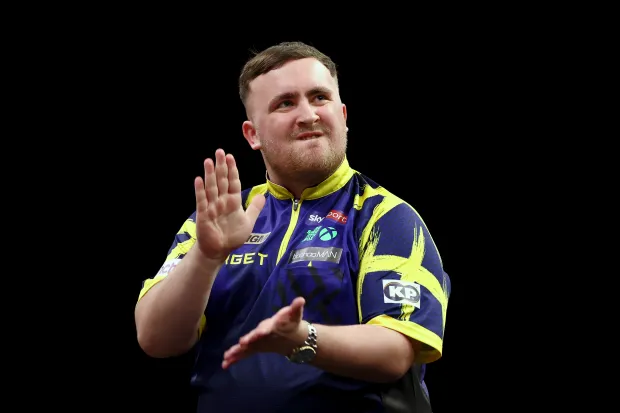
In the high-octane arena of professional darts, where every throw can shift momentum and every gesture speaks volumes, a teenage superstar’s fiery exchange has sparked fresh debate about growth under the spotlight. Luke Littler, the 19-year-old phenom dubbed “The Nuke” for his explosive talent, found himself at the centre of an on-stage bust-up that has left fans and pundits questioning whether his meteoric rise has outpaced his emotional maturity. What started as a tense quarter-final in the Premier League Darts quickly escalated into a clash of egos, with lingering fallout that highlights the perils of social media in modern sport.
The drama unfolded last week in Manchester’s AO Arena during Night 9 of the 2026 Premier League campaign. Littler, already sitting atop the table after claiming three nightly victories this season, faced Dutch rising star Gian van Veen in a best-of-11-leg thriller. The pair had history; their matchup echoed the tension of a recent World Championship final rematch, but no one anticipated the raw emotion that would erupt in the deciding leg. With the score locked at 5-5, the pressure was palpable. Van Veen stepped up with a shot at glory, aiming for a 134 checkout that would seal the win. He missed double 15 on the inside wire, the dart sliding agonisingly off target.
Frustrated, van Veen turned briefly toward the crowd to reset, a momentary pause that proved explosive. Littler, sensing an opening, reacted instinctively. Cameras captured the young Englishman geeing up the home support, his arms pumping in celebration of his opponent’s miss. Van Veen noticed immediately. The Dutchman, clearly rattled, shot back a look of disbelief. Littler then escalated matters with an impatient hand gesture, urging his rival to hurry up and get on with the throw. The arena buzzed with anticipation mixed with unease.
When Littler’s own turn came, the stakes couldn’t have been higher. Needing 90 to snatch victory, he nailed a triple 20 but followed with a wayward single 15, leaving himself on double 15. Three darts later, the opportunity slipped away. Miss after miss left him staring at the board in frustration. As van Veen prepared for his final assault, Littler turned and delivered a mocking crying gesture—both fists rubbing at his eyes in a theatrical taunt aimed squarely at his opponent. The crowd’s roar mixed cheers and jeers. Van Veen kept his composure just long enough to punish the lapse, slotting home double six to claim a dramatic 6-5 triumph and end Littler’s bid for a third straight nightly win.
The handshake that followed was anything but warm. Littler offered a perfunctory grip before storming off stage, barely making eye contact. Van Veen, still processing the exchange, wasted no time voicing his displeasure in post-match interviews. “I’m on 90, I miss double 15 on the inside, and then I see him celebrating towards the crowd. I don’t think that’s normal,” he told broadcasters. “And then he also makes that crying gesture. He’s a fantastic darts player, but today he showed he’s not a good loser. Celebrating a miss from your opponent, that really annoys me. That’s why I gave him a look. The fact he then misses three darts at a double, that’s his problem.”
Van Veen was quick to balance criticism with respect, acknowledging the bigger picture. “I love Luke to bits. All the attention he has brought to the sport is phenomenal, but today was my day.” Yet the sting of the moment lingered, especially as Littler chose to amplify the drama online rather than let it fade. In a move that has drawn sharp scrutiny, the teenager took to Instagram shortly after, posting a screenshot of his tournament victories alongside the pointed caption: “Goodnight god bless thank you Manchester.” He then reshared van Veen’s critical comments, adding three laughing emojis for good measure. The digital escalation turned a fleeting on-stage spat into a viral talking point that dominated darts discourse for days.
The incident has prompted pointed analysis from those who know the game intimately. Former top player Vincent van der Voort offered a no-nonsense take during a Dutch podcast appearance. Breaking down the sequence frame by frame, he described how van Veen’s missed dart at double 15 left Littler with a golden chance. “Normally you’d be annoyed and reset,” van der Voort explained. “But van Veen turns away, and at that moment he sees Littler gesture to the crowd like, ‘I’m getting another chance.’ Then Littler reacts too aggressively afterwards—that’s where he goes wrong. He makes it bigger than it needed to be.”
The quick “Kevin Painter handshake”—a dismissive, eyes-averted grip—only added fuel. Van der Voort’s prescription for Littler’s growing pains was refreshingly straightforward: limit the phone. “If Littler had just said afterwards, ‘That wasn’t smart,’ it would’ve been nothing. But then he continues on social media, showing off what he’s won… but yeah, he’s still a kid. It suggests he might not have the right people around him to tell him, ‘Don’t do that.’ That’s the real issue. Someone should just take his phone away for a bit—it’s not that complicated.”
At just 19, Littler carries the weight of unprecedented expectations. A prodigy who burst onto the scene as a 16-year-old sensation, he has already claimed multiple major titles, including back-to-back World Championships, and commands a level of fame that transcends darts. His boyish charm and fearless approach have drawn record crowds and boosted the sport’s popularity globally. Yet that same youth leaves him navigating adult pressures without the buffer of experience. Van der Voort highlighted the challenge: “He’s still only 19 years old, but he’s competing at the top level now, among adults. So he’ll be judged like one. If you’re winning everything, you start to feel like you can do anything. That’s normal. You don’t notice the pressure or the crowd. But when results drop, it becomes a different story.”
The former UK Open finalist drew parallels with Gerwyn Price, a player who has thrived amid crowd hostility but knows how quickly adulation can sour. “Look at Gerwyn Price—he knows what it’s like when the crowd turns against you every week. It can really affect you.” For Littler, who currently leads the Premier League standings, the Manchester loss was a rare hiccup in an otherwise dominant campaign. His ability to bounce back has defined him, but the social media response risks painting him as petulant rather than passionate.
Darts has long thrived on rivalry and needle—think the electric atmospheres of rival football derbies like Rangers versus Celtic or Ajax versus Feyenoord. Van der Voort sees value in the tension. “Sport isn’t just about winning—it’s also about rivalry. Something has to happen sometimes… That’s what you want. A bit more edge, some verbal back-and-forth. That’s what sport is about.” The PDC, he suggested, likely welcomed the buzz, as it keeps the league compelling heading into Night 10 in Brighton on Thursday.
There, Littler faces Stephen Bunting in the quarter-finals, while van Veen draws Michael van Gerwen in a mouth-watering all-Dutch clash. The bracket places them in the same half, leaving open the tantalising possibility of a semi-final rematch. Van Veen sits fifth in the table, hungry to climb higher after banking crucial points in Manchester. Littler, meanwhile, remains the man to beat, his three nightly wins underscoring why he is the world number one and reigning champion.
Ultimately, this latest bust-up serves as a pivotal chapter in Littler’s evolution. The darting prodigy has already rewritten record books and captivated millions with his prodigious talent. Yet moments like these underscore that raw skill alone isn’t enough at the elite level; composure, perspective, and perhaps a little distance from the endless scroll of notifications are equally vital. As van der Voort noted, the storm will likely pass quickly—“this will all be resolved quickly. It’s really nothing major”—but the lesson lingers. In a sport where the crowd can lift you one night and boo you the next, true greatness lies not just in hitting the big scores, but in handling the misses with grace.
Fans will be watching closely in Brighton, eager to see whether Littler channels the frustration into another dominant display or if the rivalry simmers on. One thing is certain: the Premier League Darts has never felt more alive, and its brightest young star is learning, one high-pressure leg at a time, that maturity is the ultimate double to hit.
Leave a Reply