
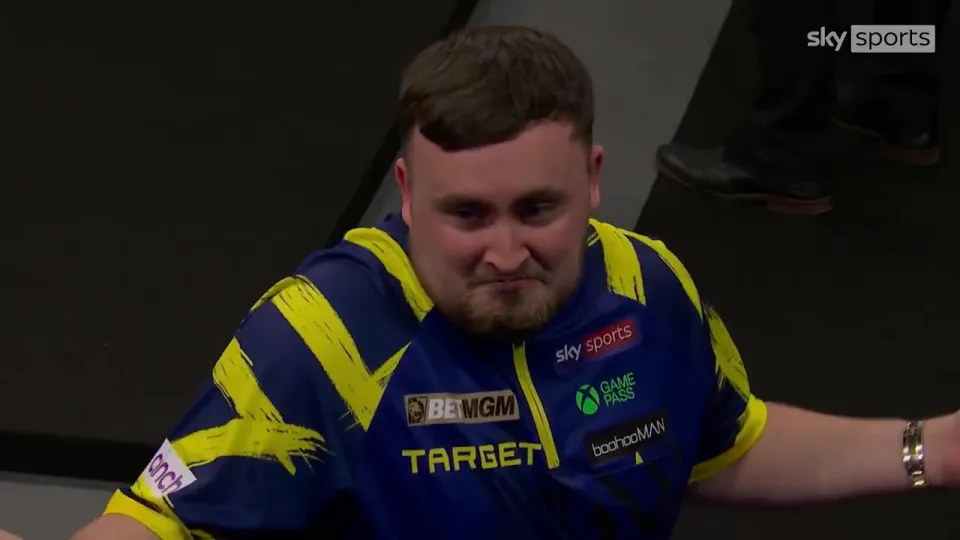
In the electric atmosphere of the Brighton Centre, where the roar of the crowd can lift a player to glory or crush them under its weight, Luke Littler walked into a storm he couldn’t escape. The 19-year-old world champion, known as The Nuke for his explosive talent and rapid rise to the top of professional darts, had come off a short break in the sun, expecting to reclaim his dominance in the Premier League Darts. Instead, on Night 10, he faced something far more unsettling than any opponent on the oche: a merciless chorus of boos that followed him from the moment he stepped into the arena. What unfolded was not just a defeat—it was a unraveling. Littler was beaten 6-4 by Stephen Bunting in what many described as his worst-ever performance on television, averaging a shocking 83.94, his lowest in any PDC televised event. No maximum 180s. No spark. Just a flat, rattled display that left the teenage sensation looking unrecognizable.
The hostility had been building for days. A week earlier in Manchester, Littler had found himself at the center of a fiery spat with Dutch star Gian van Veen, a clash that spilled over into heated words and lingering tension. Fans, quick to pick sides in the high-drama world of darts, hadn’t forgotten. As Littler made his walk-on for the quarter-final against Bunting—the third match of the evening—the Brighton crowd let him have it. Jeers echoed through the venue, drowning out the usual cheers reserved for the sport’s biggest draw. Littler, ever the showman, tried to brush it off. He cupped his ear toward the stands in a defiant gesture, then shrugged his shoulders as if to say the noise didn’t bother him. But the cameras caught the truth in his body language. The teen sensation, usually so explosive and composed under pressure, looked off from the first dart.
Bunting, celebrating his 41st birthday, couldn’t have asked for a better gift. The Bullet seized the moment, taking the opening two legs with clinical finishes on double four and double eight. Littler’s response was sluggish—he managed just 59 points with his first three darts and a meager 41 with the next three, immediately surrendering his throw in the first leg as the crowd delighted in his early struggles. The ironic cheers when he missed only grew louder. Sky Sports commentator Rod Studd captured the mismatch perfectly, noting with dry wit, “Littler is so under par, he’d be head of the Masters leaderboard.” It was that kind of night—golf jokes at a darts match, because the darts themselves were nowhere near championship level.
Yet Bunting, too, was far from flawless. He missed doubles with alarming frequency, squandering chances to pull further ahead and repeatedly letting Littler back into the contest. The world champion finally found some rhythm, nailing tops to claim a leg and trail 3-2. For a fleeting moment, the comeback seemed possible. The constant feeling in the arena was that Littler, with his trademark barrage of high-scoring throws, would suddenly ignite and turn the tide. But the spark never came. Bunting responded with the match’s standout finish—a stunning 102 checkout on double 16—before extending his lead to 4-2 with a double nine. The pressure from the crowd, the weight of recent controversy, and perhaps the exhaustion of a whirlwind season all seemed to converge on Littler’s shoulders. He narrowed the gap once more with another tops checkout, but Bunting refused to let the birthday party end early. Double six and double 16 sealed the 6-4 victory, sending the Bullet through to the semi-finals amid a mix of celebration and lingering jeers for his opponent.
Littler showed little emotion as the final dart landed. He shook Bunting’s hand with a meek nod, then exited the stage to more boos from the Brighton faithful. No fiery outburst, no dramatic exit—just a quiet surrender that spoke volumes about how deeply the night had shaken him. One fan summed up the prevailing sentiment online: “Luke Littler beyond rattled by the boos, he’s never played this bad. Maybe if he just accepted he was in the wrong he would stop getting booed and he’d be okay.” Another added, “Littler can’t hide how raging he is getting booed.” A third observer didn’t mince words: “That’s one of, if not the worst game of Premier League darts I’ve watched. That was horrific by both. Don’t want to hear Littler saying he’s not bothered, he very clearly is, worst I’ve ever seen him play since his PDC debut.” And a fourth simply declared, “This is the worst I’ve ever seen Luke Littler play.”
Bunting, for his part, was gracious in victory while acknowledging the uncomfortable undercurrent. Speaking afterward, he admitted the atmosphere had affected him too. “It was tough, to be honest, because obviously the crowd was giving him some stick. I like Luke, he’s a fantastic lad and I don’t like to see that. It probably made me more nervous, to be honest. It put me on edge. The way he was playing, I was expecting him to burst into this barrage and it just didn’t happen for him.” Bunting’s empathy was genuine—he even referenced the prior van Veen incident indirectly, choosing to stay out of the fray while focusing on his own performance. Despite his own inaccuracies, he had capitalized on Littler’s off-night and advanced, only to fall 6-5 to Michael van Gerwen in the semi-finals.
The night, however, belonged to someone else entirely. Jonny Clayton produced a stunning comeback in the final, fighting back from 5-2 down to defeat seven-time world champion Michael van Gerwen 6-5 in a gripping decider. The Welshman had earlier edged out Luke Humphries 6-5 in the quarters with a bullseye finish and dispatched Josh Rock 6-4 in the semis. His third nightly win of the season propelled him back to the top of the Premier League table, three points clear of Littler. “I thought the game was over at 5-2 but you gotta take chances,” Clayton reflected. “That last leg was my best leg. It feels great. I know what you need to get to finals. You have to take your chances. Coming into tonight, I was just hoping for two points. Happy being back to top. I just want to be in that top four.”
For Littler, the loss marked a second successive quarter-final exit in the Premier League, a rare stumble for a player who has redefined the sport with his maturity beyond his years. The Nuke had stormed onto the scene as a teenager, breaking records and captivating global audiences with his natural flair and relentless scoring. Crowds that once chanted his name now turned on him, a stark reminder of darts’ passionate, unforgiving fanbase. The booing wasn’t just noise—it was a narrative unfolding in real time, fueled by the Manchester drama and amplified by the bright lights of live television.
Yet in the broader tapestry of the 2026 Premier League campaign, this night underscored the sport’s unpredictability. Bunting’s birthday triumph, however scrappy, highlighted how even the best can be humbled by the occasion. Littler’s flat display—trebleless visits piling up, confidence misplaced—served as a humanizing moment for a prodigy who has carried the weight of expectations like few before him. As he left the Brighton Centre, the jeers fading into the night, the question lingered: Would the boos continue to rattle him, or would they fuel the fire that made him a champion in the first place?
The Premier League Darts moves on, but this chapter in Brighton will be remembered not for flawless arrows or record averages, but for the raw emotion, the divided crowd, and a young star forced to confront the pressures of fame at the board. Littler remains a force, his talent undeniable, but on this Thursday night, the boos won the first leg—and the match followed. The teenager will regroup, as he always has, but the echoes of Brighton may take more than a short break in the sun to silence. In darts, as in life, the crowd’s verdict can shift in an instant, and no one, not even The Nuke, is immune.
Leave a Reply