
In the high-stakes world of Premier League Darts, where every throw carries the weight of points, pride, and public scrutiny, tensions can simmer just below the surface. Following a heated on-stage clash between teenage sensation **Luke Littler** and rising Dutch star **Gian van Veen** in Manchester the previous week, whispers quickly spread about a deepening rift. Observers noted the pair were practicing in separate rooms ahead of Night 10 in Brighton, fueling speculation of a frosty atmosphere and lingering bad blood that might disrupt the usually camaraderie-filled backstage environment.
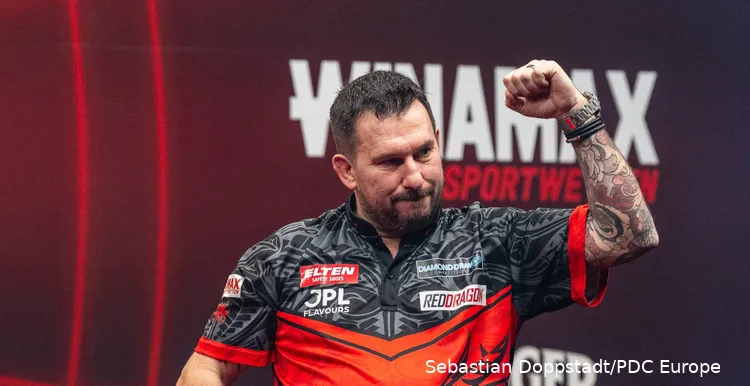
Step forward **Jonny Clayton**, the ever-grounded Welshman known as The Ferret, who wasted no time in writing off any dramatic narrative. Speaking after a memorable night in Brighton where he staged a thrilling comeback to claim victory and surge back to the top of the Premier League table, Clayton offered a calm, insider’s perspective that cut through the rumor mill with refreshing honesty.
“They’re always in separate practice rooms really,” Clayton explained matter-of-factly. He elaborated that with two practice rooms available, the setup often naturally splits the players. “If there’s two rooms, you know, like myself, Mike [van Gerwen] and Luke Humphries are in one and usually Gian comes into that. I don’t think there’s anything of it, it’s just the way it happens. Gian was in with us and Luke [Littler] was in the other one.”
His words carried the quiet authority of someone who has seen the inner workings of the tour for years. Far from a sign of animosity or a deliberate cold shoulder following the Manchester fracas—where van Veen had publicly labeled Littler’s conduct “out of order”—the separation was simply logistics in action. In the bustling PDC environment, players rotate through limited warm-up spaces, and groupings often depend on scheduling, personalities, or sheer convenience rather than any personal feud. Clayton’s insight painted a picture of business as usual behind the scenes, even as the spotlight outside magnified every detail.
This down-to-earth dismissal came as Clayton himself was riding a wave of momentum. In Brighton, the 41-year-old delivered one of the most resilient performances of the season, fighting back from 5-2 down against seven-time world champion Michael van Gerwen in the final to snatch a 6-5 victory. It marked his third nightly win of the 2026 campaign and propelled him three points clear at the summit of the table, ahead of Littler and the rest of the chasing pack. Earlier in the evening, Clayton had edged out Luke Humphries 6-5 in the quarter-finals with a dramatic bullseye finish before dispatching Josh Rock 6-4 in the semis. His ability to seize crucial moments when the pressure was at its peak spoke volumes about his experience and mental fortitude.
Reflecting on the criticism that often swirls around top players—whether it’s fan debates, social media scrutiny, or the intense analysis that follows every match—Clayton revealed he has long learned to channel such noise into positive energy. He has always embraced the idea that external pressure and doubt can serve as powerful fuel rather than a distraction. Throughout his career, including periods when his place in the Premier League was questioned, Clayton has turned skepticism into motivation, letting his darts do the talking on stage while maintaining a focused, no-nonsense approach off it.
“I just enjoy it, I really enjoy it,” he has said in the past about competing at this level, even when the odds or the narrative seemed stacked against him. That same mindset was evident in Brighton. Despite the swirling stories about Littler and van Veen, Clayton stayed locked in on his own game, refusing to get drawn into the drama. His post-match comments underscored a broader philosophy that has served him well: concentrate on what you can control, respect the talents around you, and use any external chatter—positive or negative—as extra motivation to perform.
The backdrop to Night 10 had been anything but ordinary. Littler, still recovering from a disappointing quarter-final loss to Stephen Bunting the night before (a match marred by boos and one of the young star’s lowest televised averages), found himself navigating fresh scrutiny. Van Veen, for his part, had been vocal after their Manchester encounter, suggesting relations between the two might not warm up anytime soon. Yet Clayton’s casual revelation about the practice rooms helped deflate the tension, reminding everyone that the PDC circuit is a professional environment where rivalries on the oche don’t always translate into personal divides backstage.
Clayton’s own journey in the 2026 Premier League has been a masterclass in consistency and resilience. Having started the season with something to prove after missing out in previous years, he has embraced the competition as his favorite on the calendar. Even dealing with personal challenges like occasional gout flare-ups in the past, he has shown an uncanny ability to compartmentalize and deliver when it matters most. In Nottingham earlier in the campaign, he powered through physical discomfort to claim a dominant win, later joking about the condition moving from his elbow to his ankle while insisting he would never miss a night.
This mental toughness extends to how he handles the “keyboard warriors” and fan opinions that flood social media after every session. Clayton has repeatedly emphasized that he lets his arrows speak louder than any words, focusing inward rather than engaging with the noise. It’s a mindset that has helped him build a strong following and earn respect across the darts world, from veterans like van Gerwen to the new generation headlined by Littler.
As the Premier League caravan rolls on toward the playoffs at the O2 in London, Clayton’s leadership at the top of the table feels well-earned. His third nightly victory not only boosted his points tally but also sent a clear message: experience and composure still count for everything in this format. While the spotlight often fixates on the explosive scoring of Littler or the raw talent of van Veen, Clayton continues to prove that steady progress, smart finishing, and an ability to thrive under pressure can keep a player at the summit.
For the wider darts community, Clayton’s comments on the practice room situation offered a welcome dose of perspective. In a sport where emotions run high and rivalries can captivate fans, it’s easy for small details to snowball into major storylines. Yet as The Ferret reminded everyone, sometimes things are simply the way they are—two rooms, different groups, nothing more, nothing less. He expressed genuine enjoyment at sharing the practice environment with the sport’s young guns, acknowledging the bright future they represent while staying firmly focused on his own preparation.
Looking ahead, the Premier League promises more drama, more comebacks, and plenty of high-quality darts. Littler will undoubtedly bounce back with the fearless style that made him world champion at such a young age. Van Veen will continue pushing the boundaries as one of the most exciting prospects in the game. And Clayton? He’ll keep doing what he does best—turning up, competing with a smile (and sometimes a point to prove), and using whatever comes his way, criticism included, as fuel to chase more glory.
In the end, that’s the beauty of Premier League Darts: it’s not just about the arrows on the board, but about the characters, the stories, and the quiet wisdom from veterans like Jonny Clayton that keep the whole spectacle grounded. As the nights roll on, expect more thrilling finishes, shifting table positions, and perhaps a few more practice room insights that remind us the real battle is always between the player and the oche—everything else is just noise to be harnessed or ignored. Clayton, sitting pretty at the top, seems perfectly equipped to do exactly that.
Leave a Reply