
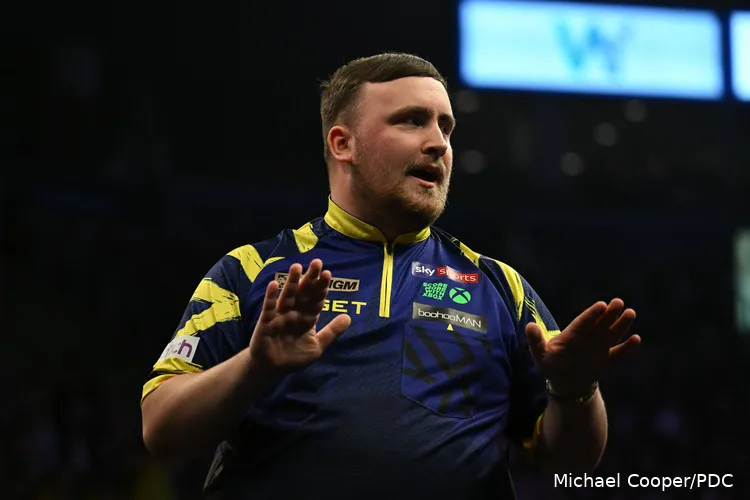
In the high-octane world of professional darts, where the thunderous roar of packed arenas can fuel legendary performances or unravel even the steadiest of nerves, **Luke Littler**—the teenage sensation who has redefined the sport—finds himself navigating a new challenge: the sharp edge of crowd disapproval. At just 19 years old, the Warrington wonderkid has already achieved what many players dream of in a lifetime, claiming major titles, shattering records, and drawing record crowds wherever he goes. Yet, recent nights on the Premier League Darts circuit have tested his composure, with booing and whistling echoing through venues like Brighton, prompting a broader conversation about fan behavior and mental resilience in the game.
The latest episode unfolded in Brighton during Premier League Night 10, where Littler suffered a shock 6-4 defeat to Stephen Bunting. It was a night that will be remembered not just for the result, but for the hostile reception the young world champion received from the moment he walked on stage. Boos rang out during his entrance, and when Littler responded with a trademark shrug and a hand-to-ear gesture—pointing as if to say he couldn’t quite hear the jeers—the noise only grew louder. His average dipped to a career-low 83.94 on television, a stark contrast to the blistering scores that have become his trademark. Many observers linked the tense atmosphere directly to a fiery incident the previous week in Manchester against Gian van Veen, where emotions boiled over after a missed dart and some on-stage gamesmanship.
Incidents like these are not entirely new to darts. The sport has long thrived on its raucous, partisan crowds—fans in fancy dress, chanting, cheering, and sometimes crossing the line into disruption. Whistling, in particular, has drawn attention in recent years, with some players finding it especially distracting during crucial throws. In Germany, where Littler has competed, whistling is reportedly more prevalent, and the teenager has made no secret of his dislike for it, though he continues to show up and compete.
Amid the debate, 1983 world champion **Keith Deller** offered straightforward, battle-hardened wisdom drawn from his own experiences and those of darts legends before him. Deller, who knows a thing or two about handling pressure on the biggest stages, believes the solution for Littler—and any player facing similar treatment—is simple yet profound: don’t let it get to you.
“I think you’ve just got to laugh it off really because if you start getting to it and the crowd knows that you don’t like it, then you’re in trouble,” Deller explained. “Because they know they’re going to do it. But if you just turn around [and ignore it]. I’m not sure about what’s the problem in all this.”
Deller pointed to iconic figures from darts’ past to illustrate his point. Eric Bristow, the Crafty Cockney and five-time world champion, famously embraced—or even thrived on—hostility. “Eric loved it and that’s what you’ve got to do,” Deller recalled. He also referenced Peter Manley, another player who faced his share of boos but chose to laugh them off rather than engage. “Peter Manley, he was one of them again. He used to get booed sometimes and just laugh.”
According to Deller, booing is as old as the game itself. “We had it back in our day. Eric [Bristow] got booed in Scotland because he used to upset Jocky Wilson a few times. That’s just the way it is.” The 1983 champion sees parallels with today’s superstar, suggesting that some of the negativity stems from a touch of jealousy. “I think there’s always a little bit of a jealousy. I mean Luke’s now a multi-millionaire. They might think: ‘Oh, look at him now’.”
Yet Deller is quick to emphasize the enormous positive impact Littler has had on the sport. Since bursting onto the scene as a 16-year-old prodigy, the teenager has transformed darts from a pub pastime into a global entertainment phenomenon. Viewing figures have soared, new sponsors have flooded in, and arenas sell out rapidly whenever his name tops the bill. “Luke Littler’s done so much for our sport. How many youngsters are taking the game up? The viewing figures now are going through the roof. Companies are becoming involved. Arenas are sold out because of Luke Littler.”
This boom has brought unprecedented prize money and opportunities, but it has also intensified the spotlight. Some pundits have even speculated about whether the mounting pressures—including occasional crowd hostility—might tempt Littler to step away from the oche in favor of other pursuits, such as gaming or content creation alongside friends like Angry Ginge. Deller firmly dismisses such notions. Littler, he argues, is in it for the long haul precisely because the rewards—both financial and competitive—continue to grow. “I just think at the end of the day, Luke Littler knows that: ‘OK, if you’re going to keep booing me, who cares? I’m still going to win major titles’.”
For a player still in his teens, learning to tune out negativity is part of a steep but necessary learning curve. Littler has already shown remarkable growth since his explosive debut at the 2024 World Darts Championship, where he reached the final as a qualifier. He has matured in handling on-stage emotions, though moments like the hand-to-ear gesture in Brighton reveal there is still room to refine that mental armor. Experts agree that showing visible frustration only fuels the fire; once the crowd senses vulnerability, the jeers can become a deliberate tactic to unsettle a favored player.
Darts has always been a sport of theater as much as precision. The walk-ons, the pyrotechnics, the chanting crowds in colorful attire—all contribute to an electric atmosphere that sets it apart from more sedate pursuits. But there is a fine line between passionate support for underdogs or local favorites and outright disruption that affects the quality of play. Whistling during a player’s throw, for instance, can throw off rhythm and concentration, turning a test of skill into something closer to psychological warfare.
Littler’s response to the Brighton crowd—while instinctive—highlighted the human side of even the most gifted athletes. At 19, he carries the weight of being the face of a booming sport, a role model for thousands of aspiring young dart players, and a lightning rod for both adoration and envy. His ability to bounce back will be key as the Premier League season progresses and major tournaments like the UK Open loom on the horizon.
Ultimately, the advice from seasoned campaigners like Deller boils down to mindset. Laugh it off. Ignore the noise. Focus on the board. Players who master this mental game often find that the crowd’s energy shifts back in their favor once the darts start flying true. History is littered with examples of athletes who turned hostility into motivation, channeling it into extraordinary performances.
As darts continues its surge in popularity, the conversation around fan conduct will likely persist. The PDC has previously addressed disruptive behavior, reminding spectators that while passion is welcome, excessive interference can lead to warnings or even ejection. For Littler, though, the path forward seems clear: keep throwing, keep winning, and treat the occasional boo as just another part of the spectacle.
In an era where the teenager’s every move is scrutinized, his resilience could become as legendary as his scoring power. Arenas will keep selling out, kids will keep picking up darts inspired by his story, and the sport will keep evolving. And if the occasional whistle or boo tries to derail him? Well, as the wisdom goes, you’ve just got to laugh it off—then let your arrows do the talking.
The bright lights of the Premier League stage await the next chapter, and few would bet against Luke Littler emerging stronger, wiser, and still very much the player everyone wants to watch. After all, in darts, as in life, it’s not the noise that defines you—it’s how you rise above it.
Leave a Reply