
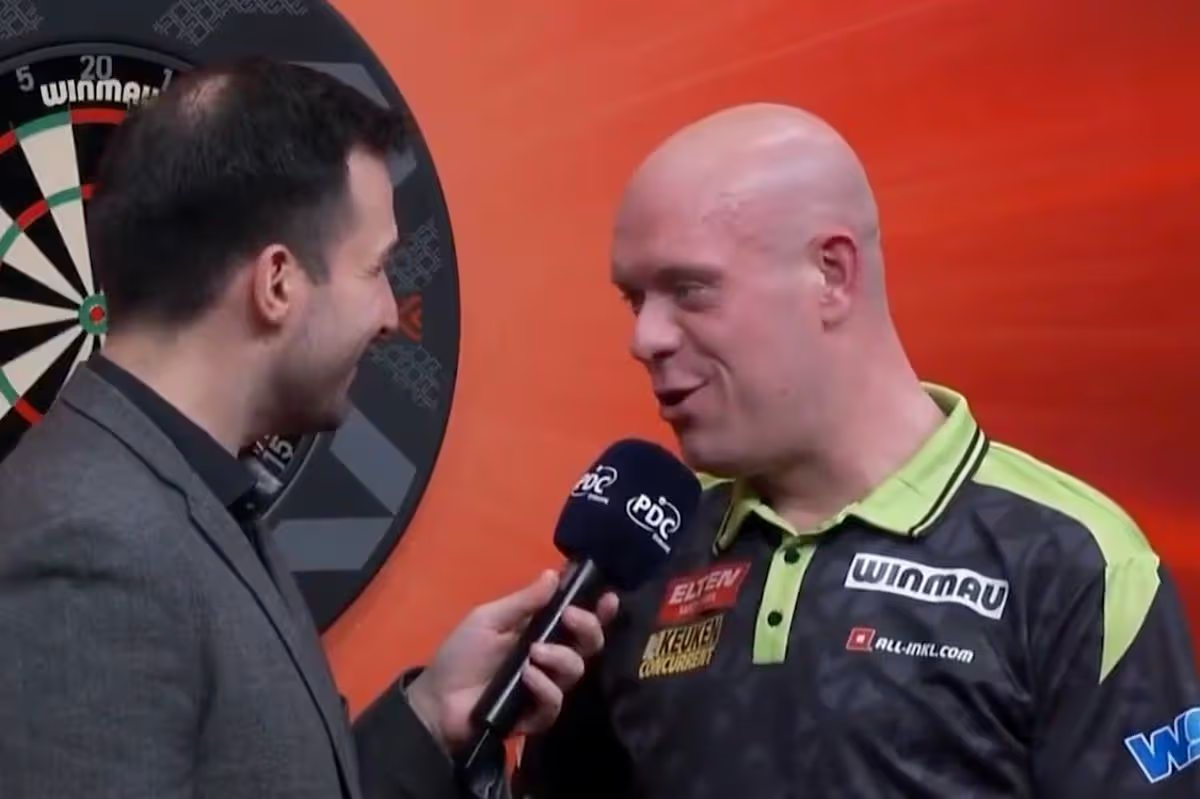
Michael van Gerwen delivered a dominant and clinical performance at the European Darts Grand Prix in Sindelfingen, overpowering Michael Unterbuchner with a straightforward 6-2 victory in the second round. The three-time world champion controlled the contest from the early stages, posting a solid average and producing moments of real quality, including a highlight-reel 102 checkout that brought the German crowd to life. The result propelled him confidently into the last 16, where an all-Dutch battle against Jermaine Wattimena awaited. Yet while the on-stage display was impressive, it was van Gerwen’s raw and uncompromising post-match interview that dominated the headlines and sparked widespread discussion across the darts world.
The match itself carried an intriguing backstory shaped by Unterbuchner’s pre-game comments. The German player had earned a boost of confidence after securing only his second-ever win on the European Tour stage, defeating William O’Connor in the first round. Drawing on his strong recent form on the Challenge Tour, where he frequently recorded averages above 90, Unterbuchner approached the high-profile clash with a mix of excitement and playful banter. When questioned about facing the formidable Dutch superstar, he responded with a cheeky quip: Michael van Gerwen? Who is that? No, no, just kidding. I’m looking forward to it. He even added a humorous personal touch, recounting how his wife had suggested booking an extra night at the hotel in anticipation of potentially extending his run in the tournament.
In the lively environment of professional darts, such light-hearted remarks are often part of the game’s charm, adding personality and a psychological edge to the build-up. Fans appreciated the underdog’s spirit, seeing it as harmless fun from a player savoring his moment under the bright lights. However, van Gerwen, renowned for his intense competitive fire and unwavering self-belief, viewed the comments through a different lens entirely. After dispatching his opponent with ruthless efficiency, the 36-year-old addressed the remarks head-on in a no-holds-barred manner that left little doubt about his feelings.
He dismissed the attempt at humor outright, stating firmly that Unterbuchner did not make a joke and describing him as one of those guys that try to be funny. Van Gerwen then turned to their head-to-head history, which has been entirely one-sided in his favor. He’s never beaten me in his life and he will never beat me in his life, he declared. He’s not good enough. Even my B and C game beats him, but who cares? The blunt assessment underscored the vast gulf in class that van Gerwen perceives between himself and the German player.
Continuing with unfiltered candor, van Gerwen questioned his opponent’s sharpness, adding that he’s not that clever either. He emphasized his own professional approach, noting that if you are a professional you always go for the shot. Then came a pointed rhetorical jab: But he doesn’t know who I am, so who am I? The remarks built toward the most memorable and dramatic line of the evening, one that encapsulated van Gerwen’s zero-tolerance policy toward any perceived lack of respect or misplaced confidence. The day I’m going to worry myself about Unterbuchner, that’s the day I’m going to quit playing darts.
This explosive statement was pure van Gerwen, delivered with the same intensity he brings to the oche. It reflected the mindset of a player who has reigned at the top of the sport for more than a decade, amassing multiple world titles, Premier League successes, and a host of other major honors through relentless dedication and mental toughness. In the high-stakes arena of professional darts, where precision meets pressure and psychological battles unfold alongside the scoring, such raw honesty injects real drama and divides opinions. Some observers may view the comments as overly harsh toward an opponent simply enjoying a career highlight, while many fans and fellow professionals admire it as the uncompromising attitude necessary to sustain elite performance year after year.
Despite the comfortable victory, van Gerwen remained honest about his own display, acknowledging imperfections along the way. He mentioned having a couple of very good legs but also highlighted one particularly frustrating leg on double one that felt like a disaster. Still, he quickly moved past the minor flaws with characteristic pragmatism. Who cares? I won the game, and that’s the most important thing. The energy from the crowd in Sindelfingen clearly resonated with him, and he appreciated how the fans were enjoying themselves throughout the evening.
The venue holds special significance for van Gerwen, as he has lifted the European Darts Grand Prix trophy there on two previous occasions, in 2016 and 2018. With that history in mind, he expressed strong ambition for the remainder of the tournament. It’s been a long time since I won here, so I hope I can give it a good go, he said, already shifting his focus forward with typical determination.
His next challenge comes against Jermaine Wattimena, a familiar face from their shared youth days in Dutch darts. Van Gerwen noted a positive personal record against his compatriot, stating that he has always had the better of him. At the same time, he offered due respect to Wattimena’s current form, recognizing that his fellow Dutchman is in good shape and playing some sharp darts. This sets up an intriguing encounter that will test van Gerwen’s ability to maintain concentration after the emotionally charged exchange with Unterbuchner.
The episode highlights broader themes within the evolving landscape of professional darts. European Tour events like this one provide crucial opportunities for players grinding away on the Challenge Tour to test themselves against the sport’s biggest names. A breakthrough win, such as Unterbuchner’s first-round success, can ignite genuine belief and create memorable storylines. Yet when that belief collides with the reality of facing a multiple-time world champion at full throttle, the difference in levels can appear stark. Van Gerwen’s response, though blunt, serves as a powerful reminder of the standards, focus, and resilience demanded at the very highest level of the game. It is less about personal vendetta and more about a champion fiercely protecting the hierarchy built on years of consistent excellence.
As the tournament continued in Sindelfingen, other results added further excitement and unpredictability to the event. Young German talent Niko Springer produced one of the standout shocks by defeating the defending champion Gary Anderson, advancing to a quarter-final meeting with Danny Noppert. Such upsets serve as timely reminders that darts can deliver surprises and keep the competition thrilling, even as established stars like van Gerwen assert their authority in individual matches.
Van Gerwen’s dramatic threat to quit if he ever found himself worrying about an opponent of Unterbuchner’s caliber was clearly hyperbolic, yet it carried a deeper message. It drew a firm line in the sand, reaffirming his status as a player who refuses to entertain doubt or complacency. In an era when darts enjoys surging global popularity, with packed arenas, passionate crowds, and expanding television audiences, moments like these bring vivid personality and emotional depth to the sport. They transform routine victories into compelling narratives that captivate fans and enrich the overall spectacle.
Looking back on the evening, van Gerwen’s commanding performance on the board, paired with his forthright and unapologetic words afterward, reinforced why he remains one of the most dominant and watchable figures in darts. His blend of clinical finishing, mental fortitude, and candid expression keeps him at the heart of the story, even as new talents emerge to challenge the established order. The European Darts Grand Prix, with its mix of seasoned champions and ambitious underdogs, provided the ideal stage for this latest memorable chapter.
The incident also subtly reflects the growth and professionalization of darts. With a packed international calendar and more pathways for lower-ranked players to compete at elite events, the pressure to deliver consistent high-level performances has intensified. Van Gerwen, having weathered every high and low across a long and illustrious career, exemplifies the dedication and fierce self-belief required to thrive at the summit. While his comments may have landed sharply for Unterbuchner and his supporters, they also illuminate the qualities that distinguish true legends from the rest of the field.
As the competition advances toward its climax in Sindelfingen, attention will naturally turn to whether van Gerwen can harness this momentum and mount another serious title bid in a venue that has previously brought him glory. With his competitive spirit undiminished and his focus locked firmly on success, the Dutch maestro appears poised to deliver more standout moments both on and off the oche. The darts world continues to thrive on passion, rivalries, and unfiltered emotion, and van Gerwen’s latest contribution ensures that this particular European Darts Grand Prix will be remembered not only for the high-quality action but also for the larger-than-life personality that keeps the sport so endlessly engaging and human.
Leave a Reply