
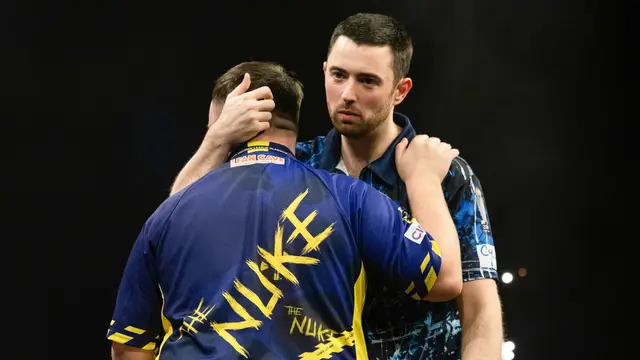
The Professional Darts Corporation has issued a strong and decisive statement following what has been widely described as one of the most disruptive and controversial nights in Premier League Darts history. The incident, which unfolded during a packed event in Glasgow, has sparked intense debate across the sport after crowd behaviour crossed the line from passionate support into outright interference, leaving several top players frustrated and concerned.
At the centre of the controversy was teenage sensation Luke Littler, whose rapid rise has made him one of the most talked-about figures in darts. Still in the early stages of his professional career, Littler has already captured global attention with his fearless performances and composure under pressure. However, even his growing experience could not fully shield him from the impact of what unfolded on that chaotic night.
The Glasgow crowd, typically known for its energy and enthusiasm, became a major talking point for all the wrong reasons. Throughout the evening, persistent whistling, booing, and disruptive noise repeatedly interrupted matches. What is usually seen as a lively and entertaining atmosphere quickly turned into something far more problematic, with players struggling to maintain focus during key moments.
The situation reached its peak during the final between Littler and world number one Luke Humphries. The match itself had all the ingredients of a classic, with two of the sport’s biggest names going head-to-head in a high-stakes encounter. But instead of being remembered purely for its quality, it became overshadowed by constant interruptions from sections of the crowd.
Littler, who battled his way through the night with wins over Rob Cross and Michael van Gerwen, was visibly affected by the atmosphere. Despite ultimately emerging victorious in a tense 6-5 contest, he did not hold back when reflecting on the experience.
“There was a few in particular that were doing it when Luke was throwing,” Littler said after the match, pointing to individuals in the crowd who repeatedly made noise during crucial moments. His comments highlighted how targeted disruptions can have a direct impact on performance, especially in a sport that demands extreme concentration and precision.
One of the most controversial moments came when referee Kirk Bevins attempted to intervene and restore order. Rather than calming the situation, the intervention appeared to have the opposite effect. Littler described how the crowd grew even louder after being told to quiet down, which directly influenced a turning point in the match.
“Kirk told them to be quiet and it got even worse,” Littler explained. “Then I missed doubles and Luke breaks at 5-4. I’m just like, ‘Kirk, you’ve made it worse for me there.’” It was a rare moment of frustration from a player who has built a reputation for staying composed under pressure.
Despite falling behind at that stage, Littler showed remarkable resilience. He immediately regained his focus, broke back against Humphries, and held his nerve in the closing stages to seal the victory. His ability to recover highlighted his growing maturity, but it also underscored just how challenging the conditions had been.
The disruption was not limited to the final. Earlier matches throughout the evening were also affected, with players experiencing similar issues during their throws. Gerwyn Price, known for thriving in intense atmospheres, appeared visibly frustrated at times, even reacting to the crowd in an attempt to deal with the noise. Such scenes are unusual at the highest level of the sport and signalled that the situation had gone too far.
What made the incident particularly concerning was the consistency of the behaviour. This was not a one-off moment or isolated disruption but rather a pattern that continued across multiple matches. The repeated nature of the noise made it increasingly difficult for players to maintain rhythm and concentration, turning what should have been a celebration of elite darts into a test of mental endurance.
In response to the backlash, the Professional Darts Corporation moved quickly to address the issue. The organisation released an official statement condemning the behaviour and making its position clear. It emphasised that any form of disruption while players are throwing, including whistling or booing, is unacceptable and will not be tolerated.
The PDC reminded fans that players dedicate countless hours to their craft and deserve an environment that allows them to perform at the highest level. It also highlighted that attending events comes with responsibilities, and those who fail to meet expected standards of behaviour risk being removed from venues.
Importantly, the governing body confirmed that it will work closely with venues and security teams to ensure stronger enforcement of these rules moving forward. This includes taking more proactive measures to identify and deal with individuals who disrupt matches, with the aim of preventing similar incidents in future events.
While the statement was firm, it also acknowledged that the majority of fans continue to contribute positively to the sport. Darts has built its identity on passionate and vocal crowds, and that energy remains a key part of its appeal. However, the Glasgow incident has highlighted the fine line between enthusiasm and interference.
This is not the first time such concerns have emerged. In recent months, there have been reports of similar behaviour at other Premier League events, raising questions about whether crowd dynamics are beginning to shift as the sport grows in popularity. With larger audiences and increased global attention, maintaining control and ensuring respectful conduct has become more challenging.
For players, the issue is not about silencing crowds but about preserving fairness. The atmosphere is part of what makes darts unique, but it should never come at the expense of competition. When noise is deliberately timed to disrupt throws, it undermines the integrity of the sport and places players at an unfair disadvantage.
For Littler in particular, the situation reflects the pressures that come with his rapid rise. As one of the most recognisable faces in darts, he often finds himself at the centre of attention, both positive and negative. While he has shown an impressive ability to handle that spotlight, the events in Glasgow demonstrated that even the most composed players can be affected when conditions become extreme.
Looking ahead, the focus will be on how effectively the PDC can implement its promised measures. The Premier League continues to travel across major venues, and ensuring consistent crowd behaviour will be crucial in maintaining the standard of competition. Officials, security teams, and referees will all play key roles in enforcing the rules and protecting players.
The Glasgow controversy may ultimately serve as a turning point. It has brought the issue of crowd conduct into sharp focus and prompted a clear response from the sport’s governing body. Whether that leads to lasting change will depend on how both organisers and fans respond in the coming weeks.
For now, the message is clear. Passion and atmosphere will always be part of darts, but respect for players must come first. The hope is that future events can recapture the balance that makes the sport so special, delivering both thrilling entertainment and a fair stage for the world’s best players to perform.
Leave a Reply