
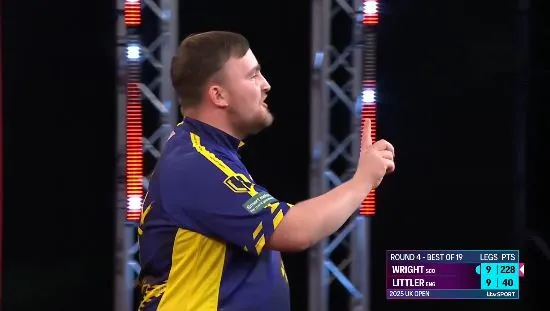
The journey of Luke Littler continues to capture attention across the darts world, and his latest appearance at the UK Open only added another dramatic chapter to his rapidly growing story. In a tense and emotional clash against Peter Wright, the teenage sensation not only had to battle a seasoned opponent but also contend with a crowd that didn’t always seem to be on his side. Yet, as the dust settled on a thrilling encounter, it was Littler’s calm defiance and his blunt three-word response that left the strongest impression.
The UK Open is known for its unpredictability and electric atmosphere, often producing matches that test players in ways beyond just skill. This contest was no different. From the opening leg, it was clear that both Littler and Wright were prepared for a fight. Wright, with his trademark flair and experience, brought a level of composure that has seen him lift major titles. Littler, on the other hand, entered the match carrying the confidence of recent success and the belief that he could overcome any challenge placed in front of him.
As the match unfolded, the quality on display lived up to expectations. Wright delivered moments of brilliance, punishing missed chances and reminding everyone why he remains one of the most dangerous competitors in the game. Littler responded in kind, producing heavy scoring and clutch finishes that kept him firmly in contention. The scoreboard reflected the intensity, with neither player able to pull away decisively.
However, as the contest grew tighter, the atmosphere inside the arena began to shift. Sections of the crowd started directing boos toward Littler, creating a hostile backdrop that added an extra layer of pressure. In darts, crowd involvement is part of the spectacle, but when it turns negative, it can disrupt even the most experienced players. For Littler, still early in his career, it was a moment that could have easily unsettled him.
Instead, he showed remarkable composure. Rather than reacting to the noise, he appeared to block it out completely, focusing solely on the task at hand. Each visit to the oche was approached with concentration and purpose. His scoring remained consistent, and when opportunities presented themselves, he took them with confidence. It was a display of mental strength that suggested he is more than capable of handling the pressures that come with being one of the sport’s most talked-about figures.
The match itself became a true test of nerve. Wright’s experience ensured that Littler would not have an easy path to victory. Time and again, the Scot applied pressure, forcing the young star to respond. Yet Littler refused to back down. He matched Wright dart for dart in crucial moments, finding the trebles when it mattered most and holding his nerve on the doubles.
As the contest reached its climax, the tension was palpable. Every throw carried significance, every miss threatened to swing the momentum. In these moments, composure is everything—and Littler delivered. He edged ahead at just the right time, closing out the match to secure a hard-fought victory that showcased both his talent and his resilience.
While the win itself was impressive, it was what happened afterward that truly captured attention. Asked about the crowd’s reaction, Littler offered a simple yet powerful response: “I don’t care.” Just three words, but they spoke volumes about his mindset.
The brevity of his answer was striking. In a sport where players often choose their words carefully, Littler’s directness stood out. It was a statement of intent, a clear indication that he refuses to let external factors dictate his performance or affect his focus. For him, the objective is straightforward—win matches, regardless of the circumstances.
That response has sparked plenty of discussion. Some see it as a sign of confidence and maturity beyond his years, evidence that he possesses the mental toughness required to succeed at the highest level. Others view it as a bold stance that could further divide opinion among fans. In either case, it reinforces the idea that Littler is not afraid to be himself, even under intense scrutiny.
This is not an isolated incident. As Littler’s profile has grown, so too has the intensity of crowd reactions. In some arenas, he is celebrated as a prodigy, a young player redefining what is possible in darts. In others, he faces resistance, with sections of the audience casting him as a figure to challenge rather than support. It is a dynamic that often accompanies rapid success, particularly for players who break through at such a young age.
What makes Littler stand out is how he handles these situations. Rather than being rattled, he appears to use them as motivation. The hostile atmosphere against Wright could have derailed his performance, but instead, it seemed to sharpen his focus. Moments like these reveal a level of mental resilience that is essential for long-term success in professional sport.
Wright’s role in the contest should not be overlooked. The experienced Scot pushed Littler to his limits, delivering a performance that demonstrated his enduring quality. Even in defeat, Wright showed why he remains a formidable competitor, capable of challenging the very best on any given day.
The crowd’s involvement, however, remains a talking point. Darts has always embraced a lively and interactive fan culture, but the balance between support and disruption is a delicate one. Booing adds drama but also raises questions about its impact on players and the overall spirit of competition. Littler’s experience at the UK Open has brought that debate back into focus.
For his part, Littler seems unfazed. His three-word message suggests a player who understands that such challenges are part of the game. Rather than seeking to change the environment, he focuses on controlling his own performance. It is a mindset that many elite athletes share—an ability to remain centered regardless of external noise.
Looking ahead, it is likely that Littler will continue to encounter similar situations. His growing stature ensures that he will be at the center of attention wherever he plays. How he responds to that attention will play a significant role in shaping his career.
For now, his approach appears to be working. His ability to deliver under pressure, combined with his refusal to be distracted, has already earned him significant success. The victory over Wright is another example of his potential and his determination to succeed on his own terms.
In the end, this match will be remembered not just for its quality, but for what it revealed about Littler as a competitor. He faced a tough opponent, a challenging atmosphere, and high expectations—and came through it all with a win.
And with three simple words, “I don’t care,” he made it clear that no matter the noise around him, his focus remains exactly where it needs to be—on the board, on the game, and on winning.