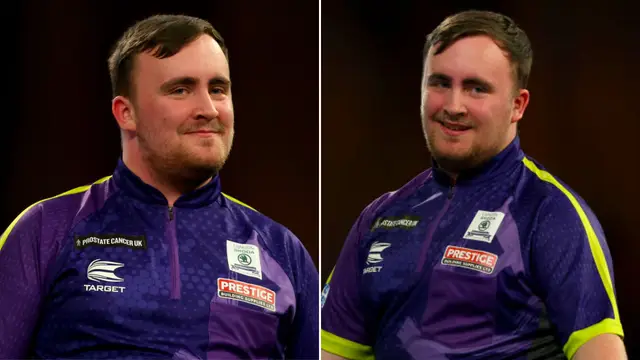
The rise of Luke Littler has been nothing short of extraordinary, a story that has captivated fans far beyond the traditional boundaries of darts. In what felt like an instant, he transformed from a promising young talent into a global sensation. His breakthrough moment came at the PDC World Darts Championship, where, at just 16 years old, he produced a run that stunned the sporting world by reaching the final. It was a performance defined not only by skill but by an almost unbelievable level of composure. Yet, as admiration grew, so too did an unexpected and persistent question — was he really as young as he claimed?
From the moment Littler stepped onto the biggest stage in darts, there was something unusual about him. It wasn’t just the way he played, although that alone would have been enough to turn heads. It was how he carried himself. He showed a calmness that many seasoned professionals struggle to maintain, especially under the intense pressure of a world championship. Match after match, he dismantled experienced opponents with a confidence that felt far beyond his years. For many watching, it created a disconnect — how could someone so young perform with such maturity?
That sense of disbelief quickly found its way onto social media, where the conversation took on a life of its own. Fans and casual viewers alike began commenting on Littler’s appearance, particularly his full beard and mature look. Jokes spread rapidly, with some claiming he looked closer to 30 than 16. Memes exaggerated the idea even further, painting humorous pictures of him as a fully grown adult with responsibilities far removed from teenage life. While much of it was clearly intended as light-hearted banter, the repetition of the joke kept the question alive.
The speculation didn’t stay confined to online platforms. It spilled into mainstream discussion, including radio shows and sports coverage. At one point, broadcaster Andy Goldstein openly revealed that he had placed a bet with colleagues, suggesting Littler might actually be much older than officially stated. The fact that such a claim could be made publicly, even in jest, showed just how widespread the curiosity had become. What began as casual observation had evolved into a genuine talking point surrounding one of the sport’s brightest new stars.
Despite the noise, Littler himself remained unfazed. When confronted directly about the speculation, he handled it with a mix of honesty and humor. Asked about the claims during a live interview, he dismissed them in a straightforward manner, confirming his age without hesitation. He even joked about his beard, noting that he had been growing it for a couple of years. His response reflected not only confidence but also a level of maturity that reinforced why people found him so unusual in the first place.
More importantly, Littler made it clear that he refused to let the speculation distract him. Rather than engaging with critics or attempting to prove himself repeatedly, he chose to ignore the noise. He spoke about blocking out negative comments, laughing at the jokes, and focusing entirely on his performances. For a teenager suddenly thrust into global attention, this approach was both impressive and necessary.
However, the situation took a more serious turn when reports emerged that a copy of his birth certificate had been circulated online. The document confirmed his date of birth as January 21, 2007, effectively ending any lingering doubts about his age. It provided the definitive proof that many had been asking for, showing clearly that he was indeed 16 during his remarkable run at the World Championship.
Yet, while the leak settled the debate, it also raised uncomfortable questions. Many viewed the sharing of such personal information as an invasion of privacy, particularly given Littler’s age. What had started as jokes and harmless speculation had crossed a line into something more intrusive. It highlighted the pressures that come with sudden fame, especially for young athletes who may not yet be fully prepared for the level of scrutiny they face.
Throughout it all, Littler’s focus never wavered. On the oche, he continued to perform with the same consistency and confidence that had first captured attention. His ability to handle high-pressure moments remained one of his most striking qualities. Whether he was chasing a crucial checkout or facing a match-deciding leg, he showed no signs of panic. Instead, he played with clarity and control, traits usually associated with far more experienced players.
Off the stage, his personality added another layer to his growing popularity. Despite his achievements, he remained relatable, still enjoying the simple routines of teenage life. Stories about his pre-match meals — often straightforward choices like omelettes or pizza — and his love of video games helped humanize him. It created a contrast that fans found fascinating: a teenager living a normal life while simultaneously competing at an elite level.
His family also played an important role in his journey. From his earliest days picking up darts as a toddler, they had supported his development and shared in his progress. As the spotlight intensified, they found themselves navigating the challenges that came with his rapid rise. Reports suggested that those close to Littler were frustrated by some of the accusations, viewing them as unnecessary and, at times, unfairly targeted at a young player.
In the broader context, the entire episode became part of what many now refer to as the “Littler effect.” His emergence brought a surge of interest to darts, attracting new audiences and generating excitement across the sport. People who had never previously followed darts found themselves drawn in by his story — a teenager defying expectations and competing with the very best.
Ultimately, the controversy surrounding his age did little to overshadow what truly mattered. If anything, it emphasized just how rare his talent is. The disbelief wasn’t really about numbers on a birth certificate; it was about the level at which he was performing. It is unusual, in any sport, to see someone so young display such control, confidence, and consistency on such a big stage.
As his career continues to unfold, the narrative has begun to shift. The focus is no longer on questioning his age but on anticipating his future. How many titles can he win? How far can he push the limits of the sport? These are the questions that now dominate the conversation.
What remains clear is that Luke Littler has already left a lasting mark on darts. His rise has reshaped expectations and inspired a new generation of players and fans. And while the speculation about his age may have been an unusual chapter in his story, it ultimately served to highlight something far more important — the arrival of a truly exceptional talent.
Leave a Reply