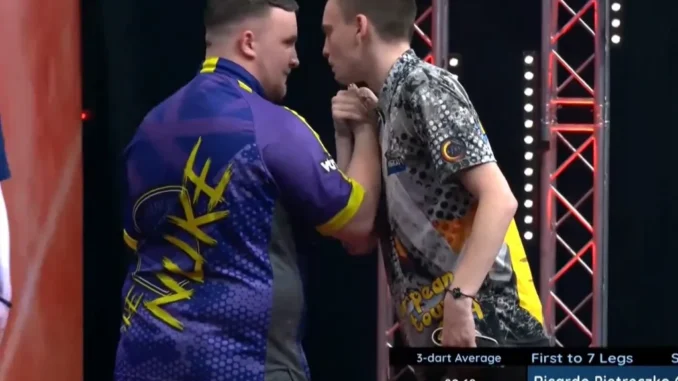
Luke Littler rival ABANDONS darts match after just two legs with average below 60 at Players Championship
A highly unusual and attention-grabbing moment unfolded at the Players Championship as one of Luke Littler’s rivals stunned spectators by abandoning his first-round match after just two legs, following a rapid collapse in form that saw his scoring average fall below 60.
The incident immediately became one of the talking points of the day, not because of a dramatic comeback or a tense deciding leg, but due to the rare sight of a professional darts player stepping away from a match so early in a ranked PDC event. The decision came after a deeply difficult opening spell in which the player struggled to land consistent scoring and appeared unable to settle into any rhythm on the oche.
From the outset, it was clear the match was not going to follow a competitive pattern. The player, who has competed against Luke Littler in various Pro Tour and televised events in recent seasons, began slowly and never managed to recover momentum. Missed trebles early in the contest immediately handed control to his opponent, who capitalised on the errors and built a comfortable early lead.
Within minutes, the scoreboard reflected the growing imbalance. Visits to the board that failed to produce heavy scoring left the struggling player chasing legs almost immediately, and frustration visibly began to build. Body language became increasingly tense, with rushed throws and repeated missed doubles further compounding the situation.
By the end of the second leg, the situation had deteriorated significantly. His three-dart average had dropped below the 60 mark, a figure far removed from the standards expected at professional level. In elite darts, even in off-days, players typically aim to remain in the mid-to-high 80s at minimum to remain competitive. Falling below 60 usually indicates a complete breakdown in scoring consistency, and in this case, it appeared to heavily influence the outcome.
Rather than continuing the match, the player made the decision to withdraw immediately after the second leg. He shook hands with his opponent and walked away from the board, effectively conceding the contest. The opponent, who had barely been tested in the opening exchanges, was awarded the victory as the match was officially brought to an early end.
For spectators inside the venue, the abrupt conclusion caused confusion at first, with many unsure whether an injury, illness, or equipment issue had forced the decision. However, it soon became clear that the withdrawal was performance-related, marking an extremely rare occurrence in a professional PDC ranking event of this stature.
The Players Championship series is known for its demanding format, where multiple matches are played across a single day and consistency is crucial. Unlike major televised tournaments with longer matches and rest days, Pro Tour events require players to maintain focus through quick turnarounds and high-pressure games. Even so, early match withdrawals remain highly uncommon, making this incident stand out even further.
While Luke Littler himself was not involved in this specific match, the rivalry context added extra attention. Littler’s rapid rise through the darts ranks has brought increased scrutiny to players around his age group and competitive circle, with many emerging names regularly compared against his performances. Matches involving his peers often draw additional interest from fans tracking the next generation of stars.
The identity of the opponent adds further context to the situation, as he has previously been seen competing in similar Pro Tour fields where margins are often extremely fine. However, in this case, there was little indication of a closely fought contest. From early on, the match was heavily one-sided, with scoring power clearly not shared equally between the two players on the day.
In professional darts, momentum plays a significant psychological role. A few missed doubles or low-scoring visits can quickly snowball into frustration, particularly when players are unable to reset between legs. Once confidence begins to dip, the technical precision required at elite level becomes increasingly difficult to maintain. This appeared to be a key factor in the rapid decline seen in this match.
The decision to walk away after just two legs suggests the player felt there was little chance of reversing the situation. In most professional settings, players are expected to complete matches regardless of scoreline unless injury or unavoidable circumstances intervene. As a result, voluntary early exits remain rare and are often discussed within the darts community when they do occur.
Reactions from fans and analysts have focused heavily on the mental demands of the sport. While darts is often perceived as a game of precision and composure, the psychological strain of repeated missed opportunities can be significant. The ability to recover mid-match is a crucial skill, and when that recovery does not happen, matches can unravel quickly.
The early abandonment also raises broader questions about form management and resilience during long Pro Tour seasons. With events held frequently and travel schedules demanding, players are often required to recover quickly from poor performances and reset for the next competition. A single heavy defeat or confidence-shaking display can sometimes carry over into subsequent events if not addressed effectively.
Despite the dramatic nature of the incident, the official result will stand as a straightforward win for the opponent, who advances to the next round with minimal effort expended. However, matches like this often provide limited competitive value for the winner, as extended match sharpness is typically built through sustained pressure rather than brief or uncontested victories.
For the player who withdrew, attention will now likely turn to recovery and preparation for upcoming fixtures. In professional darts, where rankings and qualification pathways are tightly contested, maintaining consistency across multiple events is essential. Responding positively after a difficult outing is often seen as a key part of a player’s long-term development and resilience.
While the moment will be remembered as one of the more unexpected scenes of the Players Championship, it also highlights the unpredictable nature of professional darts. Even at elite level, where margins are fine and standards are high, matches can shift dramatically within a matter of minutes. On this occasion, two legs were enough to end the contest entirely, leaving behind one of the more unusual early exits seen on the Pro Tour stage in recent times.
Leave a Reply