
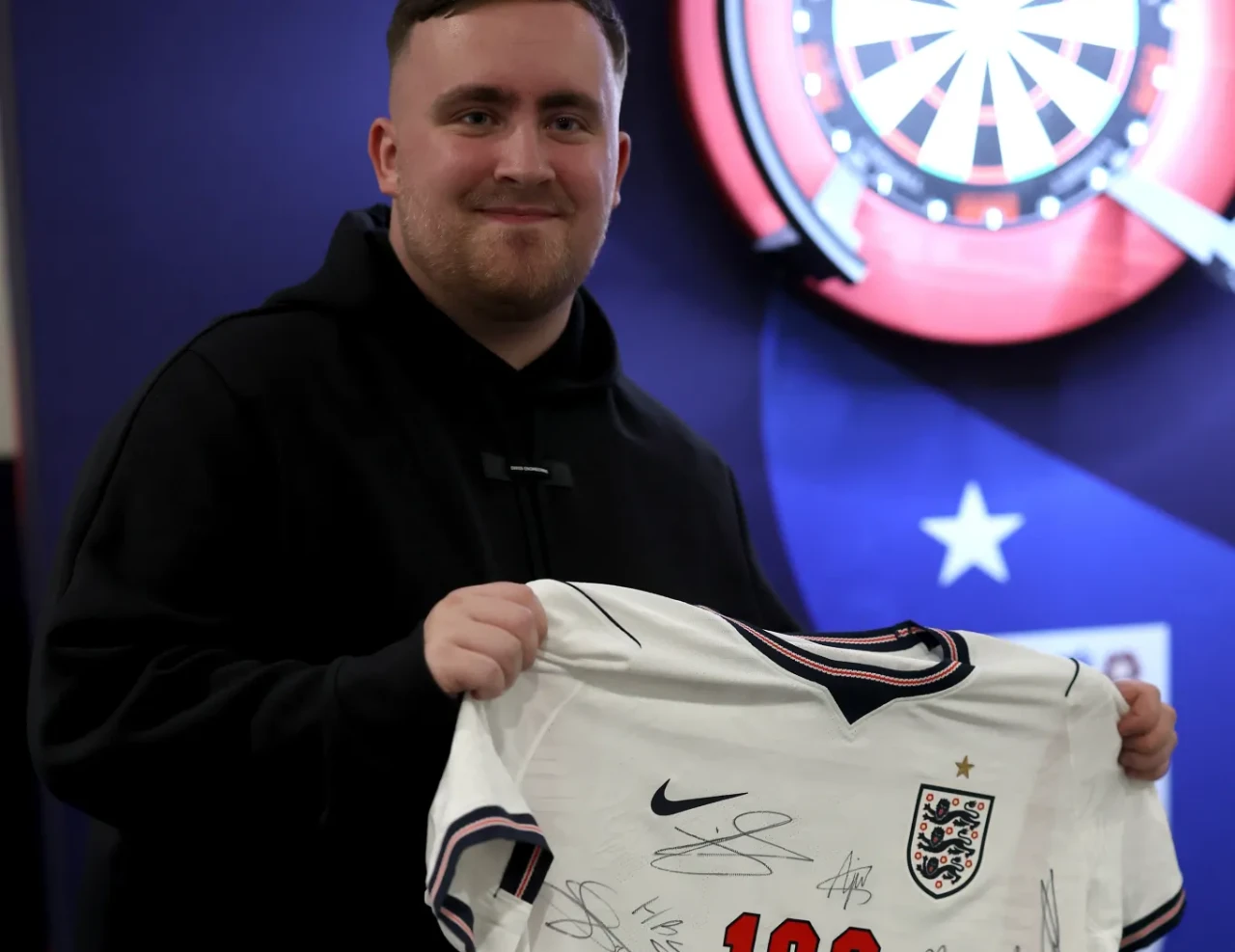
A darts champion who only just lifted a World Cup trophy is now being tipped for a completely different stage entirely — the television studio.
It sounds like something out of a scripted sports documentary, but this is very real. Fresh off a stunning World Cup of Darts triumph with Luke Humphries, teen sensation Luke Littler is already being lined up for a shock broadcasting role during the 2026 football World Cup, as broadcasters look to tap into his growing global appeal and crossover star power.
The idea that one of darts’ brightest young talents could swap the oche for a studio headset during football’s biggest tournament has sparked huge reaction across sport. At just 19, Littler is already a multi-major champion, but his influence now stretches far beyond darts — into mainstream entertainment, media, and global sport culture.
Sources indicate that ITV are among those exploring bringing Littler into their World Cup coverage plans, with the broadcaster preparing an ambitious presentation setup for the tournament in the United States, Canada, and Mexico. The network is expected to build a high-profile studio base and mix traditional punditry with celebrity guest appearances to attract younger audiences.
Littler’s name has emerged alongside a shortlist of sporting personalities being considered for cameo-style appearances, rather than full-time pundit roles. The idea is to inject personality, reach new demographics, and capitalise on figures who have recently exploded in popularity.
And few athletes fit that description better than Littler.
After his breakthrough into darts superstardom, he has become one of the most recognisable young sports figures in the UK and beyond. His rise has been so rapid that he is now regularly discussed in the same breath as established elite athletes, despite only just beginning his professional career.
His latest achievement — winning the World Cup of Darts alongside Luke Humphries — only added further momentum to his profile. The pair delivered a dominant run to the title, overcoming strong opposition and sealing victory with a commanding final performance that underlined their status as the sport’s top partnership.
That success also came with a major financial reward, as England’s triumph secured a £100,000 prize pot and reinforced their dominance on the international stage. But beyond the money, it was the statement victory that mattered most — especially after earlier criticism of their partnership chemistry.
The duo had previously faced questions over their teamwork, with inconsistencies in past tournaments raising doubts about whether they could function as a true pairing. However, their World Cup win silenced that narrative completely, with both players praising each other’s composure and resilience under pressure.
Now, while Humphries returns to focusing on individual darts success, Littler is finding himself pulled into a different kind of spotlight — one that has nothing to do with scoring 180s.
Broadcasters are increasingly interested in sports stars who can bridge audiences, and Littler’s appeal is undeniable. He represents a new generation of athlete: young, outspoken, confident, and already used to performing under intense public scrutiny.
That combination is exactly why television executives believe he could work in a broadcast setting, even if only temporarily.
The 2026 football World Cup is set to be one of the most commercially ambitious sporting events in history, with record-breaking production plans and expanded global coverage. ITV’s approach reportedly includes a visually striking studio environment in the United States, designed to bring entertainment-style presentation into traditional sports broadcasting.
Within that setup, guest contributors and celebrity appearances are expected to play a bigger role than in previous tournaments. Rather than relying solely on former footballers, broadcasters are looking at wider sporting personalities who can offer personality-driven analysis, social media reach, and crossover appeal.
That is where Littler enters the conversation.
Even though he is not a football pundit by trade, his presence could be used more as a cultural addition than a technical analyst. In modern sports broadcasting, that distinction matters. Viewers are increasingly drawn to personality-led segments, short-form reactions, and relatable sporting figures who can speak to younger audiences.
Littler’s rapid rise in darts makes him a perfect fit for that model. He has already experienced the pressures of global tournaments, intense media attention, and competing on the biggest stages in sport. That gives him credibility even outside his own discipline.
His partnership with Luke Humphries has also helped elevate his profile further. The duo are now widely seen as the dominant force in darts doubles competition, combining experience, precision, and composure in a way that has reshaped expectations for England on the world stage.
For Littler personally, the suggestion of stepping into broadcasting — even briefly — adds another layer to a career that is already expanding faster than most could have predicted. From teenage prodigy to world champion, and now potentially a media presence at football’s biggest tournament, his trajectory is anything but ordinary.
Still, those close to the situation suggest any role would be light-touch and experimental rather than a formal job. It would likely involve appearances, interviews, or feature segments rather than structured punditry.
That distinction is important, because Littler remains fully focused on darts and continuing his winning momentum. His recent form suggests there is still plenty more to come on the board, with multiple major titles already secured and further dominance expected in the coming seasons.
But the fact that broadcasters are even considering him for a World Cup role shows just how far his profile has grown.
In many ways, this is the modern sports ecosystem in action. Success on the field or stage no longer stays confined to that sport. It spills into media, entertainment, and global branding opportunities almost instantly.
For Littler, the next step may not just be about winning more darts titles — it could also be about how far his influence can stretch beyond the game itself.
And if broadcasters get their way, the next time he steps into a spotlight might not be under the pressure of a deciding leg — but under the bright lights of a World Cup television studio, speaking to millions watching across the world.