
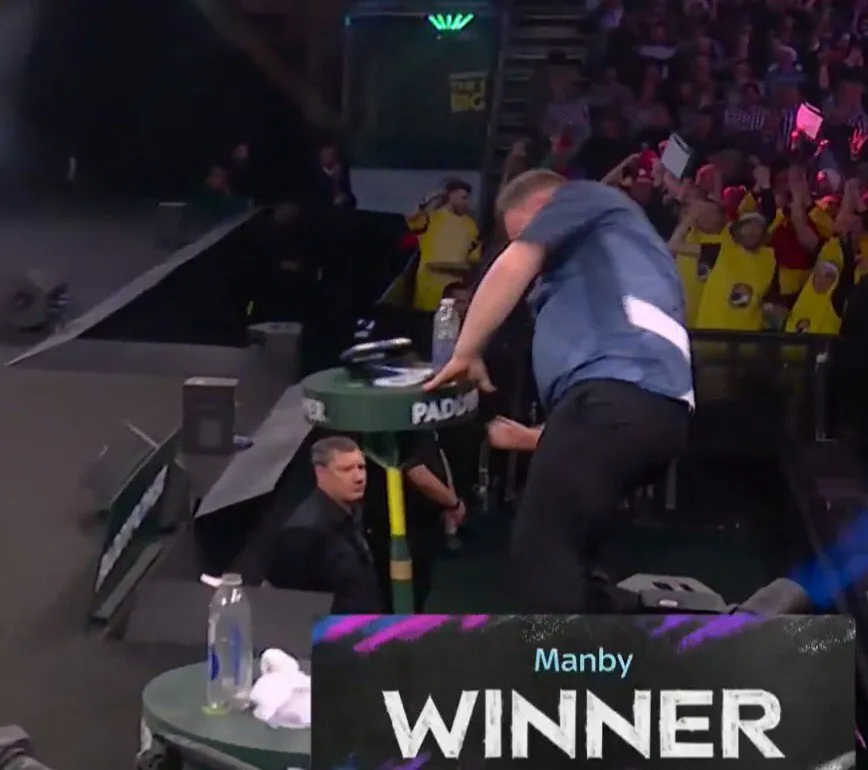
Cameron Menzies stood on the brightly lit stage at Alexandra Palace, the electric atmosphere of the PDC World Darts Championship still crackling around him. Moments earlier, he had suffered a shocking first-round exit, falling 3-2 to debutant Charlie Manby in a match that had swung dramatically in the young Englishman’s favour. What should have been a routine progression for the seeded Scot turned into a nightmare when frustration boiled over.
In a fit of uncontrolled rage, Menzies repeatedly punched the underside of a drinks table on stage. Blood immediately poured from his right hand as the crowd reacted with a mix of boos and stunned silence. Unseen in the heat of the moment was a sharp metal edge beneath the table that sliced deep into his flesh. He even appeared to press his injured hand toward stage pyrotechnics in the immediate aftermath, adding to the chaos before officials ushered him away.
The physical toll was devastating. “I had no feeling in my fingers for six weeks,” Menzies later revealed. Surgery followed quickly. Doctors cut open the hand further to inspect the damage, discovering he had narrowly avoided severing nerves and tendons. “They said when they operated on me that I was lucky that I hadn’t severed any nerves or tendons. I’d just battered and bruised them badly.” He received around 22 stitches and wore a bulky bandage resembling a boxing glove for four weeks. Even now, months later, the nerves remain numb. “I get pins and needles in my fingers. They said it won’t come back perfectly, but it should improve enough. I can hold a dart fine; it only really bothers me when it’s cold.”
The scar serves as a daily reminder. “I’ve made a massive mistake in my life and you can see from the scar, I have to live with that,” he admitted. “I was lucky it’s not as bad as it could’ve been. I’m not proud of it but I’m lucky I can still play.” In the immediate aftermath, the injury left him questioning everything. He felt close to walking away from the sport entirely. “I was struggling massively,” he confessed, describing how the damage affected his throwing hand and confidence. The incident wasn’t just a headline—it was a personal crisis that forced him to confront deeper issues with anger, anxiety, and the intense pressure of professional darts.
Rather than let the moment destroy him, Menzies chose transformation. Recognising that elite sport is as much mental as physical, he turned to hypnotherapy for support. His sessions are with the same specialist who works alongside UFC heavyweight champion Tom Aspinall and several top boxers. The therapist, known for his effective techniques with combat athletes, has become a key figure in Menzies’ recovery.
“There are a lot of players doing it that I don’t know the names of, but why not?” Menzies explained. “If there are guys fighting for UFC championships… Sport is a mental game. I like it and I am working with a guy called Ecclestone. He is great with me and has been a massive help.” Their weekly hour-long sessions begin with a relaxed 10- to 15-minute conversation. Then come the headphones and a calming soundtrack. “Nine times out of 10 he talks to your subconscious, which is the part of the brain you don’t think we need to work on,” Menzies shared. “It is scary that you don’t realise there is more to the mind that we don’t know.”
The Scotsman occasionally teases the therapist’s Northern English accent—“That is coming from a Scotsman!”—but the results are undeniable. “I have never left an appointment feeling bad. I have always done the whole hypnotherapy thing feeling good about myself.” Every night, Menzies listens to relaxation tracks to unwind and lower stress levels. “I was going through a lot at the time and maybe wanted to win too much. That was the boiling point, and I snapped. Now I listen to relaxation tracks most nights to lower my stress levels. I’m quite an anxious person, so it helps me stay calmer.”
The hypnotherapy focuses on breaking overwhelming challenges into small, manageable steps. “It tries to make your life easier and talks to your subconscious. When things get hard, you always think of a bigger problem. What he does is try to simplify it and go with the small parts first, then take steps to go further.” Initially supported for eight weeks by the Professional Darts Players Association, the therapist has continued working with Menzies beyond that period at no extra cost, recognising his genuine commitment to change. “It shows we are not just pub players anymore, we are professional athletes,” Menzies noted with pride.
This mental work runs parallel to significant physical and lifestyle improvements. Menzies has been managing an ectopic heartbeat and high blood pressure, conditions that previously left him feeling vulnerable. He has shed three stone through disciplined gym work and healthier habits, emerging fitter and more energised. “Life is a lot better!” he declared.
Nearly a year has passed since his most recent title success at Players Championship 11 in April 2025. The Ally Pally incident occurred in December 2025, and recovery has been gradual. Yet Menzies has returned to the PDC ProTour with renewed purpose. As he prepares for upcoming events, including the latest Players Championships, the 36-year-old world No. 28 or 29 carries himself differently—calmer under pressure, more resilient in defeat, and deeply aware of the unseen battles every athlete faces.
His journey from that bloodied stage at Alexandra Palace to a more balanced, mentally tuned performer offers a powerful lesson. The scar on his hand will never fully fade, and the memory of that outburst lingers. But in its place has grown a stronger version of Cameron Menzies—one who understands that true champions master not only the dartboard but also the mind beneath the surface.
Darts fans who witnessed the raw emotion that night may now see something even more compelling: a player who turned rock bottom into a foundation for growth. With hypnotherapy sessions continuing, fitness levels rising, and perspective shifting, Menzies is writing a new chapter. The road ahead includes more high-stakes tournaments, bigger crowds, and the constant demand for precision. Yet armed with tools to handle anxiety and frustration, he faces the future with quiet confidence.
In the unforgiving arena of professional darts, where milliseconds and millimetres decide fates, Cameron Menzies has learned the hardest lesson of all: sometimes the greatest victory is not on the oche, but in the silent work done long after the lights go down. His story resonates far beyond the sport—a reminder that setbacks, even self-inflicted ones, can become the catalyst for lasting change when met with honesty, effort, and the willingness to seek help from unexpected places.