
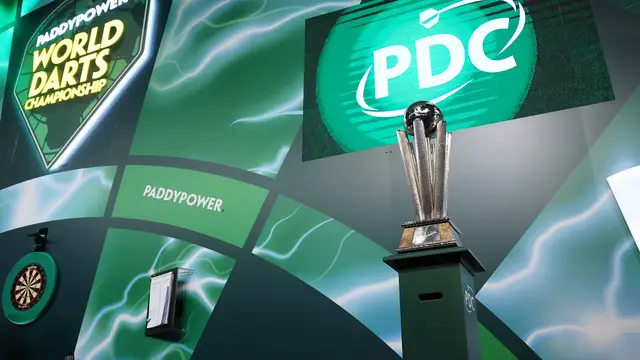
In one of the most emotional storylines to emerge from the Paddy Power World Darts Championship, veteran star Jose de Sousa saw his professional status take a crushing hit, as his journey at the top level came to an abrupt halt under the bright lights of Alexandra Palace.
De Sousa, a player widely admired for his flair, rhythm, and unique approach to the game, suffered a first-round defeat that carried far greater consequences than just elimination. The loss confirmed that he would immediately forfeit his PDC Tour Card, ending his run as a full-time professional on the circuit—for now.
At 51, the Portuguese star—fondly nicknamed “The Special One”—walked onto the stage knowing the stakes could not have been higher. Standing in his way was Ricardo Pietreczko, a rising German talent eager to make his mark. What followed was a tense and competitive clash that, at times, reminded fans of De Sousa’s brilliance during his peak years.
There were glimpses of magic. De Sousa averaged over 90, fired in six maximum 180s, and produced moments of precision that once made him one of the most feared players in the game. But despite those flashes, he was unable to sustain the level required to close out the match, eventually falling to a 3-1 defeat in sets.
It was a result that didn’t just end his tournament—it reshaped his immediate future.
The loss capped off a difficult season for De Sousa, one where consistency proved elusive. On the Pro Tour circuit, he struggled to string together deep runs, finishing 98th on the Order of Merit with earnings of £15,000. He also failed to qualify for the Players Championship Finals, a clear sign that his grip on a place among the elite was slipping.
Heading into the World Championship, the situation was already precarious. Ranked 73rd in the world, De Sousa needed a strong run to climb back into the top 64—the cutoff required to retain a Tour Card for players who have held it over a two-year cycle. Anything less would leave him exposed.
Unfortunately for him, the early exit confirmed the worst.
As he walked off stage at Alexandra Palace, the emotion was clear. This was not just another defeat—it was the end of an era. The same player who once lifted one of darts’ biggest titles was now facing the reality of stepping away from the professional tour.
That triumph, of course, came at the Grand Slam of Darts 2020, where De Sousa produced one of the most memorable runs in recent history. On his way to lifting the trophy, he defeated elite names such as Dave Chisnall, Michael van Gerwen, and James Wade—a sequence of victories that showcased his ability to rise to the biggest occasions.
That version of De Sousa was fearless, clinical, and captivating. His unorthodox counting, rapid scoring bursts, and deadly finishing made him a fan favorite and a genuine threat in any tournament he entered.
But darts can be unforgiving.
The Professional Darts Corporation’s ranking system operates on a rolling basis, meaning players must consistently perform over a two-year period to maintain their status. For De Sousa, the dip in results proved costly, and the World Championship served as the final checkpoint he couldn’t pass.
Meanwhile, for Pietreczko, the victory represents a significant step forward. The German, nicknamed “Pikachu” for his energetic presence, delivered a composed and confident display to secure progression. His reward is a second-round clash that will further test his credentials on one of the sport’s biggest stages.
For De Sousa, however, attention now turns to what comes next.
Losing a Tour Card doesn’t necessarily mean the end of a career, but it does present a major challenge. One option is to return through Q-School, the demanding qualification event where hundreds of players compete for a limited number of spots on the professional circuit. It’s a grueling route, even for experienced players, but one that offers a path back.
Alternatively, he may choose to step away from the full-time tour and explore other avenues within the sport, including exhibitions or selective appearances.
Whatever decision he makes, his legacy is already secure. De Sousa’s journey—from emerging talent to major champion—has left a lasting mark on darts. His style, personality, and achievements ensured he stood out in an era packed with elite competitors.
His story also serves as a reminder of the sport’s brutal reality. At the highest level, there is little room for decline, and even the most accomplished players can find themselves fighting to hold onto their place.
As the World Championship continues, delivering drama and unforgettable moments, De Sousa’s exit stands out as one of its most poignant chapters—a tale of past glory, present struggle, and an uncertain but still hopeful future.