
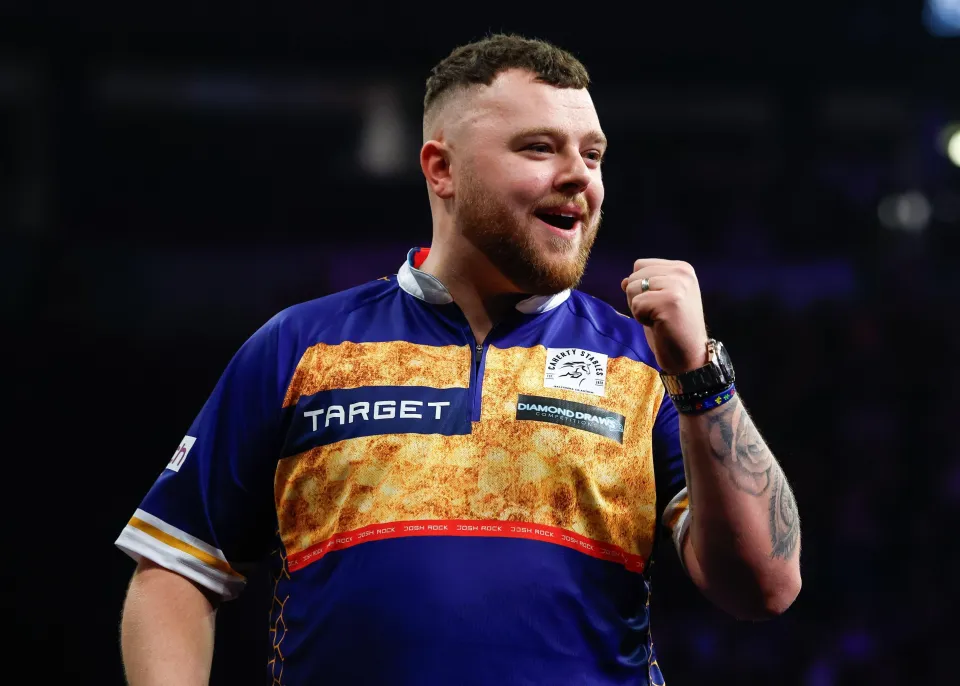
Josh Rock, the fiery 24-year-old Northern Irish darts star currently ranked world number seven, has shared a refreshingly honest and humorous take on his whirlwind transition from wide-eyed fan to battle-hardened professional on the PDC circuit. In a candid interview, the Antrim thrower—known for his explosive scoring power and no-nonsense attitude—revealed how quickly the glamour of rubbing shoulders with his childhood heroes faded into a more grounded, competitive mindset.
It all started on the very first day Rock earned his PDC tour card. Walking into the players’ room, he found himself face-to-face with the legends he had grown up idolising on television. “It was the first day when I obviously got my tour card and walked into that room, seeing Michael van Gerwen and seeing Gary,” he recalled. “The body started shaking like, f***, it’s him. Even though I’m there as a professional too.”
Among those idols was Gary Anderson, the two-time world champion whose aggressive, high-scoring style Rock has long admired and even modelled parts of his own game after. “It’s obviously fantastic. It’s weird, obviously,” Rock said of the experience. “They always say don’t meet your hero, but when I met him, he just took to me straight away. He always calls me his boy. I absolutely love it, but just obviously to be in a room with him and look at your idol, who I looked up to all my life, that’s fantastic.”
The starstruck nerves were real. Here was a young player from Northern Ireland suddenly sharing the same space as the giants of the sport—van Gerwen, the dominant Dutchman, and Anderson, the Scot with a thunderous throwing action that had inspired countless aspiring darters. For someone who had dreamed of this moment, the initial rush of excitement was overwhelming. Yet, as with many transitions into elite-level competition, the honeymoon period proved remarkably short.
Within just a month of turning fully professional, Rock’s perspective shifted dramatically—and he doesn’t shy away from admitting it with a cheeky grin. “But I think after a month, I thought, f*** them, they’re all w*****s,” he joked, capturing that classic mix of awe giving way to the raw competitiveness that defines top athletes. The heroes on pedestals became rivals on the oche, equals in the arena where only performance matters. It was no longer about starstruck admiration; it was about stepping up, proving himself, and treating every opponent as someone to be beaten rather than revered.
This rapid change in mindset speaks volumes about the mental demands of professional darts. The sport may look straightforward—three darts, a board, repeat—but the psychological journey from fan to foe is anything but simple. Rock’s quick rise through the ranks has been nothing short of remarkable. By the age of 24, he has already claimed a World Cup title for Northern Ireland (alongside his partner) and reached the semi-finals of four major tournaments. His powerful scoring, reminiscent of Anderson’s best days, has earned him comparisons to the greats and propelled him into the world’s top 10, securing a coveted wildcard spot in the 2026 Premier League Darts.
In the Premier League this season, Rock has been thrown straight into the deep end, facing the cream of the crop week after week in a high-pressure, league-format environment. While results have been mixed—he sits near the bottom of the table with limited points accumulated so far—the experience is forging him into a tougher competitor. He has shown flashes of brilliance, including a memorable nine-darter on home soil in Belfast, proving that when his scoring clicks, he can trouble anyone. The campaign has tested his resilience, with some heavy defeats alongside moments where his averages soared into the high 90s and beyond. Yet Rock remains unfazed, viewing the Premier League as essential schooling rather than a setback.
Rock often draws parallels between his game and Anderson’s, highlighting the shared emphasis on heavy scoring that can overwhelm opponents even on off days at the doubles. “The reason I always compare myself to Gary Anderson is because he won two world titles from scoring and s*** at double because he was that much of a power scorer,” he explained. “He gave himself extra darts at a double before anyone else got there. So, I find a lot of myself, a lot of Gary Anderson and me.” It’s this self-awareness and strategic insight that sets Rock apart—he studies the greats not just with admiration, but with an eye toward surpassing them in his own way.
Of course, no conversation about the current darts landscape is complete without mentioning the extraordinary dominance of Luke Littler. At just 19, the teenage sensation sits far ahead as world number one, casting a long shadow over the rest of the field. Rock is realistic about the challenge. “You can [aspire to be the best], but it’ll be a very, very long time because he’s that far in front,” he acknowledged. “I could win every single thing this year and still not be anywhere close to number one in the world. It just shows how far ahead he is. And obviously the prize money’s gone up which helps close the gap. So, I just have to keep plugging away. Hopefully, he dips in form.”
Far from being discouraged, Rock embraces the long game. Darts has no strict age limit, something he points to with optimism when reflecting on veterans still competing at the highest level. “I could have 25, 30 years at this game,” he said. “You have Peter Wright still playing who’s 56. He wishes he was 30. You’ve got Raymond van Barneveld, 58, as well. So, I’ve got a very, very long time at this game. There’s no age limit. Definitely, there’s no age limit at all, which is good.”
This perspective keeps him motivated amid the ups and downs. While some young stars chase instant fame through billboards and endorsements, Rock finds his deepest thrill in simpler, more nostalgic markers of success. “The one that gets me the most is like the football cards,” he shared with a laugh. “Obviously, growing up, the Match Attax, you were all happy you got the Ronaldo 100 Club and stuff. Then seeing a signature, one of mine, you’re like, hell, I used to collect them. Now, there’s actually ones of me. They’re the ones that get me. The ones, the billboards and stuff, I couldn’t give a s***. It’s the cards, just the cards. I’m like, f***ing hell. I used to love Match Attax when I was younger.”
That grounded attitude—rooted in the joy of the game rather than superficial trappings—has served him well through his ascent. From local competitions in Northern Ireland to global stages, Rock has stayed true to his aggressive, attacking style while adapting to the mental realities of life as a pro. The initial starstruck phase gave way not to disillusionment, but to a healthy dose of competitive fire. Turning those idols into “w*****s” in his mind (in the playful, rivalrous sense) was the spark he needed to stop shaking with nerves and start throwing with purpose.
As the 2026 Premier League season continues and major tournaments loom, Rock’s blend of youthful energy, self-belief, and hard-earned perspective positions him as a genuine contender for years to come. He knows the path to the very top won’t be quick or easy, especially with talents like Littler redefining what’s possible. But with decades potentially ahead and the lessons from his rapid mindset shift already internalized, “Rocky” is ready to keep battling—treating every opponent with respect on the board, yet never putting them back on that unreachable pedestal.
In an era where darts has never been more competitive or entertaining, Josh Rock’s story adds a relatable, human layer. From trembling at the sight of his heroes to confidently carving out his own legacy, his journey reminds fans and fellow players alike that professional sports is as much about mental evolution as physical skill. Whether he’s powering 180s or reflecting on Match Attax cards, one thing is clear: this Antrim star is in it for the long haul, and he’s not afraid to laugh along the way.