
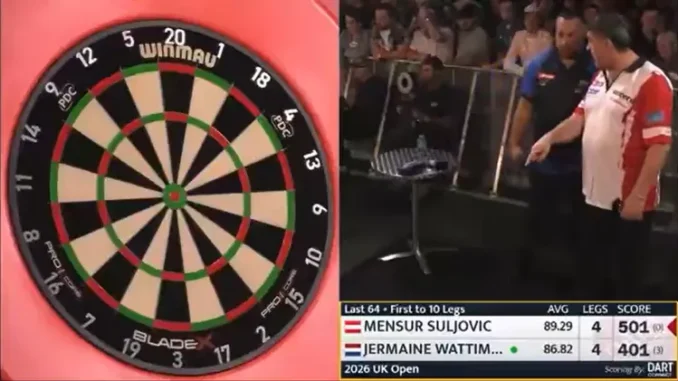
The intense atmosphere of the UK Open Darts Championship once again produced drama as Austrian star Mensur Suljović found himself at the center of controversy during his clash with Dutch opponent Jermaine Wattimena in Minehead. What began as a closely fought match between two experienced professionals quickly turned into one of the most talked-about moments of the tournament after a tense on-stage confrontation disrupted the flow of play.
Both players entered the match determined to progress deeper into the competition. Suljović, known throughout darts for his calm demeanor and deliberate pace on the oche, faced the energetic Wattimena, a player famous for his rapid throwing style and powerful scoring bursts. The contrast between their approaches created an intriguing contest from the very beginning.
The match unfolded as a tight battle, with each player trading legs and refusing to give the other any breathing room. As the tension inside the arena grew, the scoreline eventually reached a dramatic 4–4 tie. It was at this critical stage that the match took an unexpected turn.
While preparing for his next visit to the board, Suljović suddenly paused the action. He turned toward Wattimena and delivered a sharp verbal remark that immediately caught the attention of both the crowd and officials. The exact reason for the exchange was not entirely clear, but it was obvious that emotions were running high.
Some observers believed Suljović was reacting to something he felt his opponent had done during the match, possibly interpreting Wattimena’s behavior as an attempt to disrupt his rhythm. Others suggested the Austrian was responding to an earlier remark or gesture from the Dutch player. Whatever the cause, the brief exchange broke the concentration of both players and sparked murmurs throughout the arena.
The moment quickly became a talking point among spectators and fans watching the tournament unfold. In professional darts, where focus and rhythm are crucial, even a brief interruption can dramatically affect the momentum of a match.
The situation also reignited a long-running debate surrounding Suljović’s playing style. Throughout his career, the Austrian has often been associated with a slower, more methodical tempo. Supporters see it as part of his personality and approach to the game, while critics have sometimes argued that the pace can unsettle opponents who prefer a faster rhythm.
This debate intensified earlier in the season during the PDC World Darts Championship when Suljović faced England’s Joe Cullen. After losing that match, Cullen voiced strong frustration about the pace of play.
“If that’s darts, I don’t want no part of it! Always liked Mensur away from the board but that was plain for all to see,” Cullen said at the time. “I don’t think I’m alone in feeling this way. The old guard will say it’s part of the game but word it how you will—it’s cheating! That’s not darts.”
Suljović rejected the accusation and insisted there was no deliberate attempt to gain an unfair advantage.
“No, I don’t know what his problem is,” he responded. “What’s his problem? I miss doubles, everything—I’m never doing that on purpose. That’s not correct.”
The clash with Wattimena also carried echoes of an earlier disagreement between the two players. Their rivalry dates back several years, including a meeting at the World Matchplay Darts in 2019, when Suljović produced a dominant 10–1 victory.
After that match, Wattimena openly criticized the Austrian’s style, suggesting it crossed the line from tactics into unsporting behavior.
“The way I see it, you can call it gamesmanship or whatever you want, but in my eyes it’s cheating,” Wattimena said at the time. “I’ve never ever been called a cheat in my life.”
However, he later softened his stance and apologized for the remark, acknowledging that emotions had been running high after the defeat.
Back in Minehead at the UK Open, the latest flashpoint only added another layer to their complicated rivalry. Despite the interruption and the tension surrounding the exchange, Suljović eventually regained his focus and composure.
Drawing on his experience, he steadied his performance and secured the crucial legs needed to close out the match. The win ensured his progression into the last 32 of the tournament, while Wattimena was left to reflect on a contest that ended amid renewed debate.
Moments like these highlight the psychological battles that are often just as important as the scoring power displayed on the dartboard. Professional darts has evolved dramatically over the past few decades, transforming from a pub pastime into a global spectacle played in packed arenas and broadcast to millions of viewers.
With that growth has come greater scrutiny of player behavior and sportsmanship. Incidents involving pacing, crowd reactions, or on-stage exchanges frequently spark discussions among fans about where the line should be drawn.
For some supporters, the mental tactics and emotional intensity are part of what makes darts so captivating. Others believe stricter officiating might be needed when disputes interrupt play.
As the tournament continues, Suljović’s performances will likely remain under close watch—not just for his scoring ability but also for how he handles the spotlight that often follows him. Love him or criticize him, the Austrian remains one of the most distinctive personalities in the sport.
And as this latest incident shows, in darts the drama does not always come from the perfect throw alone. Sometimes, the most compelling battles happen away from the dartboard, where psychology, pride, and pressure collide. 🎯