
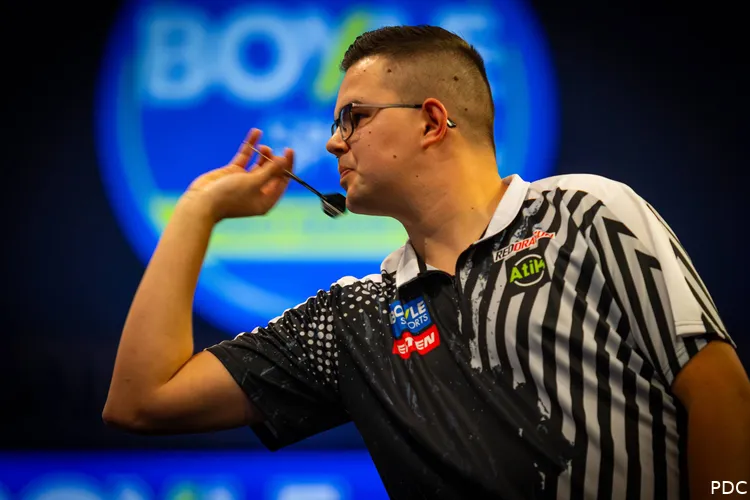
In the roaring heart of Manchester’s AO Arena, where the crowd pulsed with anticipation and the bright lights of the oche cast long shadows across the stage, Premier League Darts served up a quarter-final that will linger in the memory long after the final dart of the night had flown. It wasn’t just the scoreline that mattered—though that was dramatic enough—but the raw, unfiltered tension that crackled between two of the sport’s brightest stars: 19-year-old world number one Luke Littler, the local hero from nearby Warrington and a die-hard Manchester United supporter, and Gian van Veen, the rising Dutch talent who had already reached the World Darts Championship final and was fighting his way back from injury.
Littler had arrived in Manchester on a roll, fresh from back-to-back nightly victories in Dublin and Berlin that had catapulted him to the top of the Premier League table. The home fans were behind him every step of the way, chanting his name and willing him toward a third straight triumph on British soil. Van Veen, by contrast, had endured a tougher campaign. Still recovering from kidney stone surgery that had forced him to miss earlier nights, he hadn’t tasted victory in the league since week four. Yet on this Thursday evening, the 2025 World Championship runner-up showed exactly why he belongs among the elite, producing a performance laced with grit, precision, and no small amount of fire.
The match itself unfolded like a classic darts thriller. Van Veen stormed into an early 4-1 lead, punishing Littler’s occasional lapses with clinical finishing. The young Englishman, however, refused to lie down. He clawed his way back to 4-3, and as the legs ticked by, the pressure mounted. At 5-3, Van Veen stood on the brink of victory, needing just one more double to seal the win. He stepped up for double 15—but the dart landed on the inside wire. The miss hung in the air like a challenge. What followed was pure theatre.
Littler, sensing the shift, turned toward the crowd and celebrated the error with unmistakable gusto, arms pumping in front of the partisan Manchester faithful. The needle was immediate. Van Veen, visibly fuming at himself and now at his opponent’s reaction, shot a glare across the stage. Littler responded with a mocking crying gesture toward the spectators, as if to underline the moment. The decider became a war of nerves. Littler stepped up for his own match-winning opportunity at double seven—but he missed three times. Van Veen pounced, closing out the leg and the match 6-5 in a blaze of defiance. A brief, icy handshake followed, but the fire between them was far from extinguished.
Speaking moments after his quarter-final triumph, Van Veen didn’t hold back. He branded Littler’s conduct “out of order” and labelled the world champion “a bad loser.” Celebrating an opponent’s miss, he argued, crossed a line that really annoyed him. “I’m on 90, I miss double 15 on the inside, and then I see him celebrating towards the crowd. I don’t think that’s normal,” he explained. “And then he also makes that crying gesture. He’s a fantastic darts player, but today he showed he’s not a good loser. Celebrating a miss from your opponent, that really annoys me. That’s why I gave him a look. The fact he then misses three darts at a double, that’s his problem.”
Van Veen went on to reach the final that night, only to suffer his fourth nightly final defeat of the season. Yet the real story was the simmering rivalry that had just been born—or at least dramatically reignited—under the Manchester lights. Littler, never one to shy away from the spotlight, responded in his own way. On his Instagram stories, he shared a screenshot of Van Veen’s post-match comments and added three laughing emojis, a cheeky dismissal that suggested he found the Dutchman’s reaction more amusing than concerning.
Days later, Van Veen doubled down when asked about the exchange by Swedish streaming service Viaplay. The pair had not spoken since the clash, and there had been no olive branch extended. “No, we haven’t spoken,” Van Veen confirmed. “He hasn’t approached me either. I saw his reaction on social media. He thought it was funny. Well, I don’t think things will be very friendly between us anytime soon. I’m here for myself. He’s a fantastic darter, the world No 1, so what he does for the sport is great, but I care little about what he thinks of me.”
It was a statement that cut through the usual post-match pleasantries. Van Veen made it crystal clear: respect for Littler’s talent and his transformative impact on darts—drawing huge crowds, boosting TV audiences, and inspiring a new generation—did not extend to personal affection after what happened on stage. The Dutchman was playing for himself, focused on climbing the table and proving his worth after a rocky start to the league phase.
Not everyone saw the incident as a lasting rift. Defending Premier League champion Luke Humphries, who knows the pressures of life at the top better than most, offered a more sanguine perspective. “It comes with the territory,” Humphries said. “We’ve seen it many times over many years. Players have done it here and there, and sometimes you probably think ‘oh God, I wish I hadn’t done that now’. It’s hot news right now, isn’t it, but in two weeks it’ll all be forgotten. No-one will remember it and we’ll all move on. That’s my take on it.”
Whether the spat fades or simmers depends, of course, on what happens next. The Premier League Darts rolls on to Night 10 in Brighton next Thursday, where the paths of Van Veen and Littler could cross again in the semi-finals. Van Veen faces Michael van Gerwen in an all-Dutch quarter-final, while Littler takes on Stephen Bunting. A win for both would set up a rematch loaded with extra spice. Ranking points remain the currency of the league—five for the nightly winner, three for the runner-up, two for semi-finalists—with the top four progressing to Finals Night at London’s O2 on May 28.
Beyond the immediate drama, the episode highlights the unique intensity of professional darts. In a sport where players stand metres apart, staring each other down under bright lights with thousands watching, emotions run high. Littler, still only 19, has carried the burden of being the sport’s biggest draw with remarkable poise, but even he is human. Van Veen, battle-hardened from his World Championship run and recent health battles, refuses to be intimidated. Their clash in Manchester wasn’t just about one leg or one gesture; it was a reminder that behind the 180s and checked finishes, darts is a game of mental warfare as much as skill.
The Premier League has always thrived on these storylines—rivalries that capture the imagination and keep fans glued to their screens. Littler’s meteoric rise has already changed the landscape, filling arenas and boosting the sport’s global appeal. Van Veen’s fearless approach shows that the new generation is ready to challenge the established order. Whether their relationship thaws or remains frosty, one thing is certain: when these two meet again, the darts will be sharp, the atmosphere electric, and the narrative even richer.
As the league heads toward its climax, nights like the one in Manchester remind us why this format is so compelling. Every throw carries weight. Every reaction can spark a headline. And every rivalry has the potential to define a season. Van Veen may care little about Littler’s opinion right now, but the rest of the darts world is watching with bated breath to see how this chapter unfolds. The oche awaits, and the next round of fireworks could be just around the corner.