
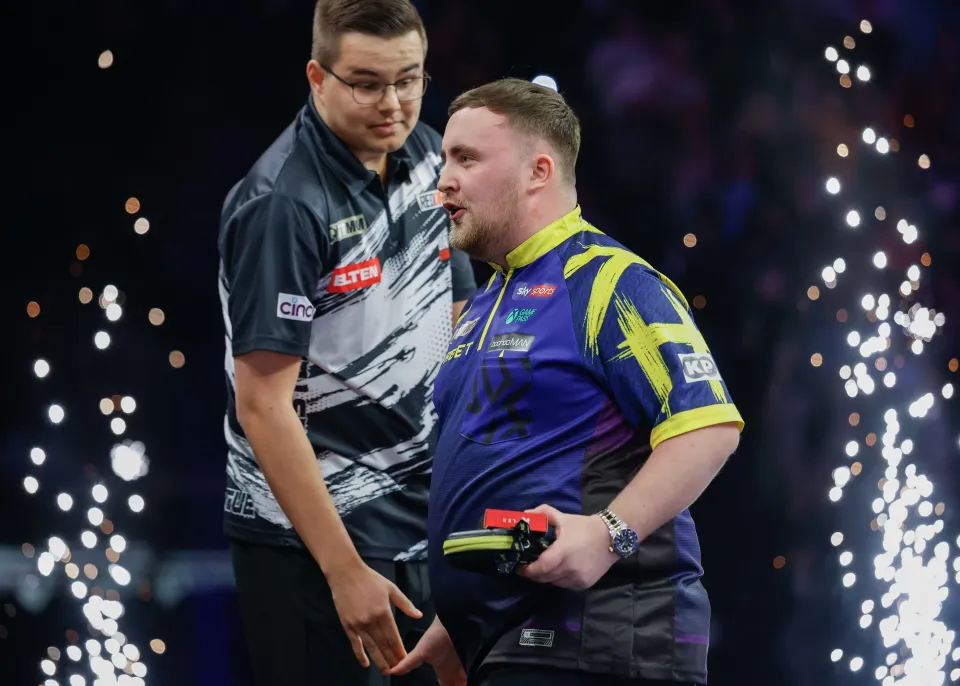
The electric atmosphere inside Manchester’s AO Arena crackled with anticipation as two of darts’ rising stars squared off in a Premier League Darts quarter-final that would soon descend into one of the most bad-tempered encounters of the young season. Luke Littler, the 19-year-old world number one and two-time world champion affectionately known as “The Nuke,” faced off against the talented Dutchman Gian van Veen. What began as a high-stakes battle of precision and nerve quickly spiraled into a fiery confrontation, leaving pundits, players, and fans alike debating the boundaries of sportsmanship on the oche.
The match itself was a thriller from the outset. Van Veen stormed into an early 4-1 lead, showcasing the clinical finishing that had made him a formidable opponent throughout the campaign. Littler, playing in front of a raucous hometown crowd that roared his every success, clawed his way back level at 5-5, turning the contest into a nail-biting decider. With the tension mounting and the crowd on its feet, the drama reached its boiling point in the decisive leg.
Van Veen found himself on 90, staring down a potential match-winning double 15. His dart landed inside the wire—frustratingly close but not quite there. As the Dutchman turned away momentarily, visibly annoyed with himself, Littler seized the moment. Instead of maintaining a neutral stance, the teenage sensation began celebrating the missed opportunity, pumping up the partisan Manchester audience who responded with enthusiastic cheers and boos directed at Van Veen.
“I was on 90, I miss double 15 on the inside, and then I see him celebrating towards the crowd. I don’t think that’s normal,” Van Veen later recounted in the heat of the post-match interview. “And then he also makes that crying gesture. He’s a fantastic darts player, but today he showed he’s not a good loser. Celebrating a miss from your opponent, that really annoys me. He was celebrating me missing double 15. That’s out of order. I was fuming about that.”
The exchange escalated rapidly. Van Veen turned back toward his rival, his expression one of clear disbelief and irritation. Littler responded by throwing his arms into the air in a dismissive gesture, as if urging his opponent to hurry up and get on with the throw. Words were exchanged on stage—sharp enough that commentator Wayne Mardle, watching intently from the booth, later admitted he could lip-read them but chose not to repeat what was said to avoid any professional repercussions.
Littler then stepped up to the oche with the chance to close out the match himself, needing three darts at double seven. In a rare moment of faltering under pressure, he missed all three, the darts failing to find their mark amid the simmering hostility. As he walked away from the board, still visibly agitated, Littler directed a mocking “cry baby” gesture toward Van Veen, further inflaming the situation. The brief handshake at the end of the match felt anything but cordial, with the bad blood palpable even as Van Veen secured the 6-5 victory.
For the Dutchman, the incident struck a deep chord. Having previously lost to Littler in the World Championship final at Alexandra Palace earlier in the year, Van Veen made no secret of his frustration. “From my perspective I missed the double 15 and I looked around. He was celebrating me missing and I was like that is out of order,” he explained. He emphasized that while he admired Littler’s undeniable talent and the global attention the young Englishman had brought to the sport, this particular display crossed a line. “I love Luke to bits, he’s a fantastic player and guy for the sport… but today was my day.”
The controversy didn’t end on the stage. In the Sky Sports studio and beyond, reactions poured in, highlighting just how unusual the outburst seemed from a player who had largely built his meteoric rise on composure and crowd-pleasing charisma. Former professional darts player and Sky Sports pundit Mark Webster, a veteran of the sport known for his measured insights, was particularly vocal about his surprise. Speaking exclusively in the days following the clash, Webster admitted he was left utterly stunned by Littler’s conduct.
“I was a bit flabbergasted by it all really. I don’t see what the problem was for Luke, and I think Gian conducted himself really well,” Webster said. His astonishment stemmed from the expectation that Littler, despite his youth and the intense pressures of Premier League nights, would rise above such reactive behavior. Webster’s comments resonated widely, as many in the darts community echoed the sentiment that the celebration of an opponent’s miss, followed by the emotional gestures, felt out of character for the sport’s young superstar.
Other voices in the broadcast booth offered their own takes. Wayne Mardle, another respected pundit, broke down the sequence in real time and afterward, describing how Littler appeared to give a “Simon Whitlock ‘well done'” reaction to the missed double—a subtle but provocative nod that clearly irked Van Veen. “You shouldn’t do that,” Mardle noted, underscoring the unwritten rules of etiquette that typically govern darts matches, where players often maintain stoic professionalism even in defeat.
The incident sparked broader conversations about sportsmanship in darts. The sport has long prided itself on its unique blend of fierce competition and mutual respect, with players frequently sharing laughs and pints after even the most intense battles. Littler’s rapid ascent—from teenage sensation to world champion—has brought unprecedented mainstream attention, filling arenas and boosting viewing figures. Yet moments like this raise questions about the growing pressures on young athletes thrust into the spotlight. Is such raw emotion a sign of passion, or does it risk tarnishing the image of a player who has otherwise been celebrated for his maturity beyond his years?
Fans were divided in the aftermath. Supporters of Littler pointed to the electric home crowd and the high stakes of Premier League night, arguing that competitive fire is what makes the sport thrilling. Others sided with Van Veen, viewing the celebration and subsequent gestures as poor form, especially from the world number one who is expected to set an example. Social media buzzed with debates, memes of the “cry baby” gesture, and calls for both players to move on.
In the days since, Littler has not publicly elaborated extensively on the clash, though the darts world continues to dissect every angle. Van Veen, for his part, suggested the rivalry might carry a lingering edge. “I expect the hostility with Luke Littler to linger,” he hinted, while also acknowledging the bigger picture: both men are elevating the sport with their talent.
Darts enthusiasts know that rivalries often fuel the drama that keeps audiences hooked—think of the legendary battles between Phil Taylor and Raymond van Barneveld or the intense modern clashes involving Gerwyn Price. This latest chapter between Littler and Van Veen fits into that tradition, blending skill, emotion, and controversy into compelling theater. Yet it also serves as a reminder that even the most gifted athletes are human, capable of letting frustration boil over in the heat of battle.
As the Premier League Darts season progresses, all eyes will be on whether this fiery encounter becomes a footnote or the spark for a more sustained personal rivalry. Littler remains the dominant force, his scoring power and finishing ability still the benchmark for others. Van Veen, meanwhile, has proven he can go toe-to-toe with the best and stand his ground when provoked.
For now, the darts community reflects on a night where talent met temperament. Webster’s “flabbergasted” reaction captures the collective surprise: a young phenom whose journey has been marked by record-breaking achievements suddenly showing a more raw, unfiltered side. Whether it was a momentary lapse or a glimpse into the intense pressures of stardom, one thing is clear—the oche remains a stage where emotions run as high as the scores, and every dart can ignite more than just a treble twenty.
The sport’s ability to forgive and forget such incidents is legendary, with many predicting the dust will settle quickly. As one observer noted in the wake of the event, hot controversies in darts often fade within weeks as the focus shifts back to the next leg, the next maximum, and the next title chase. Still, for those who witnessed the Manchester meltdown, the images of Littler’s animated gestures and Van Veen’s steely response will linger as a vivid reminder of just how personal—and passionate—the game can get.