
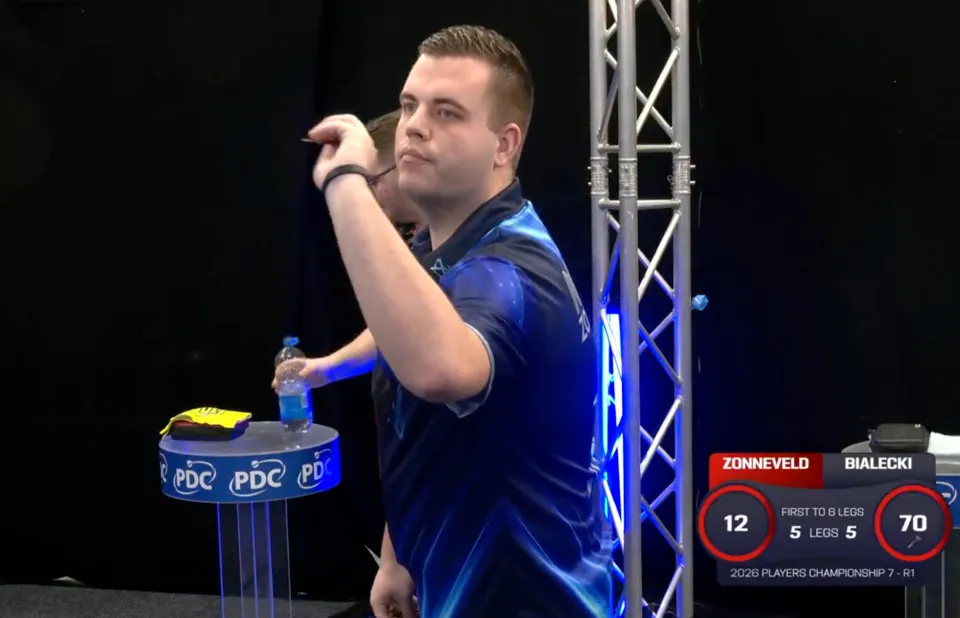
In the brutal, razor-sharp theatre of professional darts, where legends are forged in milliseconds and hearts are shattered just as quickly, Niels Zonneveld experienced one of the most agonising rollercoasters a player can endure. The 27-year-old Dutch talent, nicknamed “Triple Z,” stood on the precipice of perfection during a last-leg decider at Players Championship 7 in Leicester. Tied at 5-5 against Poland’s promising 22-year-old Sebastian Bialecki, Zonneveld produced a sequence that had the arena buzzing with electric anticipation—only for the dream to collapse in spectacular, heartbreaking fashion.
Zonneveld kicked off the deciding leg with a thunderous maximum 180. On his very next visit, he repeated the feat with another flawless 180. The crowd sensed history in the making. A nine-darter—the rarest and most celebrated achievement in the sport—was suddenly a genuine possibility in the most high-stakes moment imaginable: a match-deciding leg. With the finish line in sight, Zonneveld lined up double 12 to complete the perfect leg and seal victory. One clean dart would have written his name into darts folklore and delivered an instant classic.
But darts is a game that revels in its cruelty. The dart drifted agonisingly off target, missing the double 12 and handing Bialecki a lifeline when the young Pole still required a daunting 265 to keep the match alive. What unfolded next defied belief. Zonneveld, clearly rattled but determined, stepped up to the oche with not one, not two, but seven separate opportunities to close out the contest and claim the win. Time and again, his finishing deserted him at the critical juncture. Darts sailed wide, fell short, or simply refused to find the wire.
The tension inside the venue became almost unbearable. Fans watching live and those streaming online could scarcely believe the unfolding drama. Bialecki, showing remarkable composure for his age, stayed alive through every miss. When the Pole finally returned to the oche, he needed just 70. With ice in his veins, Bialecki executed perfectly: a single 18, followed by a 20, and then the decisive double 16. In one clinical visit, he stole the leg and the match, securing a stunning 6-5 victory.
Social media erupted instantly with a mixture of disbelief, sympathy, and dark humour. One fan captured the collective sentiment perfectly with the words that quickly went viral: “That’s a sickener.” Others piled on with raw reactions: “Bottled it. Seven match darts and still couldn’t close the deal. That’s a howler.” Another observer noted, “That’s why you never give up in a leg. Anyone can miss multiple match darts.” Clips of the near-nine-darter and the subsequent collapse spread rapidly across platforms, turning the match into one of those unforgettable “what if” moments that darts fans debate and replay for years to come.
For Zonneveld, the pain cut deep. Just weeks earlier, he had stunned the darts world with a notable upset victory over world number one Luke Littler, proving he possessed the game to compete at the highest level. He had also pushed established star Jonny Clayton all the way in the semi-finals of the Belgian Darts Open, showing real signs of form and growing confidence. Reaching the later stages of Players Championship events is no small achievement—these floor tournaments form the relentless backbone of the PDC calendar, where players grind through multiple matches daily to earn vital ranking points and prize money while honing their skills for major televised occasions.
Yet this defeat represented the sharpest of reminders about the fine margins in elite darts. Two opening maximums had ignited hopes of a nine-darter glory; seven missed match darts later, the Dutchman was left staring at defeat. The swing in momentum was as swift as it was merciless. Bialecki, by contrast, demonstrated the fighting spirit and opportunism that mark a dangerous contender. At just 22, the Polish thrower capitalised on every opening left by Zonneveld, maintaining composure when the pressure was at its absolute peak. Snatching victory from such an improbable position will provide a significant confidence boost as he continues his climb up the rankings.
The encounter perfectly illustrated why professional darts remains one of sport’s most compelling spectacles. It demands not only technical precision and consistent scoring but also unbreakable mental resilience. A nine-darter attempt in a decider already carries enormous pressure; missing it and then failing to convert seven match darts turns ecstasy into agony in the space of minutes. Zonneveld’s brave charge for perfection ensured the match would live long in the memory, even if the final result went against him.
As the 2026 Players Championship series rolls on, both players will draw valuable lessons from this dramatic clash. Zonneveld will no doubt focus on sharpening his finishing under extreme duress, converting those hard-earned opportunities into victories. Bialecki will carry the belief that comes from staying alive when all seemed lost, a quality that can propel a young talent forward in a highly competitive field.
For the wider darts community, the episode served as a thrilling reminder of the sport’s unpredictability. One missed double can transform certain triumph into devastating defeat, while one recovered checkout can rewrite the entire narrative. In the end, Sebastian Bialecki walked away with the win, but Niels Zonneveld’s courageous attempt at perfection in the deciding leg guaranteed that this match would be remembered far beyond the final scoreline.
That’s the merciless magic of darts: the sublime heights of two 180s and a near-nine-darter, followed by the ridiculous collapse of seven missed match darts, all packed into one unforgettable leg. It’s a sickener for the loser, an inspiration for the winner, and pure entertainment for everyone watching. As the tour continues, fans will keep tuning in, forever wondering what fresh drama the next deciding leg will deliver.