
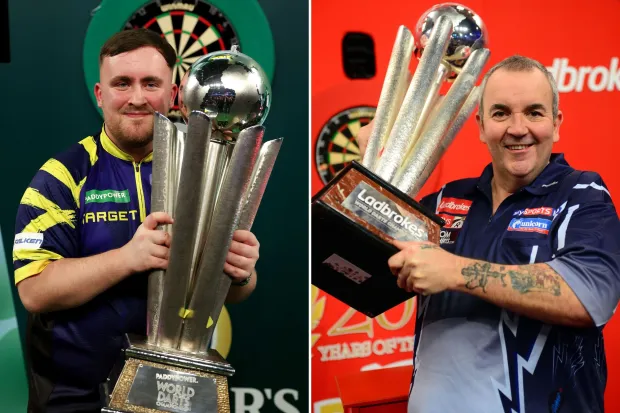
Phil Taylor grew up in a house his parents bought for £100. The upstairs was condemned. His dad knocked a brick out of the wall so they could run an extension lead to the neighbour’s electricity. At 17 he was a sheet metal worker. Luke Littler, at the same age, was already a millionaire and a world champion.
That gap is the whole story.
Taylor has spent the last couple of years talking about Littler with a mix of pride and old-school honesty. The 16-time world champion keeps coming back to the same point. Their careers started in different universes, and money sat at the centre of his.
He has never dressed it up.
“I started entering competitions and winning them. Instead of working in a factory earning £70 a week, I could earn £500 on the weekend. That’s why I took it up. I would’ve never become a professional if I couldn’t have earned money.”
That is not a throwaway line. That is the origin story of the greatest player the sport has produced. Darts was not a calling first. It was a way out.
Two different starting lines
Taylor has explained how he treated the cash even after the titles piled up.
“I only ever paid myself a wage. The bulk of my money was in a limited company. I was never a rich fella. If I played in the first Players tournament of the season and won, I think it was £10,000, my theory was that’s the gas and electric paid for the year. If I won the next, which I did, then that was my food bill, my road tax, the insurance on my cars. I was always playing for something.”
Then the kicker.
“But it’s all different now. They get paid for showing up.”
He has said similar things elsewhere. At one event he recalled paying himself £200 a week so he stayed hungry.
“I could have had £1million, £2m, £3m in the bank, but a hungry lion will fight harder than a lion that hasn’t eaten. You have got to keep yourself hungry. I had 30 houses, I was worth millions, but in my opinion that basic wage was all I was worth.”
Littler does not live that life. He does not need to. Prize funds have exploded. A world title that once paid Taylor £12,000 now pays seven figures. Appearances, sponsors and a Target deal sit on top. The teenager has already earned more in a couple of seasons than most players manage in a career.
Taylor sees that difference clearly. He has also said, more than once, that money is not what drives Littler.
“Luke isn’t motivated by money – he just likes winning.”
And later: “What is good for his forte for me is he’s not money orientated. He isn’t interested in money. He doesn’t have big posh cars or big flashy watches and gold hanging round his neck. He’s just a normal teenager.”
That is the contrast Taylor keeps drawing. He needed the next cheque. Littler, in Taylor’s view, just wants the next win.
The awkward bit Littler said himself
Here is where it gets interesting, because Littler has not always sung from that hymn sheet.
Asked on the Stick to Football podcast what would keep him going long enough to chase Taylor’s 16 world titles, he answered: “Probably just the money, to be fair.”
He still called Taylor his idol. He still said the record would take some doing. He also said the field is stronger now and that Taylor “would struggle” in the modern era. Then he added that if he can be bothered to stay around, he might beat the record. If he wants to, he will.
That is a 19-year-old talking, not a pension plan. It does not cancel Taylor’s reading of him. It does show the two men are not describing the same engine.
Scott Mitchell, a former world champion from a different generation, looked at it another way. He wondered whether Littler’s bank balance becomes the problem, not the solution.
“I think the biggest thing that’s going to impact on Littler’s dominance is how much money he wants. How much money does he need to live, or how much money do you earn to keep your hunger to want to keep winning?”
Mitchell’s take on Taylor was the opposite of Taylor’s own: “For Phil, the money was never the issue, it was always the title, always the accolade that he liked.”
So even the old heads do not fully agree on what made The Power tick. Taylor says bills and wages. Others say silverware. Both can be true. A man can hunt titles because titles paid the gas.
Why this actually matters
Littler has two world titles before most players have a proper tour card. Taylor won his first world title at 29. That age gap is brutal if you care about records. It is also a trap. If money is already sorted, what keeps a teenager on the road for another 15 years of floor events, late nights and hostile rooms?
Taylor’s method was almost monastic. Arrive early. Practise. Leave. Stay a bit antisocial. Pay yourself a wage so you never feel rich. Put the rest in a company and in houses. He even put up £40,000 of his own money when the rebel players broke from the BDO to form the PDC.
“When you’ve got £45,000 in the bank, that took a lot of guts, but it was well worth it.”
Littler’s method looks lighter. Short practice. Phone out. Games. Family first. Taylor has praised that too. He has also told him to stay off social media, split his money for tax, and invest in case he “fall[s] down and break[s] [his] arm.”
That advice is the closest thing we have to Taylor handing over the keys. Look after the money. Do not let the noise in. Stay hungry even when you do not have to be.
The sport around them has changed as well. Players get appearance money. Majors pay fortunes. Crowds are younger. The calendar is heavier. Taylor built the modern PDC and then watched it become something he never had at 17. He says he is proud of that. You can hear the pride and the distance in the same sentence.
What happens from here
Nobody serious thinks Littler is finished. The question Taylor is really asking is about stamina of the mind, not the arm. Can a kid who never had to worry about the electric bill keep living like every tournament still pays the bills?
Taylor kept himself poor on paper so he stayed sharp. Littler does not have that option in the same way. The money is already there. The fame is already there. The comparison will follow him until he either gets close to 16 world titles or walks away earlier than the record demands.
That is the huge difference Taylor keeps pointing at. One man turned darts into a living because the factory wage was not enough. The other turned darts into a living before he could legally buy a pint.
Both can be great. Only one of them had to be hungry just to keep the lights on.
Do you think Littler needs that old hunger to last, or is winning enough on its own now?