
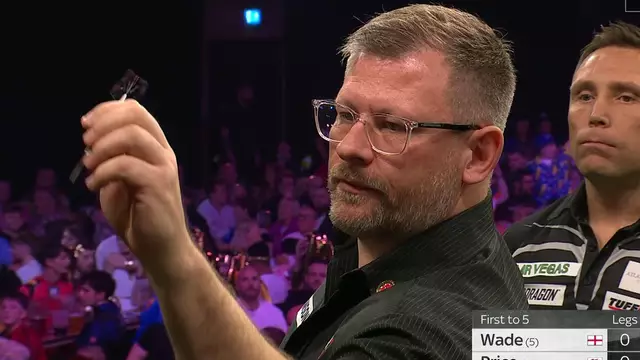
James Wade may have been eliminated from the 2025 Grand Slam of Darts after only two matches, but it was his walk-on that became one of the tournament’s most talked-about moments.
The veteran Englishman appeared to ignore fresh PDC guidance designed to speed up player entrances, repeatedly stopping to sign autographs and interact with supporters before finally making his way to the stage.
And standing there waiting was Gerwyn Price.
The Welshman, who knows Wade well, could only laugh at the situation. What followed was a light-hearted exchange between two friends, but it also highlighted a wider issue the PDC was trying to address at one of its biggest tournaments.
The new PDC guidance
The 2025 Grand Slam of Darts brought a change to the way the players approached their walk-ons.
Ahead of the tournament, the PDC issued a briefing reminding players to be ready to make their way towards the stage once the MC announced them. The organisation had become increasingly concerned about lengthy entrances, particularly as players stopped for selfies and autographs.
The message was not actually a ban on interacting with supporters.
LiveDarts reported that players were encouraged to sign autographs before reaching the end of the walk-on rather than stopping on the return journey to the stage. The PDC also stressed that players should be facing forward when their names were announced. (LiveDarts)
It was essentially an attempt to keep the show moving.
That makes sense from a television perspective. The Grand Slam schedule is packed, broadcasters have fixed time slots and delays can quickly create problems later in the session.
But then James Wade came along.
Wade does things his own way
Wade has developed a reputation for taking his time during walk-ons and regularly stopping to sign autographs.
At the Grand Slam, that habit became particularly noticeable because the tournament was using individual walk-ons during the group stage rather than the joint entrances that had been used at previous editions. (LiveDarts)
When Wade was introduced against Price, the difference between the two approaches was obvious.
Price had already reached the stage and was waiting while Wade continued to interact with supporters.
There was no suggestion that Wade was deliberately trying to cause trouble, and the PDC itself made clear that players had not been prohibited from signing autographs.
Still, the timing made the moment hilarious.
Wade kept stopping, fans kept getting their opportunity and Price was left waiting for his opponent to arrive.
For a player as experienced as Wade, it was hardly surprising that he was prepared to bend the spirit of the new guidance in the name of giving fans a memorable experience.
Price had the perfect response
Once Wade finally arrived, Price apparently joked about whether his friend had actually read the briefing.
“I said to him ‘come on, did you not read the players’ briefing?!’” Price said afterwards. (SPORTbible)
He then explained the relationship between the two players and suggested Wade’s antics could sometimes be part of his psychological approach.
“He’s a good friend, and sometimes he tries getting in your head a little bit, and it does work now and again, but not today.” (SPORTbible)
That last part is important.
There was no genuine feud here.
Price and Wade are friends, and their exchange appeared to be nothing more than two experienced professionals having a laugh at the situation.
But Price also made it clear that Wade’s reputation for getting into opponents’ heads is real.
And against a player with Wade’s experience, even a seemingly harmless delay can become part of the theatre surrounding a match.
The Machine had bigger problems on the night
Unfortunately for Wade, the walk-on was probably the most enjoyable part of his afternoon.
Once the darts started, Price produced a ruthless performance.
Wade had already suffered a narrow 5-4 defeat to Stefan Bellmont in his opening Group D match, leaving him under serious pressure. Price had also lost his opener, going down 5-4 to Ricky Evans.
That made their meeting a genuine must-win contest.
Price delivered.
The Welshman whitewashed Wade 5-0, averaging over 100 and finishing with a 100 per cent checkout percentage. Wade averaged 87 and did not get a single opportunity at a double. (SPORTbible)
That statistic tells the story better than anything else.
Wade never really got into the match.
Price was clinical from the beginning and quickly turned what had looked like an intriguing battle between two friends into a one-sided contest.
Wade had no chance to turn the walk-on mind games into an advantage.
A difficult tournament for Wade
The early exit was especially disappointing given Wade’s reputation at the Grand Slam.
Before the tournament, Sporting Life noted that he had only failed to reach the knockout stages once in his previous 17 appearances at the event. He also arrived in Wolverhampton having enjoyed an excellent 2025 on the major stage, reaching finals at both the UK Open and World Matchplay. (Sporting Life)
His run at the World Matchplay had been particularly impressive.
Wade reached the final at Blackpool before losing to Luke Littler, continuing a season in which he had repeatedly shown that his experience remained a major weapon against the newer generation.
So expectations were understandably high.
Instead, he lost his first two group matches and was eliminated before the final group game.
That is the brutal nature of the Grand Slam format.
There is very little room for a slow start.
Wade himself had acknowledged before the tournament that the opening matches were crucial, saying: “If you don’t start well, you’re in trouble.” (Dartsnews.com)
Unfortunately for him, that prediction proved accurate.
The bigger debate over walk-ons
The Wade incident also raises an interesting question about what the PDC wants its televised product to look like.
Walk-ons are a huge part of modern darts. The music, the costumes, the crowd interaction and the personalities have helped transform darts into a major entertainment product.
For many fans inside the venue, getting close enough to a player to receive an autograph can be one of the highlights of attending an event.
But television viewers see things differently.
When a player takes several minutes to reach the stage, the broadcast can lose momentum and the next match can be pushed back.
The PDC’s position appears to be a compromise: interact with fans, but do it in a way that does not interfere with the timing of the show. The organisation specifically said players had not been banned from signing autographs and that appropriate crowd interaction was still encouraged. (LiveDarts)
Wade’s walk-on simply demonstrated how difficult that balance can be.
And perhaps that is why fans found the whole thing so entertaining.
James Wade remains James Wade
There was something fitting about Wade being the player at the centre of this particular controversy.
He has never been the most conventional character in professional darts. His methodical style, long career and willingness to do things his own way have helped make him one of the sport’s most recognisable figures.
The Grand Slam incident did not appear to cause any serious confrontation, and Price’s comments made clear that there was plenty of humour behind it.
But it did provide one of the tournament’s more memorable moments.
Wade may have wanted to frustrate Price before their match, or he may simply have been enjoying the opportunity to meet fans. Either way, the result was the same: Price waited, Wade took his time and the PDC’s new guidance suddenly became part of the story.
The irony, of course, is that Wade’s walk-on lasted considerably longer than his hopes of progressing through the group stage.
Price made sure of that with a 5-0 demolition.
For darts fans, though, the incident leaves an interesting question. Should players be given complete freedom to interact with supporters during their walk-ons, or does the PDC have a point about keeping the televised show moving?
And after watching James Wade ignore the spirit of the new guidance, it is fair to ask: did The Machine simply give the fans what they wanted, or did he take the tradition a little too far?