
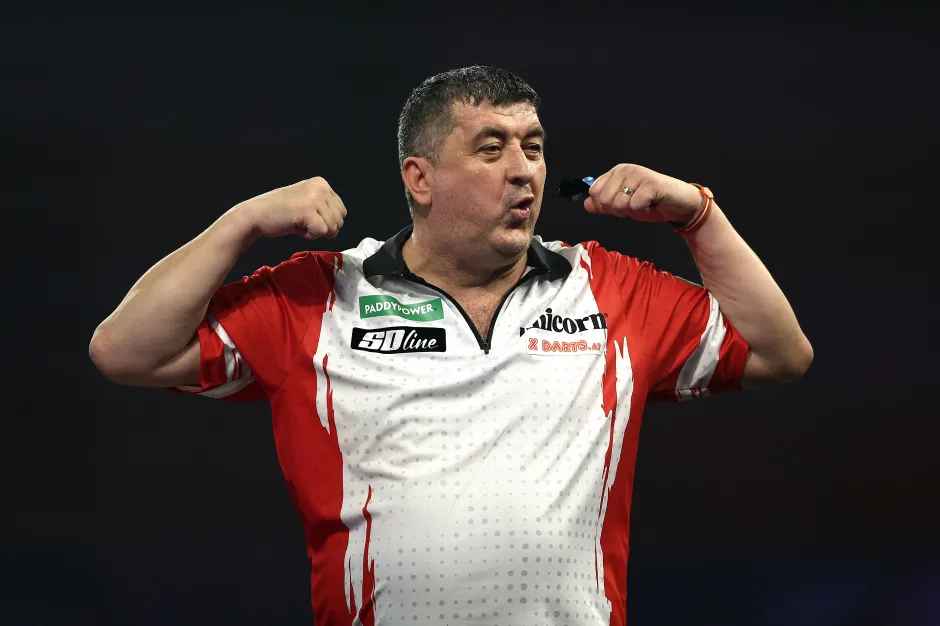
A controversial victory has turned into an uncomfortable week for Mensur Suljovic, with the Austrian darts veteran apologising after his actions against Ross Smith at the Swiss Darts Trophy sparked widespread criticism. What should have been remembered as a dramatic comeback has instead become a debate about sportsmanship, respect and the line players should never cross when the pressure reaches boiling point.
Suljovic fought back from 5-3 down to beat Smith 6-5 in Basel, but the manner of his victory attracted as much attention as the result itself. His decision to encourage the crowd while Smith was throwing for the match, followed by an inappropriate remark during a post-match interview, left the veteran facing serious questions about his conduct.
And although Suljovic has now apologised, the controversy is far from over. The Darts Regulation Authority (DRA) has been asked to examine the incident, leaving the possibility of disciplinary action hanging over a player who has spent years building his reputation on the professional circuit.
The Match That Changed the Conversation
The tension unfolded during a last-16 encounter that appeared to be slipping away from Suljovic. Smith was leading 5-3 and had two opportunities to finish the match, with double 18 standing between him and victory.
Instead of keeping the focus entirely on the darts, Suljovic gestured towards the spectators to increase the noise as Smith prepared to throw. Smith missed both match darts, allowing the Austrian to return to the oche and complete a remarkable escape.
Suljovic eventually hit double 10 with his final dart to secure a 6-5 victory. It was a significant comeback, but the timing of his crowd interaction made the finish difficult to celebrate without considering the controversy surrounding it.
There is an important distinction here. Darts is an entertainment sport, and players regularly use the crowd to build momentum, especially during high-pressure European Tour matches. The atmosphere is part of what makes the sport so compelling.
However, encouraging spectators to distract an opponent while they are throwing for the match is a different proposition. The question is not whether Suljovic wanted to win. Every professional player does. It is whether his methods crossed a line that should remain clear for everyone.
Smith Accepts His Mistakes but Makes His Feelings Clear
Smith did not pretend that Suljovic was solely responsible for the defeat. In a post-match message on X, the Englishman acknowledged that he had missed the opportunities that could have ended the contest.
“I don’t blame Mensur for me losing that game,” Smith wrote. “I missed two match darts. Simple as that.”
He also explained the difficulty of knowing what an opponent might be doing behind him while he was concentrating on his throw.
Smith then delivered the line that captured the mood surrounding the incident: “Karma will come around.”
That response deserves credit. Smith had every reason to be frustrated, yet he still recognised his own responsibility for failing to finish the match.
At the same time, accepting defeat does not mean accepting every tactic used against you. Missing doubles is part of professional darts, but players should be able to expect a reasonable level of respect when attempting to close out a contest.
The controversy could easily have remained a heated sporting disagreement. What happened during Suljovic’s subsequent interview made the situation considerably worse.
The Interview Remark That Sparked Further Backlash
After progressing to the quarter-finals, Suljovic was questioned about his behaviour against Smith by tournament master of ceremonies Philip Brzezinski.
Rather than simply acknowledging the criticism, the Austrian defended his actions and questioned why Smith was complaining. During the exchange, he made a generalisation about women that attracted further condemnation.
“Women, women – they’re always complaining, sorry. Sorry, you don’t do that.”
Those words shifted the debate beyond the usual arguments about gamesmanship. Whatever Suljovic intended to communicate about Smith’s reaction, making a dismissive remark about women was unnecessary and undermined any reasonable defence of his conduct.
Players can disagree, trade verbal jabs and express frustration after a tense encounter. That does not mean every comment should be excused as competitive emotion.
There is also a difference between an impulsive reaction immediately after a match and comments made during a later interview, when a player has had time to reflect. That distinction became particularly important when Suljovic eventually issued his apology.
Suljovic Issues a Public Apology
On Monday, October 12, Suljovic addressed the controversy in an Instagram statement, apologising both to Smith and to women over his interview remarks.
“The emotions got the better of me in that moment. I wanted to get the crowd behind me and, in doing so, I didn’t properly realise that Ross was throwing for the match.”
He continued: “Looking back, I understand that the timing was unfortunate and was perceived as unfair. I would like to apologise to Ross for that.”
Suljovic also expressed respect for his opponent, describing Smith as one of the world’s best darts players and acknowledging his achievements.
Addressing the more serious part of the controversy, he said: “My comment about women during the interview was also completely inappropriate. I should never have said something like that. I would like to sincerely apologise to all women for those remarks.”
He concluded by recognising that excitement must not come at the expense of basic sporting values.
“Darts thrives on emotion, but fairness and respect are just as important. Yesterday, I let my emotions get the better of me.”
“I’m sorry for that.”
The apology is an important first step. However, whether it fully repairs the damage to his reputation will depend on how Suljovic responds to the criticism going forward.
There is no need to dismiss an apology automatically, but neither should an apology mean that the original behaviour becomes irrelevant. Taking responsibility means recognising what went wrong and demonstrating that the same mistake will not be repeated.
Questions Remain Over Possible Disciplinary Action
The Professional Darts Corporation has confirmed that the incident on stage and the subsequent interview have been referred to the Darts Regulation Authority.
That referral does not mean Suljovic has already been found guilty of a disciplinary offence or that a particular punishment has been decided. It means the matter has been passed to the relevant regulatory body for consideration.
The case also arrives against the background of previous criticism of Suljovic’s gamesmanship. During his World Championship encounter with Joe Cullen in December 2025, the Austrian faced accusations concerning his pace of play, celebrations and conduct between visits. Suljovic denied deliberately provoking Cullen.
Those earlier disputes do not automatically establish wrongdoing in Basel. Every incident deserves to be judged on its own circumstances, rather than treating a player’s reputation as proof of guilt.
Nevertheless, the latest controversy highlights why consistency matters. Professional darts depends on competitive tension, but it also needs clear expectations about how players behave when matches become heated.
A warning, fine or other disciplinary response would have to be determined through the appropriate process. The important thing is that the sport handles the incident fairly and makes its expectations clear to every player.
What Happens Next for Suljovic and Smith?
Suljovic’s comeback against Smith demonstrated his ability to remain in a contest under enormous pressure. His subsequent progress at the Swiss Darts Trophy also showed that his performance on the oche was not defined by a single disputed match.
But sporting ability and sporting conduct are separate issues. A player can produce brilliant darts while still making a poor decision, and acknowledging that does not diminish the achievement of winning a difficult contest.
For Smith, the challenge is to move forward without allowing the frustration of Basel to overshadow his own performances. He missed two match darts, and that is the part he can work on. His criticism of Suljovic’s conduct can stand alongside that honest assessment.
For Suljovic, the next step is more straightforward: let the apology be followed by better judgement. He has admitted that his comments were inappropriate and that the timing of his crowd interaction was wrong. Now he must show that he understands why those moments caused such a reaction.
Darts is at its best when the drama comes from extraordinary finishes, tense deciding legs and players producing their finest performances under pressure. The crowd should add to that spectacle, not become a tool for undermining an opponent at the most critical moment.
Suljovic has apologised, but the debate over his conduct is unlikely to disappear immediately, especially while the regulatory process remains unresolved.
What do you think? Was Suljovic’s apology a genuine acknowledgement of his mistakes, and should the Darts Regulation Authority impose a punishment for what happened in Basel?