
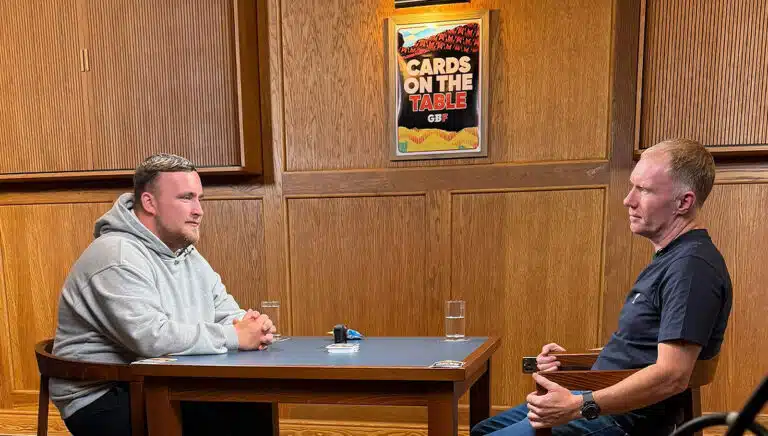
Paul Scholes and Luke Littler have delivered a serious statement about the power of sports content, with their first appearance together in a new podcast spin-off generating more than 12 million views in just seven days. The crossover between a Manchester United legend and one of darts’ biggest modern stars has clearly struck a chord with audiences, proving that fans will happily follow their favourite sporting personalities beyond their usual arenas.
The success is particularly interesting because this was not simply another lengthy football discussion or a traditional sit-down interview. The pair featured in Cards On The Table, a new format designed to encourage candid conversations, unexpected revelations and competitive moments. And judging by the early numbers, the idea has made an impressive start.
A New Format That Is Already Making Headlines
The spin-off is called Cards On The Table, and its concept is straightforward. Guests take turns drawing cards that introduce questions, debates, personal stories or challenges, creating an atmosphere that feels more spontaneous than a conventional interview.
That difference matters. Plenty of sports podcasts can assemble famous guests, but getting those guests to reveal something genuinely interesting is another challenge entirely. The format encourages personalities to respond to unexpected prompts rather than simply deliver the predictable answers fans have heard before.
The debut episode, released on October 5, paired Littler with Scholes, an 11-time Premier League champion and one of Manchester United’s most celebrated former midfielders. Their shared love of United gave the conversation an obvious starting point, but their different sporting backgrounds opened the door to a much wider audience.
The episode generated more than 12 million views in its first seven days. That is a remarkable opening for a new format, although the figure represents views rather than 12 million individual people. The distinction matters when assessing what the numbers actually mean.
Why Paul Scholes and Luke Littler Worked So Well Together
The pairing makes sense when you look beyond their sporting achievements.
Scholes represents a generation of football supporters who remember Manchester United’s dominance under Sir Alex Ferguson. His reputation as a player was built on extraordinary passing ability, intelligence and composure, while his reputation as a pundit has developed around his willingness to offer strong opinions.
Littler, meanwhile, has become one of darts’ biggest attractions. His success has introduced the sport to younger audiences, while his enthusiasm for Manchester United makes him a natural guest for a football-focused show.
Put those personalities together and there is plenty of room for disagreement, humour and unexpected revelations.
The episode also benefited from Littler’s willingness to discuss subjects beyond darts. He spoke about his ambitions, his fears and his devotion to United, giving football supporters reasons to watch even if they rarely follow professional darts.
For darts fans, the appeal worked in reverse. They had an opportunity to see a sporting hero discussing football with someone whose experiences at the highest level are completely different from his own.
That crossover is a major strength. Rather than relying exclusively on an established football audience, the show can attract viewers through Littler’s popularity and introduce them to the wider podcast.
Littler’s Retirement Remark Grabbed Attention
One of the most striking moments came when Littler discussed his relationship with darts and the possibility of walking away from the sport.
At one point, he said: “Tomorrow I might just retire and just hate darts.”
It was an eye-catching remark, especially given the expectations surrounding a young player who has already achieved so much.
However, the comment should not automatically be interpreted as an announcement of imminent retirement. In the context of a conversation about his career and personal feelings towards the sport, it illustrated the unpredictable way Littler can speak about his ambitions.
That is precisely the kind of moment a format like Cards On The Table hopes to create. A single candid remark can generate discussion well beyond the original episode, bringing new viewers to the show.
The conversation also explored Littler’s ambition to challenge Phil Taylor’s record of 16 world championship titles. When asked whether he could surpass that achievement, Littler responded: “I think I could. Definitely could. I’ve got probably say 30, 40 years to do it.”
It was an ambitious statement, but one that reflects how he sees his long-term potential. Whether he eventually approaches Taylor’s record remains an enormous challenge, and longevity in elite sport is never guaranteed.
Nevertheless, the exchange gave viewers something more substantial than a routine discussion of tournament results.
Scholes Also Opened Up About Manchester United
Littler was not the only one producing interesting moments.
Scholes discussed former Manchester United midfielder Paul Pogba and his own role in the circumstances surrounding Pogba’s first departure from the club. Reflecting on the situation, Scholes said: “I was half the reason he left the first time.”
That admission offered another example of how the programme could move beyond familiar football talking points.
Supporters have spent years debating United’s handling of talented players, recruitment decisions and the club’s struggles to recreate their greatest successes. Hearing a former player discuss his own involvement in a past controversy gives those conversations a more personal dimension.
The pair also tackled the challenge of selecting an all-time Manchester United Premier League XI, a subject guaranteed to provoke arguments among supporters.
These discussions are ideal podcast material because there is rarely a universally accepted answer. Every generation has its favourites, and even the most accomplished former players can disagree about which teammates deserve recognition.
For the producers, that disagreement is an advantage. Strong opinions give viewers a reason to react, share clips and debate the choices long after an episode ends.
The Bigger Picture for The Good, The Bad & The Football
The 12-million-view debut arrives at an encouraging time for the main podcast.
In August, Platform Media announced that Scholes, Nicky Butt and Paddy McGuinness would return for another two years. The company reported that the main show had accumulated more than 750 million cross-social views and 20 million long-form views and listens in under a year. Those figures measure different types of consumption and should not be confused with the spin-off’s seven-day total.
The expansion into Cards On The Table suggests the creators believe their audience wants more than weekly football analysis. Shorter interviews built around personalities and unexpected questions can offer another route to discovery, particularly through social media.
That strategy makes sense in a crowded sports-media market. A full podcast episode requires a significant time commitment, whereas a compelling clip can capture attention in seconds and encourage viewers to seek out the complete conversation.
Still, one successful launch does not guarantee that every future episode will attract the same audience. Littler’s popularity, his relationship with United and the novelty of the format all helped the debut stand out.
The real test will be whether the producers can repeat that success with guests who bring different stories, rivalries and fan bases to the table.
What Happens Next?
Scholes, Butt and McGuinness are set to alternate in the hosting role, with guests from sport and entertainment joining future episodes. That approach gives the series flexibility while keeping the format recognisable.
For Littler, the appearance reinforces his growing presence beyond the oche. For Scholes, it provides another platform to connect with football supporters while exploring conversations that would not necessarily fit into a traditional match-analysis programme.
Ultimately, the 12 million views are an impressive opening, but the most important achievement may be the format’s ability to make two familiar sporting names feel interesting in a different setting.
If Cards On The Table continues to produce candid moments, lively debates and genuine chemistry between its guests, it could become a valuable addition to the podcast’s wider brand.
What do you think made the debut such a success: Littler’s popularity, Scholes’ straight-talking personality, or the chemistry between two sporting figures from completely different worlds?