
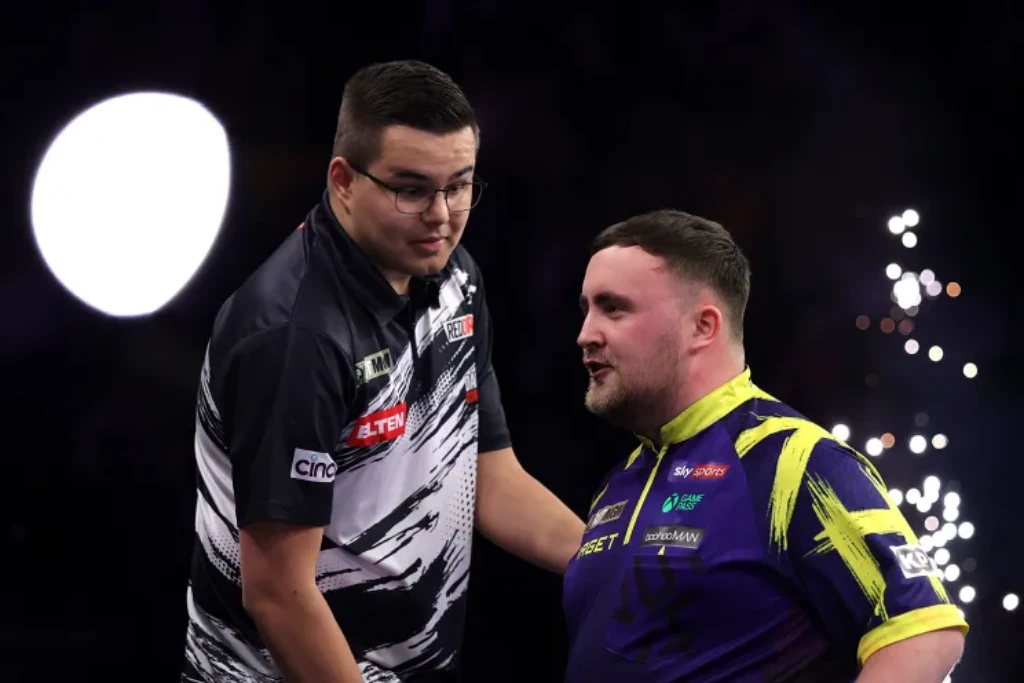
Tensions between Luke Littler and Gian van Veen have escalated following a fiery on-stage exchange that has quickly become one of the most talked-about moments in recent darts action. What began as a tightly contested match turned into a heated confrontation, with both players offering contrasting accounts of what truly happened during a dramatic final-leg showdown.
The incident unfolded during a high-stakes clash, where emotions were already running high. With the match hanging in the balance, Van Veen narrowly secured victory, but the closing stages were overshadowed by visible tension between the two rising stars. The immediate aftermath saw a frosty handshake and minimal acknowledgment, signaling that something had clearly gone wrong beyond the scoreline.
At the center of the controversy was Littler’s reaction when Van Veen missed a crucial dart. The Dutchman appeared to take exception to what he perceived as an inappropriate gesture, later suggesting that Littler’s actions crossed a line in terms of sportsmanship. From his perspective, celebrating or reacting visibly to an opponent’s mistake was unnecessary and disrespectful in such a closely fought contest.
Littler, however, has strongly pushed back against that narrative. Speaking after the match, the young English star made it clear that he believed his actions had been misinterpreted. “I wasn’t even looking at him,” Littler insisted, firmly denying that his reaction was aimed at his opponent. Instead, he revealed that his focus had been directed toward the crowd—specifically his girlfriend Faith and her father, who were in attendance.
By bringing his girlfriend into the explanation, Littler sought to provide context that would paint his actions in a more personal and less confrontational light. According to him, the gesture was a moment of connection with his support system rather than an attempt to mock or undermine Van Veen. This clarification, however, has done little to completely settle the debate, as opinions remain divided over how the moment should be interpreted.
Adding further fuel to the situation was Littler’s frustration with what he described as Van Veen’s behavior during the match. The teenage star pointed to an instance where he felt his opponent was staring him down while still holding a dart, a moment he believed intensified the already charged atmosphere. Littler suggested that such conduct contributed to the breakdown in mutual respect and made the situation more volatile than it needed to be.
“I just didn’t like it,” Littler said when reflecting on the exchange, indicating that he felt the line between competitive intensity and unsporting behavior had been blurred. His comments suggest that, from his perspective, the issue was not one-sided but rather a culmination of actions from both players during a high-pressure encounter.
Van Veen, on the other hand, has shown little interest in backing down. The Dutchman has maintained that Littler’s reaction was out of order, reinforcing his belief that players should maintain composure regardless of the circumstances. His stance reflects a more traditional view of on-stage etiquette, where visible reactions to an opponent’s misfortune are generally discouraged.
The tension between the two did not end when they left the stage. In the hours following the match, Littler appeared to mock the situation with a gesture and later added a sarcastic remark on social media, moves that only intensified the spotlight on the dispute. While some fans viewed his actions as harmless or even entertaining, others criticized them as unnecessary and potentially damaging to his reputation.
For many observers, the clash highlights the growing rivalry between two of darts’ brightest young talents. Littler has rapidly become one of the sport’s biggest names, achieving remarkable success at a young age and drawing significant attention wherever he plays. Van Veen, meanwhile, is widely regarded as one of the few players capable of consistently challenging him, making their encounters particularly compelling.
Their competitive history adds another layer to the narrative. Having faced each other on some of the biggest stages, both players are familiar with the pressure and expectations that come with elite-level darts. Each meeting now carries added significance, not just in terms of results but also in the ongoing battle for dominance between two emerging stars.
The reaction from the wider darts community has been mixed. Some former players and pundits have questioned Littler’s conduct, suggesting that he may need to better manage his emotions in high-pressure situations. Others have defended him, arguing that passion and personality are part of what makes modern darts so engaging and that moments like these can help drive interest in the sport.
There is also a broader conversation about generational differences in approach. Younger players like Littler often bring a more expressive and emotional style to the stage, while others favor a more reserved demeanor. The clash with Van Veen may, in part, reflect these differing attitudes toward competition and self-expression.
Despite the controversy, Littler’s performances on the board remain largely unaffected. He continues to compete at the highest level, demonstrating the skill and composure that have defined his rapid rise. However, incidents like this serve as a reminder that success also brings increased scrutiny, with every action subject to analysis and debate.
For Van Veen, the victory represents a significant statement, not only in terms of the result but also in asserting himself within this emerging rivalry. His willingness to speak out suggests that he is prepared to stand his ground, setting the stage for potentially more intense encounters in the future.
Ultimately, the incident underscores the fine line between competitive fire and controversy. While both players have their supporters, the truth likely lies somewhere in between their differing accounts. What is clear, however, is that their rivalry has taken on a new dimension, one that extends beyond the oche and into the broader narrative of the sport.
As the darts calendar continues, all eyes will be on the next meeting between Littler and Van Veen. Whether tensions cool or escalate further remains to be seen, but one thing is certain—their clashes are quickly becoming must-watch events, filled not only with top-level darts but also with the kind of drama that keeps fans talking long after the final dart has been thrown.
Leave a Reply