
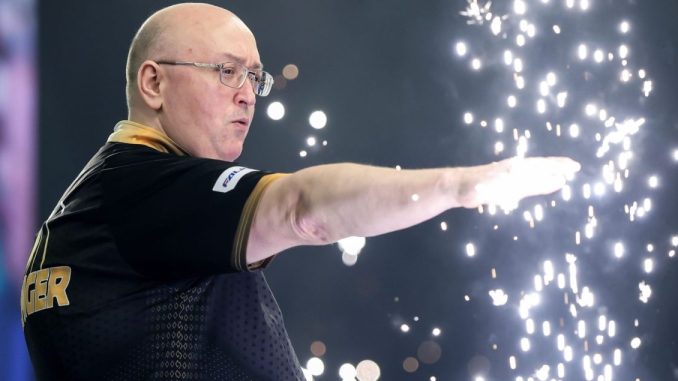
Mensur Suljović has made it clear that he is determined to step out of the shadow of darts legend Phil Taylor, insisting he should not be compared to the 16-time world champion despite continued discussions around his playing style and consistency at the highest level.
The Austrian star, known for his calm presence on stage and steady scoring power, has long been respected as one of the most reliable competitors on the professional circuit. However, comparisons to Taylor have followed many players throughout the modern era of darts, especially those who demonstrate high averages, clinical finishing, and the ability to control matches under pressure.
Suljović has now addressed those comparisons directly, making it clear that he does not see himself as a successor or reflection of Taylor’s dominance, but rather as a completely different type of player with his own identity in the sport.
“I am not Phil Taylor,” he has insisted in strong terms, pushing back against any suggestion that his career should be measured against the achievements of the sport’s most decorated figure.
For Suljović, the focus has always been on consistency, discipline, and gradual improvement rather than dominance or legacy-defining records. While Taylor built his reputation on relentless title wins and unmatched statistical superiority across decades, Suljović has carved out a career defined more by persistence, resilience, and the ability to compete with the best on his day.
The Austrian has spent years competing at the top level of professional darts, regularly featuring in televised events, major tournaments, and ranking competitions. His style is often described as composed and methodical, with an emphasis on accuracy rather than explosive scoring bursts. This has led some observers to draw parallels with Taylor’s own clinical approach during his prime years.
However, Suljović’s point is that surface-level similarities in playing style do not translate into comparable careers, achievements, or influence on the sport. While Taylor dominated an entire era of darts, winning world titles almost at will and redefining expectations of excellence, Suljović has taken a different path — one built on longevity and competitiveness rather than overwhelming dominance.
The discussion around comparisons with Taylor is not new in darts. Many players over the years have been labelled as potential “next Taylor” candidates, a tag that has often brought more pressure than benefit. The sheer scale of Taylor’s achievements, including 16 world championships and countless major titles, has made him a benchmark that few players feel comfortable being measured against.
Suljović appears keen to distance himself from that narrative entirely, preferring to be judged on his own results and contributions to the modern game.
He has consistently been regarded as one of the most technically sound players on the circuit, with a reputation for strong finishing under pressure. His ability to grind out results against top opposition has helped him maintain a presence in major tournaments for many years, even during periods when form has fluctuated.
Despite not being a dominant title winner like Taylor, Suljović has enjoyed several strong runs in televised events, including deep progress in major championships where he has tested some of the sport’s biggest names. His calm temperament and measured approach have often made him a difficult opponent in high-pressure situations.
But while those qualities have earned him respect, they have also fuelled comparisons that he now seems determined to reject.
In the modern darts landscape, comparisons to legends are almost unavoidable. With the sport growing rapidly in popularity, especially following the emergence of younger stars and increased global attention, analysts and fans often look for historical reference points to measure current players. Taylor, as the most successful figure in darts history, remains the most common comparison.
However, Suljović’s stance reflects a broader sentiment shared by many professionals: that the modern game should not be defined by attempting to replicate the past, but by developing its own identity.
Today’s darts environment is significantly different from the era in which Taylor dominated. The level of global competition has expanded, prize money has increased, and the depth of talent across tournaments is greater than ever before. Players now face a more crowded and unpredictable field, where consistency is harder to maintain and dominance is more difficult to establish.
In this context, Suljović’s career can be viewed through a different lens. Rather than chasing legacy-defining records, he has focused on remaining competitive across a long professional journey, adapting to changes in the sport while continuing to compete at a high level.
His rejection of comparisons also highlights the pressure that comes with being linked to iconic figures. Many players have struggled under the expectation of being “the next big thing” or a successor to legends, often finding that such labels create unrealistic expectations from fans and media alike.
Suljović’s message is therefore as much about identity as it is about respect for Taylor’s legacy. By stating clearly that he is not Phil Taylor, he is reinforcing the idea that each player in darts has their own path, strengths, and place in the sport’s history.
Phil Taylor’s influence on darts remains unmatched. His dominance across multiple decades set a standard that transformed the professional game, raising expectations for scoring power, mental toughness, and tournament consistency. Even years after his retirement from full-time competition, his name continues to dominate discussions whenever greatness in darts is mentioned.
For Suljović, however, that legacy is not something he is aiming to replicate or measure himself against. Instead, his focus remains on his own performance, his own results, and his own standing within the modern era of the sport.
As darts continues to evolve, with new stars emerging and the game reaching wider audiences than ever before, players like Suljović represent an important part of its competitive backbone — professionals who may not dominate headlines but consistently contribute to the depth and quality of the circuit.
His firm stance serves as a reminder that while legends like Taylor will always define history, the current generation is writing its own story, one that does not need constant comparison to the past in order to be meaningful.
And in insisting that he is no Phil Taylor, Suljović is ultimately making a broader point about modern darts: greatness comes in many forms, and not all of them need to mirror the giants who came before.
Leave a Reply