
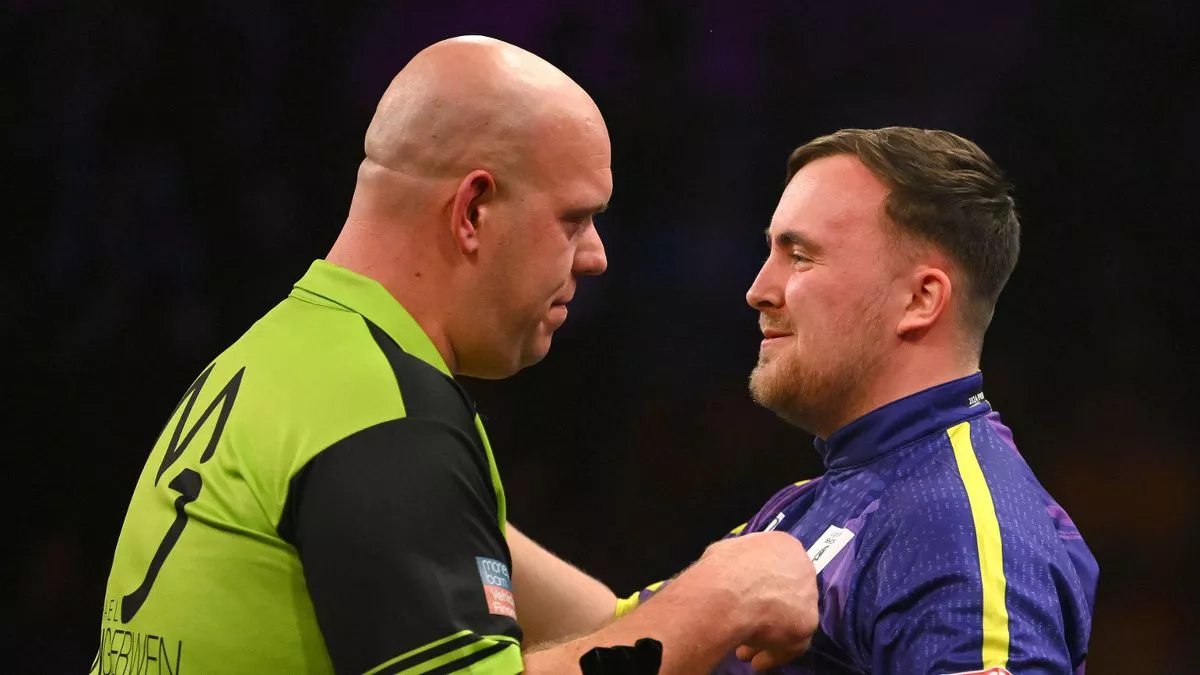
The rivalry between Michael van Gerwen and Luke Littler has entered a fascinating new phase, one that stretches beyond the oche and into the financial realities of professional darts. What might once have been viewed purely as a battle for titles and bragging rights has now evolved into a situation with serious monetary implications, with Van Gerwen reportedly facing a £200,000 problem—and Littler’s rapid rise playing a central role in shaping it.
At the core of this issue is the way darts rankings are calculated. The system operates on a rolling two-year prize money model, meaning every pound earned in ranking events contributes to a player’s standing for a limited period before eventually dropping off. It rewards sustained success but also creates significant pressure, particularly for players who have accumulated large sums through deep runs in major tournaments. For Van Gerwen, a player who has spent years dominating the sport, that pressure is now intensifying.
During his peak years, Van Gerwen built a commanding presence by consistently reaching finals and winning titles across the calendar. That success translated into substantial prize money, cementing his place among the elite. However, the very achievements that established his dominance are now contributing to his current dilemma. Reports indicate that roughly £200,000 of his previously earned prize money is due to come off his ranking total unless he can replicate similar results in the same events this season.
This creates a scenario where maintaining his ranking is no longer simply about performing well—it is about matching or exceeding past success. Anything less could result in a drop in the standings, which carries consequences far beyond numbers on a list. Ranking positions influence tournament seedings, which in turn shape the difficulty of a player’s path through competitions. A lower ranking can mean tougher opponents earlier in tournaments, making it harder to progress and earn the prize money needed to recover.
While this challenge would be significant under any circumstances, the emergence of Littler has added a new layer of complexity. The teenage sensation has taken the darts world by storm, delivering performances that have not only captured attention but also generated substantial earnings. His ability to win major titles and thrive under pressure has allowed him to climb the rankings at an extraordinary pace.
Littler’s success has effectively raised the bar for everyone else. For Van Gerwen, it means that defending his position is no longer just about maintaining his own standards—it is about keeping up with a player who is consistently setting new ones. Each victory Littler secures widens the gap, making it increasingly difficult for those chasing to stay within reach.
The financial aspect of this rivalry is particularly striking. The £200,000 figure attached to Van Gerwen’s situation is not just a theoretical number; it represents a tangible loss that could impact his standing in the sport. In a system driven by prize money, every pound matters, and the stakes have never been higher. Modern darts offers larger rewards than ever before, but that also means the consequences of falling short are more significant.
Van Gerwen has previously voiced concerns about the ranking system, suggesting that its heavy reliance on prize money can sometimes distort the true picture of a player’s consistency. From his perspective, a couple of big wins can disproportionately influence standings, while steady performances across multiple events may not always receive the same recognition. It is a debate that has gained traction as the sport continues to grow and evolve.
Littler, however, represents the new reality of this structure. He has embraced the system and used it to his advantage, maximizing his earnings through high-impact performances on the biggest stages. His response to criticism has been confident, reflecting a mindset that thrives under the current conditions rather than questioning them. In many ways, he embodies the direction in which the sport is heading.
Recent encounters between the two players have only intensified the narrative. Littler has already secured notable victories over Van Gerwen, including in high-pressure situations where both ranking points and prize money were on the line. Each of those wins not only boosts Littler’s position but also denies Van Gerwen the opportunity to strengthen his own. In a tightly contested ranking system, those head-to-head results can have lasting implications.
Beyond the statistics, there is a clear psychological dimension to this evolving rivalry. For years, Van Gerwen was the dominant force in darts—the player others aimed to beat. His presence alone often dictated the tone of tournaments. Now, that dynamic is shifting. Littler’s fearless approach and consistent success have introduced a new benchmark, one that challenges even the most established players to adapt.
For Van Gerwen, this represents a moment of reckoning but also an opportunity. His career has been defined by resilience and an ability to respond to challenges. He has faced strong competition before and has repeatedly found ways to elevate his game. The question now is whether he can do so again in the face of a younger opponent who seems unfazed by the pressures of the professional stage.
The coming months will be crucial. To avoid the potential £200,000 drop from his ranking total, Van Gerwen will need to deliver strong performances in key tournaments. That means reaching the latter stages, competing for titles, and ideally adding new prize money to offset what is set to fall away. It is a demanding task, but one that aligns with the expectations placed on a player of his caliber.
At the same time, Littler’s trajectory shows no signs of slowing. His consistency, combined with his ability to produce standout moments, makes him a constant threat in every event he enters. With each tournament, he has the chance to extend his lead and further solidify his position at the top of the sport.
This situation highlights a broader shift within darts. The emergence of a new generation, led by Littler, is reshaping the competitive landscape. Established stars like Van Gerwen are being pushed to adapt, ensuring that the sport remains dynamic and unpredictable. It is a transition that brings both challenges and excitement, as different eras collide.
Ultimately, the £200,000 “problem” facing Van Gerwen is about more than just money. It reflects the evolving nature of darts, where success must be sustained and competition is fiercer than ever. It underscores the importance of consistency, adaptability, and the ability to perform under pressure.
For fans, it adds an extra layer of intrigue to an already compelling rivalry. Every match between Van Gerwen and Littler now carries additional significance, not just in terms of who wins or loses, but in how it shapes the broader narrative of the sport.
As the season unfolds, all eyes will be on how this story develops. Will Van Gerwen rise to the challenge and defend his position, or will Littler continue his ascent and further widen the gap? One thing is certain: the battle between experience and youth, between established greatness and emerging brilliance, is far from over—and its outcome could redefine the landscape of professional darts for years to come.