
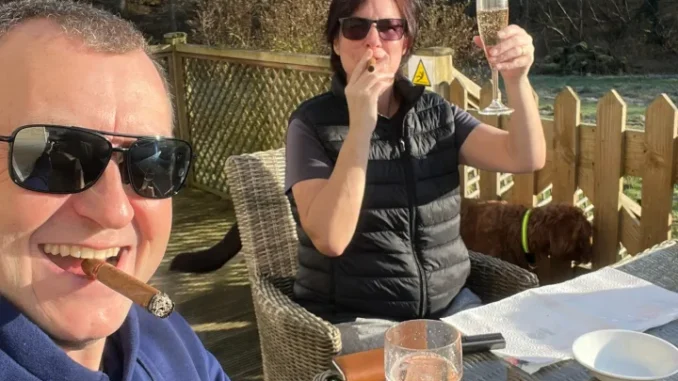
Wayne Mardle has spent much of his life in front of crowds, whether dazzling fans with his flamboyant style as a professional darts player or captivating audiences with his passionate commentary. Known for his infectious enthusiasm and unmistakable personality, he has long been one of the sport’s most recognisable figures. Yet behind the energy and showmanship lies a deeply personal story that has unfolded over the past year—one marked by loss, reflection, and ultimately, the courage to begin again.
The passing of his wife Donna was a devastating moment that changed everything. They had shared more than two decades together, building a life that stretched across his playing career and into his broadcasting success. Donna was widely seen as his anchor, someone who stood by him through every chapter of his journey. Losing her left a void that could not be filled, and for a time, Mardle stepped away from the spotlight to process the enormity of what had happened.
During those early months, the usually vibrant figure that fans had come to know was replaced by someone navigating grief in its rawest form. Mardle later opened up about how difficult that period had been, describing the experience as something that hits in waves rather than following a predictable path. He explained that grief is not linear; it does not steadily fade away but instead resurfaces at unexpected moments, sometimes just as intense as the first day.
He spoke honestly about how there were times when he felt able to cope, only for the weight of the loss to return suddenly. That unpredictability made the process even more challenging. In sharing his experience, he also offered reassurance to others going through similar situations, emphasising that there is no correct way to grieve. People must allow themselves to feel whatever comes naturally, without pressure to meet expectations or timelines.
This openness revealed a different side of Mardle. While fans had always appreciated his humour and energy, they now saw his vulnerability and resilience. It deepened the connection many felt with him, as his story became about more than darts—it became about real life, with all its complexities and emotions.
As time passed, Mardle slowly began to rebuild. Returning to his role within the darts world was one step, reconnecting with a sport that has been central to his identity for decades. Being back around familiar faces and environments likely provided a sense of stability during a period when so much had changed.
However, the most significant development in his personal journey has been the emergence of a new relationship. More than a year after Donna’s passing, Mardle has found companionship again, beginning a relationship with Deborah, a 53-year-old single mother. Their connection has gradually become visible through small but meaningful glimpses shared publicly, offering insight into this new chapter of his life.
Rather than making a grand announcement, the relationship has been introduced in a natural and understated way. Light-hearted moments, shared smiles, and everyday interactions have painted a picture of two people finding comfort in each other’s company. In one instance, the pair expressed a simple outlook on life—embracing happiness when it comes, rather than turning away from it. That sentiment has come to define this stage of Mardle’s journey.
There have also been glimpses of humour and warmth, including moments involving Deborah’s dog, which highlighted how easily Mardle has become part of her daily life. These small details may seem insignificant, but they carry a deeper meaning. They show a return to normality, a sense of ease that often feels distant after experiencing profound loss.
Importantly, this new relationship does not replace what Mardle had with Donna. Their 22-year marriage remains a central part of his story, a chapter that continues to shape who he is. The love and memories they shared do not disappear; instead, they exist alongside his present, forming part of the foundation on which he is building his future.
Mardle’s journey reflects a truth that many people come to understand in their own time: moving forward does not mean leaving the past behind. It means finding a way to carry it with you while still allowing yourself to experience new moments of happiness. That balance is not easy to achieve, but it is essential for healing.
Within the darts community, the response to his story has been overwhelmingly supportive. Fellow players, colleagues, and fans have all recognised the challenges he has faced and the strength it has taken to reach this point. Seeing him smile again, sharing moments of joy, has been welcomed as a positive step.
Professionally, this renewed sense of balance could also have a meaningful impact. As a commentator, Mardle has always brought energy and passion to his role, helping to bring the sport to life for viewers. With a more settled personal life, he is in a position to continue contributing at a high level, combining his deep knowledge of the game with the personality that has made him so popular.
Beyond darts, his experience resonates on a much wider level. Loss is something that touches everyone at some stage, and the process of dealing with it is rarely straightforward. By speaking openly about his emotions, Mardle has helped to break down some of the barriers around discussing grief, showing that it is okay to struggle and that healing takes time.
At the same time, his story offers hope. It demonstrates that even after the darkest moments, there is still the possibility of light. Finding happiness again does not diminish what came before; it simply reflects the human capacity to adapt, to grow, and to continue.
As he moves forward, Mardle appears to be embracing that idea. He is not rushing the process or trying to present a perfect picture. Instead, he is allowing life to unfold naturally, taking opportunities for happiness as they arise while remaining grounded in the experiences that have shaped him.
In many ways, this chapter of his life stands as one of his most significant achievements—not in terms of trophies or titles, but in terms of personal strength. It is a story of resilience, honesty, and the willingness to open up to life again after experiencing deep loss.
For those who have followed his journey, it adds a new dimension to the man they admire. And for Wayne Mardle, it represents something deeply meaningful—a second chance at happiness, built on acceptance, courage, and the understanding that even after heartbreak, life can still move forward in ways that bring joy once more.
Leave a Reply