
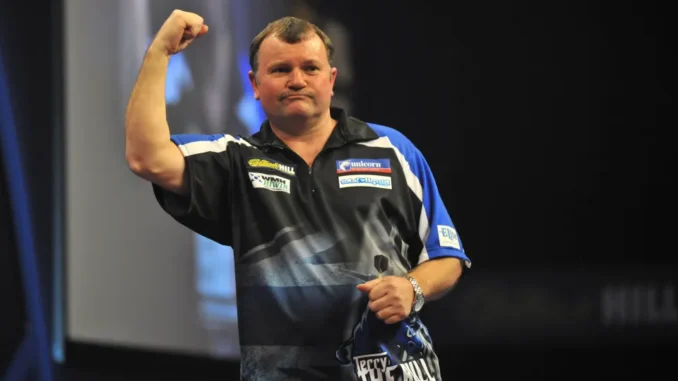
Phil Taylor has reflected in more detail on the moment he first began to sense that the end of his extraordinary darts career was approaching, admitting that a subtle but noticeable shift in crowd atmosphere during a World Matchplay match made him feel something had changed in the sport he once dominated completely.
The 16-time world champion, who built a reputation as the most dominant player in darts history, revealed that it was not a defeat, injury, or loss of form that first triggered thoughts of retirement. Instead, it was a feeling he experienced during his 2013 World Matchplay clash against Terry Jenkins at the Winter Gardens in Blackpool, a venue where he had enjoyed some of his greatest triumphs.
Taylor’s connection with the World Matchplay had always been special. The tournament was one of his strongest hunting grounds, where he won an astonishing 16 titles across his career. For years, the Blackpool crowd had been part of the spectacle, known for their passion, intensity, and appreciation of top-level darts. Taylor often thrived in that environment, feeding off the energy as he dismantled opponents on his way to yet another trophy.
However, during his match with Jenkins, something felt different to him. While the competition itself was still high quality and the stakes were unchanged, Taylor sensed that the atmosphere in the arena was not what he was used to.
Recalling the moment, Taylor explained that he had always regarded the World Matchplay crowd as among the best in the sport, but on this occasion, he felt a noticeable shift in how the event was being experienced inside the venue.
“I was playing Terry Jenkins at the World Matchplay – I always thought the crowd at that tournament were the best around,” Taylor said. “They were real darts fans and I looked around during my match with Terry and the atmosphere wasn’t what it used to be.”
It was not one specific incident or confrontation that stood out, but rather a general change in energy that he picked up on while competing. For a player who had spent decades reading crowds and feeding off their reactions, this difference was impossible to ignore.
As the match continued, Taylor admitted that the thought crossed his mind that something fundamental about the sport he loved was changing. It was the first time he had ever seriously considered that his time at the top might be coming to a natural close.
“That was the first time I was thinking, ‘this isn’t right and my career is coming to an end’,” he said.
For Taylor, who had built his legacy through unmatched consistency, relentless winning, and an ability to perform under pressure in the most hostile environments, this internal shift was significant. He was not reacting to a loss or a decline in performance, but to a feeling about the environment around him. That, in many ways, made it even more striking.
At that stage of his career, Taylor was still one of the most feared competitors in darts. Even though younger players were beginning to emerge and challenge the established order, he remained capable of winning major tournaments and competing at the highest level. His presence alone continued to influence matches, with opponents often stepping onto the oche already aware of his reputation and dominance.
However, while his ability remained strong, the sport around him was evolving rapidly. By the early 2010s, darts had transformed into a far more entertainment-driven spectacle than in previous decades. The crowd experience had changed significantly, with larger audiences, louder celebrations, themed costumes, and a more party-like atmosphere becoming the norm at televised events.
For many players, this evolution was exciting and added to the spectacle. But for Taylor, who had grown up in a more traditional era of darts, it required adjustment. He was accustomed to a different kind of crowd engagement, one that focused heavily on concentration and the tension of each throw rather than constant noise and distraction.
“I wasn’t used to the sort of new-age crowd of everyone at the bar in fancy dress,” he explained, describing how the environment at major tournaments had shifted compared to earlier in his career.
While he never dismissed the fans or the direction the sport was heading, Taylor acknowledged that he personally found it harder to connect with the changing atmosphere. That disconnect gradually influenced how he viewed his place in the game.
The 2013 World Matchplay moment did not immediately lead to retirement, but it stayed with him as a reference point. It was a mental marker that things were no longer exactly as they had been during his peak dominance in the 1990s and 2000s. From that point onwards, even as he continued to win and compete at the highest level, the awareness of change remained in the background.
Taylor went on to enjoy several more successful years on the professional circuit. He added further titles to his already record-breaking collection and continued to perform at a level many players could only aspire to reach. Yet the sport itself was moving forward, with a new generation of players emerging and the overall structure of professional darts becoming more global and physically demanding.
As time progressed, Taylor’s schedule, preparation, and recovery all became more challenging. The increasing intensity of the tour, combined with the natural effects of ageing, meant that maintaining dominance became harder. Still, he remained competitive and respected, often still seen as a major threat in any tournament he entered.
Eventually, in 2018, Taylor brought his professional career to a close after reaching the World Championship final. It marked the end of one of the most successful sporting careers ever seen, not just in darts but in any discipline. His record of 16 world titles remains unmatched, as does his legacy at the World Matchplay and other major tournaments.
Looking back, Taylor’s reflection on that 2013 moment offers a unique insight into how even the greatest careers can be influenced by subtle changes in environment and perception. It was not a dramatic turning point in terms of results, but rather an emotional and psychological shift that signalled the beginning of the end.
What stands out most is how aware he was of the changing nature of the sport around him. While many athletes focus purely on performance, Taylor also recognised the importance of atmosphere, connection, and feeling within competition. When that connection began to feel different, he knew instinctively that something was changing.
Today, that World Matchplay night against Terry Jenkins is remembered by Taylor not as a defining defeat, but as the moment he first truly understood that even a career built on dominance eventually reaches its natural conclusion.
Leave a Reply