
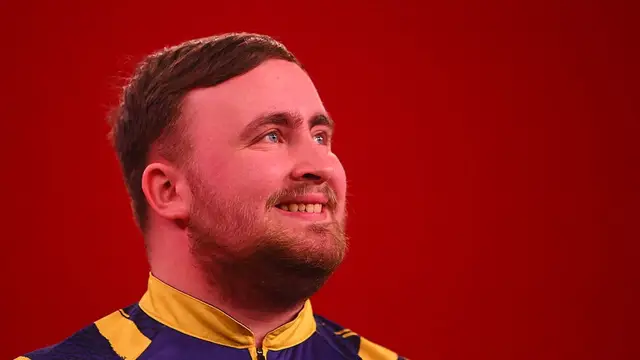
In the high-pressure world of professional darts, where silence can feel deafening and every throw carries the weight of expectation, the semi-final clash between Luke Littler and Gerwyn Price at the Players Championship Finals delivered everything fans could have hoped for—and more. Inside the packed Winter Gardens in Minehead on a tense November evening in 2025, the atmosphere crackled with anticipation as two of the sport’s biggest personalities collided in a battle that mixed precision scoring with psychological warfare.
On one side stood Luke Littler, the teenage phenomenon nicknamed “The Nuke,” already established as the world No. 1 despite his youth. On the other was Gerwyn Price, the 2021 world champion known as “The Iceman,” a player who thrives in hostility, intensity, and confrontation. What unfolded over the next hour was not just a darts match, but a gripping contest of nerves, momentum swings, and subtle mind games that would eventually define the outcome.
Littler entered the semi-final in blistering form. Earlier in the tournament, he had dismantled Chris Dobey 10-5 in the quarter-finals, producing a devastating display of scoring power that included nine maximum 180s and an average close to 108. It was yet another reminder of how rapidly the Runcorn-born star has risen through the ranks. By 18, he had already collected major titles including a second Premier League crown, a dramatic World Grand Prix victory, and a Grand Slam triumph over Luke Humphries. His reputation as darts’ new global superstar was no longer emerging—it was fully established.
But standing in his way was a player who had repeatedly caused him problems. Price had built a strong psychological edge over Littler earlier in the year, winning multiple encounters including tense finishes in both Premier League and Players Championship events. Their rivalry had quickly become one of the most compelling in the sport, blending raw scoring power with emotional intensity. Price’s aggressive presence at the oche, combined with his trademark celebrations and vocal energy, often pushed matches into combative territory.
From the opening legs, the semi-final lived up to expectations. Littler came out firing, racing into a 5-2 lead with a barrage of heavy scoring, including several early 180s and a clinical 86 checkout on the bullseye that set the tone. His rhythm was smooth, his timing sharp, and his confidence visible in every movement.
Yet Price was never going to fade quietly. Known for his resilience and ability to drag matches into trenches, he responded with typical grit. A superb 114 finish sparked his comeback, followed by a run of three consecutive legs that dragged him right back into contention. At 7-6, the match had completely shifted momentum, and the crowd sensed a turning point.
The Welshman’s energy was unmistakable. He prowled the stage, gesturing after key moments, attempting to disrupt Littler’s flow with presence alone. His average hovered around the 99 mark, supported by multiple maximums and heavy scoring bursts. Littler, meanwhile, maintained a slightly higher output but began to show brief signs of frustration after missing several doubles in succession.
At the interval, the match was finely poised, with Littler holding only a narrow advantage. Pundits debated whether experience or youthful fearlessness would prevail. Price, as he had done so many times before, looked capable of grinding his way back into control.
But the defining moment of the match was still to come.
As the contest reached its final stages with Littler edging towards victory at 10-8, tensions escalated. Price, fully aware of the situation, intensified his on-stage behaviour. His pacing became more deliberate, his reactions more animated, and his attempts to engage the crowd more visible. It was classic psychological pressure—an effort to unsettle a teenager standing on the brink of another final.
Then came the moment that would dominate post-match discussion.
During a crucial leg, as Price prepared to throw, Littler leaned in with a calm expression and delivered a quiet remark just loud enough for nearby microphones to capture fragments. He followed it with a subtle smile and a mirrored version of Price’s own pre-throw routine, a deliberate mimicry that immediately caught attention from both spectators and commentators.
It was not loud. It was not aggressive. But it was calculated.
The effect was immediate. Price, usually composed in high-pressure moments, appeared slightly disrupted on his next visit to the board, narrowly missing key scoring beds. Littler seized the opportunity without hesitation, punishing the miss with a clinical 13-darter to close out the match 11-8.
The reaction inside the arena was instant chaos. The crowd erupted as Littler confirmed his place in the final, while commentators struggled to fully process the moment they had just witnessed. Social media exploded within minutes, with clips of the exchange circulating widely and fans dissecting every angle of the interaction.
Many described it as a masterstroke of psychological gamesmanship. Others labelled it a turning point that showcased Littler’s growing maturity as a competitor. Rather than being rattled by Price’s intensity, the teenager had responded with calm confidence and a subtle reversal of pressure.
For Price, there was no visible anger after the match. Instead, he offered respect, acknowledging Littler’s performance and composure. Despite the defeat, he recognised the level required to compete with the teenager at his peak.
For Littler, the victory was another step in a remarkable rise. He went on to defeat Nathan Aspinall 11-8 in the final, securing the Players Championship title and adding yet another major trophy to his rapidly expanding collection. His average in the final exceeded 103, reinforcing his status as the sport’s most dominant young talent.
Looking back, the semi-final against Price stood out not just for the scoring quality, but for the psychological dimension that unfolded alongside it. In modern darts, where margins are razor-thin and pressure is constant, mental strength is often as important as technical ability.
Littler’s subtle exchange with Price became symbolic of that shift. It highlighted a player who is not only capable of outscoring opponents, but also outthinking them in key moments. The ability to stay composed under provocation, and even turn it into an advantage, is what separates good players from great ones.
As the lights dimmed in Minehead and another tournament concluded, one thing was clear. Luke Littler was no longer just the sport’s most exciting young talent. He was becoming its most complete competitor—equally dangerous with his scoring power and his psychological edge.
And in a sport defined by inches, timing, and nerve, that combination may prove unstoppable for years to come.