
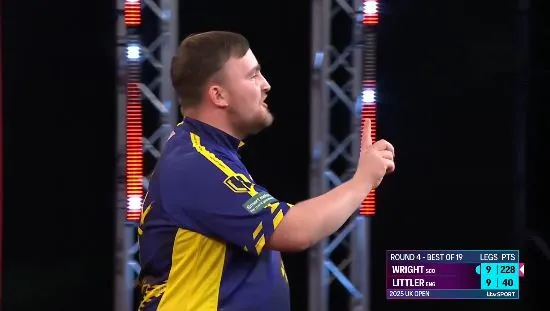
The growing tension between darts prodigy Luke Littler and sections of live crowds has once again become a major talking point in the sport, after senior officials moved to clarify their position on the increasingly emotional atmosphere surrounding his Premier League appearances.
Littler, still in the early stages of what is already shaping up to be a remarkable career, has become one of the most recognisable names in darts. His rapid rise, fearless scoring power, and emotional on-stage reactions have turned him into a headline attraction at every event he enters. But alongside the praise and admiration, there has also been a noticeable shift in how certain crowds respond to him, with repeated instances of booing and hostile reactions becoming part of the backdrop to his matches.
Across multiple Premier League nights this season, Littler has experienced mixed receptions depending on the venue. In some arenas he has been warmly supported, with fans applauding his high scoring and calm finishing. In others, however, he has been met with loud jeers, particularly during key moments such as walk-ons, set-ups for doubles, or after winning legs in dominant fashion. The inconsistency in crowd reaction has created a tense and unpredictable atmosphere around some of his biggest matches.
The issue has now been addressed directly by the leadership of the Professional Darts Corporation, with chief executive Matt Porter offering insight into how the organisation views the situation and how they believe it should be understood within the wider culture of darts.
Porter made it clear that Littler’s experience is not unusual for a player who has risen to prominence so quickly, especially one who plays with visible emotion and engages actively with the energy of the crowd. He pointed out that Littler is not a passive competitor on stage and often feeds off atmosphere, whether positive or negative.
Luke has always enjoyed interacting with the crowd and I don’t think he minds it too much to a certain extent, Porter explained. If you are going to engage with the audience or play into the atmosphere a bit, then you do have to accept that they will respond in their own way. When Luke does that, it is often with a smile, and it is something he clearly uses as motivation.
Those remarks highlight an important aspect of Littler’s personality as a player. Unlike some competitors who prefer to remain emotionally neutral and avoid any confrontation with the audience, he often shows visible reactions during matches. Whether it is a fist pump after a big checkout or a glance toward the crowd after a crucial leg, he is not afraid to let emotions show. For many supporters, this makes him more entertaining and relatable, but for others it can intensify already heated atmospheres inside the arena.
Porter also addressed how crowd behaviour in darts tends to evolve over time, often influenced by previous matches or televised events. He suggested that fans frequently replicate what they see elsewhere, meaning that once a particular type of reaction becomes common, it can spread quickly from one venue to another.
Darts crowds tend to follow patterns, he said. They can copy what they have seen in previous weeks. Once a certain type of reaction starts to develop, it can become a trend across different arenas, and then you need to find ways to change that dynamic.
This observation reflects a long-standing feature of darts as a sport. Unlike many other professional competitions, darts takes place in close-quarters environments where players are only a few metres away from spectators. The atmosphere is often loud, informal and highly reactive, with fans directly influencing the energy of matches. That closeness means emotional exchanges between players and crowds are almost inevitable, particularly when the stakes are high.
The situation involving Littler has also drawn comparisons to other players who have experienced similar crowd reactions earlier in their careers. One of the most notable examples is Gerwyn Price, who was heavily booed during major tournaments in the past but eventually managed to shift perceptions through consistent performances and a calmer approach on stage.
Porter referenced this kind of transformation as evidence that crowd relationships in darts are not fixed and can change significantly over time.
The Gerwyn Price example shows that things can be turned around completely, he said. He managed to change how people viewed him, and that demonstrates that crowd perception is not permanent.
For Littler, this comparison is particularly relevant given how early he is in his career. At just the beginning of what is expected to be a long journey in professional darts, he is already competing at the highest level and regularly reaching the latter stages of major tournaments. His ability to remain competitive despite external distractions has been widely praised, and many within the sport believe he has the mental strength to handle the pressures that come with his rapid rise.
However, the emotional nature of his performances continues to be a talking point. There have been moments where Littler has responded directly to crowd noise, whether through facial expressions, gestures or brief acknowledgements toward sections of the audience. While some fans interpret this as confidence and personality, others believe it risks escalating tensions and adding unnecessary pressure during matches.
Littler himself has previously made it clear that he is not overly concerned by crowd reactions. He has insisted that he focuses primarily on his own game and does not allow external noise to disrupt his rhythm or concentration. His attitude reflects a strong competitive mindset, with an emphasis on performance rather than public opinion.
I don’t regret anything, he has said when discussing his approach to matches played in hostile environments, reinforcing the idea that he is comfortable competing under pressure.
Despite the controversy, there is no doubt that Littler has become one of the biggest attractions in darts. His matches consistently draw high television audiences, and live events featuring him often sell out quickly. His presence has also brought a new wave of attention to the sport, particularly among younger fans who see him as a symbol of the modern era of darts.
That popularity, however, comes with increased scrutiny. Every reaction he makes is analysed, every performance is discussed in detail, and every interaction with fans becomes part of a wider narrative surrounding his career. This level of attention is something few players experience at such a young age, and it places him in a unique position within the sport.
Porter acknowledged that managing this balance will be important not only for Littler’s development but also for the sport as a whole. While he emphasised that crowd interaction is part of what makes darts distinctive, he also suggested that respect between players and fans remains essential.
If he can take it in stride and not let it affect him, then he will be fine, Porter said. But at the same time, there may come a point where adjustments are needed to ensure everything remains balanced.
As the Premier League season continues and the competition intensifies, Littler’s journey will remain under close observation. His performances at the oche will continue to define his rise, but equally important will be how he manages the emotional landscape that surrounds him.
For now, he stands at the centre of one of the most discussed dynamics in modern darts, a young star navigating fame, pressure and crowd reaction all at once, while continuing to deliver performances that keep him firmly in the spotlight.
Leave a Reply