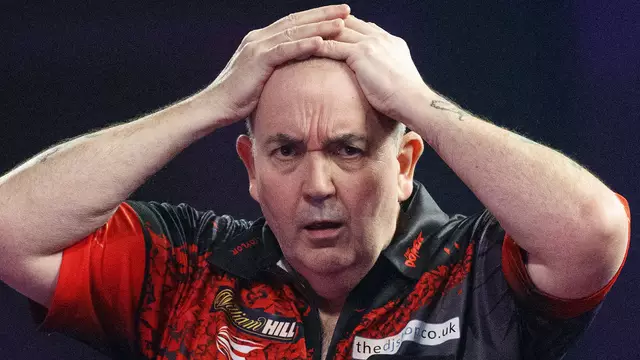
In the fiercely competitive world of professional darts, where matches can turn in a single visit and fortunes are built on precision, few stories carry as much intrigue as that of Martin Adams. Known affectionately as “Wolfie,” Adams carved out a legendary career defined by consistency, composure, and unwavering loyalty. Yet, as fellow icon Phil Taylor has reflected in recent years, that same loyalty may have cost Adams the chance to become one of the wealthiest players the sport has ever seen.
To understand the weight of that claim, it’s necessary to revisit one of the most pivotal moments in darts history — the dramatic split of 1993. At the time, the British Darts Organisation (BDO) was the dominant force in the sport, overseeing major tournaments and shaping the professional landscape. However, growing dissatisfaction among top players over prize money, television exposure, and overall treatment led to a breaking point. A group of 16 elite professionals made the bold decision to break away and form a new संगठन, the Professional Darts Corporation (PDC), then known as the World Darts Council.
This split reshaped the entire sport. While the move initially came with risks — including bans, legal disputes, and uncertainty — it ultimately paved the way for darts to become a global spectacle. The PDC quickly secured lucrative television deals, attracted major sponsors, and introduced a level of commercial success the BDO could not match. Over time, it became the dominant force in professional darts, offering prize money and opportunities far beyond what had previously been possible.
At the center of this revolution was Phil Taylor, whose decision to join the breakaway group proved transformative. Taylor went on to become the most successful player in darts history, winning 16 world titles and building a career that extended far beyond prize money. Sponsorships, exhibitions, and worldwide recognition turned him into a multi-millionaire and a global sporting icon. His success became the blueprint for what was possible in the modern era of darts.
Yet, while many of the sport’s biggest names eventually made the switch to the PDC — including figures like Raymond van Barneveld and Gary Anderson — Martin Adams chose a different path. He remained loyal to the BDO, committing himself to the organization that had supported his rise. It was a decision rooted not in hesitation, but in principle.
Taylor has often spoken about Adams with deep respect, but also with a sense of “what might have been.” Reflecting on Adams’ ability, he has suggested that “Wolfie” possessed all the tools needed to thrive in the PDC environment. In Taylor’s view, Adams had the scoring power, the finishing ability, and the mental strength to compete with — and potentially beat — the very best in the world. More than that, he believes the competitive intensity of the PDC would have pushed Adams to even greater heights.
Looking back, Taylor has been candid in his assessment. He has openly suggested that Adams could have become a “multi, multi-millionaire” had he made the switch. It’s not a statement made lightly, considering Taylor’s own journey and the financial rewards that came with it. In essence, Taylor sees Adams as one of the great “what if” stories in darts — a player whose career could have taken a dramatically different trajectory.
Despite never joining the PDC full-time, Adams’ achievements within the BDO were nothing short of remarkable. Emerging in the late 1980s, he quickly established himself as one of the organization’s leading figures. His smooth throwing action, calm presence, and ability to deliver under pressure made him a fan favorite. Over the years, he collected multiple major titles, including three BDO World Championships — victories that cemented his place among the sport’s elite.
Those world titles, particularly his triumphs in 2007, 2010, and 2011, showcased his resilience and class. The Lakeside stage became his domain, where he repeatedly proved his ability to handle the biggest moments. His 2011 victory, in particular, demonstrated his experience and composure, as he battled through a tough final to secure yet another title.
Adams was not entirely absent from the PDC stage, however. On several occasions, he accepted invitations to compete in cross-organization events, giving fans a glimpse of how he might have fared against the top PDC stars on a regular basis. One of his most notable appearances came at the World Matchplay, where he reached the semi-finals — a run that hinted at the level he could have achieved had he committed fully to the circuit.
Beyond individual tournaments, Adams also played a significant role in team darts. As captain of England, he carried a sense of responsibility that extended beyond personal success. His loyalty to the BDO was deeply tied to this role, as well as to the many people behind the scenes who supported the organization. For Adams, the decision to stay was about more than money or fame — it was about commitment, respect, and gratitude.
He has spoken openly about this mindset, explaining that he did not want to walk away from those who had helped him reach the top. In an era where many players were chasing bigger rewards, Adams chose stability and loyalty instead. It was a rare stance, particularly as the financial gap between the BDO and PDC continued to grow.
The long-term impact of the 1993 split is clear today. The PDC has become a global powerhouse, with packed arenas, major sponsorship deals, and prize funds that continue to rise. Events like the World Championship now offer life-changing sums of money, with winners earning hundreds of thousands of pounds. It is this financial reality that fuels Taylor’s reflections on Adams’ career.
And yet, measuring Adams’ success purely in financial terms would miss the broader picture. His legacy is built on more than earnings. It is defined by his achievements, his sportsmanship, and the respect he commands within the darts community. He remains one of the most admired figures in the game, not just for what he won, but for how he conducted himself throughout his career.
Even in later years, Adams has continued to compete, demonstrating the same passion and dedication that defined his prime. His longevity speaks volumes about his love for the sport, as well as his enduring ability.
Ultimately, the story of Martin Adams is one of choice. While others pursued the opportunities offered by a changing landscape, he remained true to his principles. Phil Taylor’s comments serve as a reminder of what might have been — the titles, the rivalries, and the financial rewards that could have followed. But they also highlight something equally important: that success in sport is not always measured by wealth alone.
Adams may not have taken the path that led to millions, but he built something just as meaningful — a career defined by loyalty, integrity, and excellence. In a sport driven by precision and pressure, that may be the greatest achievement of all.
Leave a Reply