
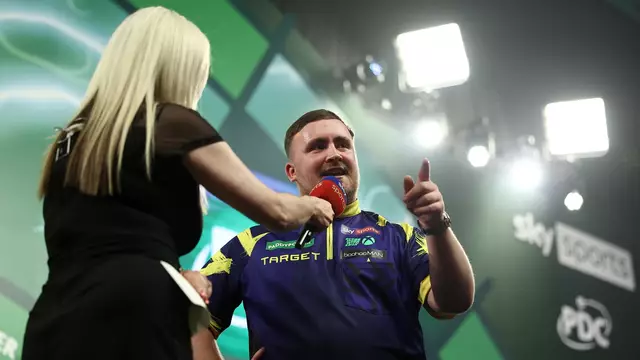
The atmosphere inside Alexandra Palace reached a fever pitch during the PDC World Darts Championship as Luke Littler stepped onto the stage for one of the most talked-about matches of the tournament. Facing Rob Cross in the last 16, the reigning champion found himself not only battling a former world title winner but also dealing with an unexpectedly hostile crowd that turned the contest into a dramatic spectacle.
Coming into the match, Littler carried the weight of expectation. Now the world number one and defending champion, the 18-year-old has already rewritten what is possible in darts at such a young age. His rapid rise has been built on fearless scoring, ruthless finishing, and a mentality that seems immune to pressure. Against Cross, however, he faced a different kind of challenge — one that went beyond the standard test of skill.
From the opening exchanges, it was clear the crowd had chosen its favorite. Cross, the 2018 world champion, received strong backing throughout, while Littler was met with boos from sections of the audience. At first, it seemed like typical darts crowd behavior, where fans often support the underdog to create a more competitive atmosphere. But as the match progressed, the tone became more pronounced, with the noise directed at Littler growing louder each time he edged ahead.
Despite the reception, Littler’s performance remained of the highest quality. He averaged over 106, a figure that underlined his control and consistency under pressure. His scoring was relentless, producing a remarkable 17 maximum 180s — a new tournament record that highlighted just how dominant he can be when in rhythm. Each visit to the board seemed to reinforce his authority, even as the crowd reaction tried to disrupt his flow.
Cross, to his credit, refused to fade away. Drawing on his experience, he kept himself in the contest, taking sets and applying pressure whenever possible. His ability to capitalize on any slight dip from Littler ensured the match remained competitive, preventing it from becoming a straightforward procession. This only added to the tension inside the venue, as fans sensed the possibility of an upset.
As Littler moved closer to victory, the atmosphere became increasingly charged. Rather than quieting the crowd, his dominance appeared to fuel their reaction. Boos rang out more frequently, particularly at key moments, creating a challenging environment for a player still early in his career. Yet instead of shrinking under the pressure, Littler leaned into it.
His celebrations became more animated as the match wore on. After winning crucial legs, he responded to the crowd directly — pointing, shouting, and making it clear he was fully aware of the reception he was receiving. It was a visible shift from his usual composed demeanor, suggesting that the occasion had stirred something deeper.
When the final moment arrived, Littler showed his class. A composed 68 checkout sealed a 4-2 victory, securing his place in the quarter-finals and ending Cross’s challenge. It was a clinical finish to a match that had tested not only his skill but also his temperament.
However, the drama did not end with the final dart. During his post-match interview, Littler addressed the crowd in a way that immediately became one of the defining moments of the tournament. Clearly frustrated, he responded to the boos with a remark that blended sarcasm and defiance, pointing out that fans buying tickets were effectively contributing to his prize money. It was a bold response, and one that divided opinion almost instantly.
For some, it was exactly what darts thrives on — personality, rivalry, and interaction between player and crowd. The sport has long embraced a pantomime-like atmosphere, where heroes and villains are created in real time. From that perspective, Littler’s reaction added another layer to the spectacle, positioning him as a central figure in the tournament’s narrative.
Others, however, viewed the comments differently. Critics argued that the response came across as dismissive or unnecessary, suggesting that a player in his position should maintain composure regardless of the crowd’s behavior. The debate quickly spread across social media and pundit discussions, turning a single moment into a wider conversation about sportsmanship and pressure.
In the aftermath, Littler himself offered a more measured reflection. He admitted that emotions had played a role in his reaction, acknowledging that he may have “lost his head” in the heat of the moment. At the same time, he highlighted the difficulty of dealing with such an environment, especially when the crowd is overwhelmingly against you. His comments provided insight into the reality of competing at the highest level, where external factors can be just as challenging as the opponent on the stage.
Away from the spotlight, the situation drew a strong response from his family, particularly his mother, who defended him passionately on social media. Her reaction underscored the intensity of the scrutiny surrounding Littler and the protective instinct of those closest to him. For a young player still navigating fame, that support system remains crucial.
The crowd’s shift in attitude toward Littler reflects a broader pattern in sport. As players rise to dominance, they often move from being fan favorites to targets of opposition support. The underdog narrative is powerful, and in darts, where crowd involvement is central to the experience, that dynamic can change quickly. Established stars like Michael van Gerwen have experienced similar treatment, with fans often rallying behind challengers to keep contests alive.
For Littler, this may be a sign that he has reached a new level. Being the player everyone wants to beat comes with added pressure, but it also confirms his status at the top of the game. The challenge now is learning how to manage that role, both in terms of performance and public perception.
What remains beyond doubt is his ability. Even in a difficult atmosphere, he delivered a performance that few players could match. His scoring power, finishing, and mental resilience were all on display, reinforcing why he is considered the leading force in modern darts.
As the tournament moves forward, Littler’s pursuit of another world title continues to gather momentum. Each match brings new challenges, both on and off the oche, but experiences like this could prove invaluable in shaping his career. They test not just skill, but character.
In the end, this was more than just a victory over Rob Cross. It was a moment that highlighted the complexities of life at the top — the pressure, the expectation, and the unpredictability of the crowd. For Luke Littler, it was another step in a journey that is unfolding at remarkable speed, one that continues to captivate the sport and redefine its future.
Leave a Reply