
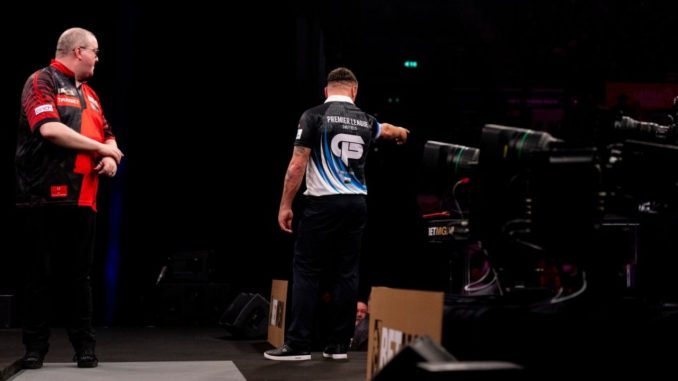
A Premier League Darts night in Sheffield took an unexpected turn when a heated semi-final between Gerwyn Price and Stephen Bunting was interrupted by crowd disruption, leading to the removal of a spectator and a strong public response from the referee involved in the incident.
What was expected to be a straightforward night of high-intensity darts quickly became a talking point for reasons beyond the scoreboard. The match was halted mid-leg after persistent whistling and shouting from the crowd began to interfere with play. Both players visibly stepped away from the oche as the noise escalated, with the atmosphere shifting from competitive excitement to frustration inside the arena.
The situation reached its peak when Gerwyn Price, known for his vocal reactions to crowd interference throughout his career, decided to take matters into his own hands. Instead of ignoring the disruption, he turned toward the crowd and identified the individual he believed was responsible. His action immediately drew the attention of officials and security staff, who moved in to assess the situation.
Referee Owen Binks was the official in charge on the night, and he quickly made the call to suspend play until the issue was resolved. Security personnel were directed to the area pointed out by Price, and the fan was escorted out of the venue shortly after. The decision ensured that the match could not resume until order had been restored and the integrity of the competition was protected.
In the aftermath of the incident, Binks spoke openly about what had happened and made it clear that the interruption was taken seriously by all officials present. He explained that while crowd noise is part of the sport, there is a clear difference between natural atmosphere and targeted disruption aimed at players during key moments.
According to the referee, the disruption was obvious enough that even though it is often difficult to identify individuals in a loud arena, the player affected was able to pinpoint the source. Binks acknowledged Price’s role in helping identify the fan, saying his intervention helped speed up the resolution of the issue and allowed officials to act decisively.
“We were waiting for a fan to get kicked out,” Binks explained when reflecting on the pause in play. He made it clear that the match would not continue under those conditions and stressed that officials were unified in that decision. “Usually you can’t hear who’s whistling and booing, but on this occasion Gezzy [Gerwyn Price] – fair play to him – noticed who was doing it and pointed him out. We were never going to start the game again until he was kicked out.”
The referee’s comments highlighted just how disruptive the situation had become, and how rare it is for a player to actively assist in identifying a specific offender during live play. In most cases, officials must rely on security teams and general crowd monitoring, but this incident allowed for a quicker resolution due to Price’s direct involvement.
Binks did not shy away from expressing his personal views on the behaviour either. While darts is well known for its lively crowds, chants, and often chaotic energy, he stressed that there is a clear boundary between entertainment and interference. In his view, that boundary had been crossed.
He explained that players are performing under intense pressure, not just for sporting success but for financial reward and professional reputation. Interruptions of this nature, he said, go beyond harmless fun and risk affecting both performance and fairness in competition.
“The point of this is when you go to the darts, be respectful because these players are playing for a lot of money,” Binks said. “They are playing for their kids and to provide for their families. If you are whistling because you think it is funny then you shouldn’t be there.”
His comments reflected a growing sentiment among officials and players in professional darts that crowd behaviour is becoming more difficult to manage as the sport continues to expand in popularity. Larger arenas and louder audiences have added to the spectacle, but they have also increased the potential for isolated individuals to disrupt matches at critical moments.
Binks went further in his criticism of such behaviour, describing the incident in blunt terms and making it clear that it had no place in the sport. “This isn’t some random fun game — this is their lives. It is ridiculous,” he added, reinforcing his belief that respect for the players must remain a priority.
Following the removal of the fan, order was eventually restored inside the arena and the semi-final resumed. Despite the interruption, Stephen Bunting was able to regain focus more effectively than his opponent and went on to secure a 6–3 victory over Price. The win booked his place in the final, where he carried his form forward and delivered another strong performance to complete a successful night.
However, even as the competition moved on, much of the post-match discussion remained centred on the referee’s intervention and the unusual circumstances surrounding the fan’s removal. The collaboration between player, official, and security was seen as an example of how such situations can be handled swiftly when all parties act decisively.
For Gerwyn Price, the incident added another chapter to his long history of interactions with vocal or hostile crowds. Throughout his career, he has frequently been at the centre of crowd-related controversies, often responding directly to noise or perceived disrespect during matches. In this case, his decision to identify the individual played a key role in resolving the situation quickly.
Stephen Bunting, meanwhile, managed to stay focused despite the disruption, ultimately using the break in play to reset before continuing his path to victory. His ability to maintain composure under difficult circumstances was noted by observers, particularly given the intensity of the match and the importance of the semi-final stage.
The broader reaction within the sport has once again raised questions about crowd management and the balance between atmosphere and fairness. Darts has built its modern identity on energetic audiences, costumes, chanting, and entertainment-driven nights that attract large crowds. However, incidents like this highlight the challenges that come with maintaining control in such environments.
Owen Binks’ decision to speak openly after the match added further weight to the discussion. His strong language and firm stance suggested that officials are becoming less tolerant of deliberate disruption, especially when it affects players during critical stages of play. His comments also reinforced the idea that referees and security teams will continue to take immediate action when similar incidents occur in future events.
As the sport continues to grow globally, the Sheffield incident may serve as a reminder of the importance of maintaining respect within the crowd, ensuring that the focus remains on the players and the competition rather than individual disruptions.
Leave a Reply