
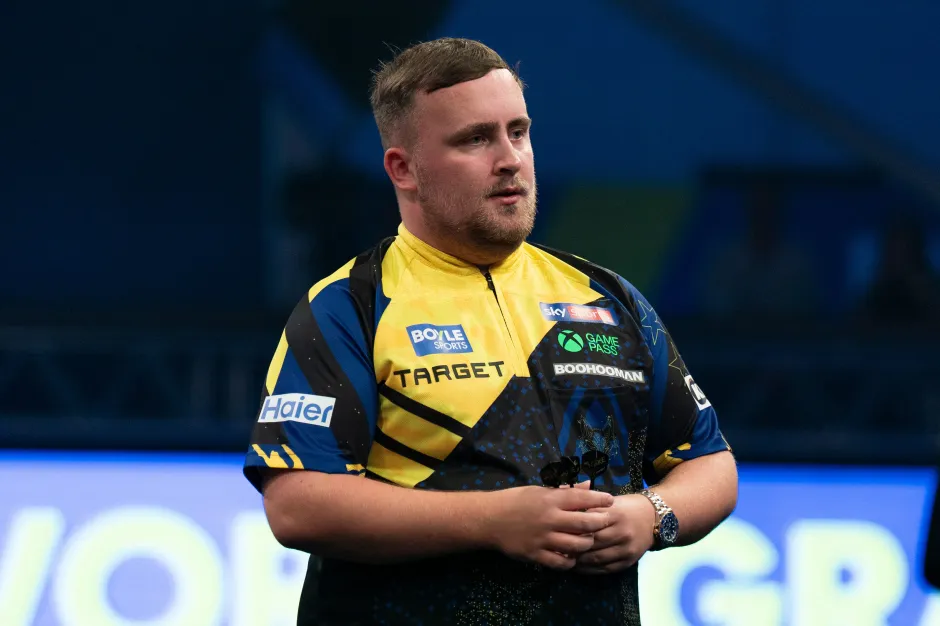
Barry Hearn reveals what he told Luke Littler about crowd booing
Luke Littler has spent most of 2026 making the darts world look almost unfair. Six premier titles in a row, another world championship and the world No.1 ranking have turned the 19-year-old into the sport’s biggest attraction. But there is another side to becoming the man everyone wants to beat: sometimes the crowd wants you to lose too.
That has become impossible to ignore. Littler has faced booing and hostile reactions at several venues, with the latest flashpoint coming in the Netherlands. After all the noise, Barry Hearn has now revealed the advice he gave the young superstar — and it is much more about controlling the reaction than controlling the crowd.
Hearn’s message to Littler
Hearn’s basic advice is simple: don’t give the crowd the reaction it is looking for.
Speaking to talkSPORT, Hearn pointed Littler towards players such as Peter Manley and Gerwyn Price, who have also experienced hostile receptions. His argument is that top players sometimes have to absorb the atmosphere, stay professional and allow the situation to burn itself out.
Hearn has also made clear that he does not approve of everything happening in the stands. Earlier this year, while discussing disruptive crowds, he said: “In the meantime, the players are pros. They’ve got to get used to it. And they will do. But I don’t like it.”
That distinction matters. Darts has always sold itself as a loud, colourful sporting experience, but there is a difference between singing, shouting and trying to unsettle an opponent and deliberately interfering with a player’s throw.
Why Littler has become the target
There is an obvious sporting reason for much of the hostility: Littler keeps winning.
At just 19, he is already a two-time PDC World Champion. In 2026, he won the World Championship, World Masters, UK Open, Premier League, World Cup of Darts and World Matchplay before his World Series run ended in Amsterdam.
Sky Sports reported that Littler had won those first six premier events of the season before Jonny Clayton defeated him 10-4 in the World Series of Darts Finals quarter-final. That ended Littler’s hopes of completing a clean sweep of the major titles.
The numbers help explain why the atmosphere can turn against him. As the world No.1 and defending world champion, Littler is rarely the underdog. For supporters who want the surprise result, cheering against him creates an obvious storyline.
Littler himself has previously shown that he understands this part of the sport. At the 2026 World Championship, he was booed during his 4-2 victory over Rob Cross.
Afterwards, he told Sky Sports: “I’m not bothered [by the booing]. Really not bothered. You guys pay for tickets and you pay for my prize so thanks for booing me.”
He added: “No-one wanted me to win but I proved them wrong yet again.”
That is the mentality Hearn appears to want Littler to rediscover.
The Netherlands controversy changed the tone
The latest Dutch controversy, however, has made this issue more serious than ordinary sporting pantomime.
Littler faced another hostile reception at the World Series of Darts Finals in Amsterdam. The atmosphere became such a major talking point that he threatened to stop playing Euro Tour events in the Netherlands if the treatment continued.
He subsequently withdrew from Players Championship 29 and 30 in Den Bosch. The decision also carried a sporting consequence because it damaged his chances of qualifying for November’s Players Championship Finals.
That is where the debate gets complicated.
A player should be able to expect basic respect while throwing. At the same time, darts has built much of its identity around noisy crowds, personalities and a party atmosphere. Finding the line between those two things is not easy.
Hearn’s “smile” strategy
Hearn’s latest advice is essentially to refuse to feed the confrontation.
He told talkSPORT that dealing with boos should be like dealing with bullies: smile, show that you are not rattled and move on. He warned that publicly challenging the behaviour can sometimes encourage people to do it even more.
That fits with comments Hearn made earlier this year, when he described telling people in authority not to do something as “a red rag to a bull – and they’ll do it ten times more.”
He also argued that removing huge numbers of spectators is unrealistic, saying: “You can’t sling out 12,000 people from the Ahoy Stadium in Rotterdam. Because it takes too long to get them back in again.”
His broader argument is that fans eventually have to recognise when their behaviour damages the experience for everyone.
There is some logic to that approach. Littler’s biggest weapon is not his relationship with the crowd; it is what happens when he stands at the oche. Every time he responds to boos with another big finish, another victory or another trophy, the sporting argument speaks for itself.
But Littler is also entitled to decide what environments he wants to compete in. His 2026 schedule has already been carefully managed, with the world No.1 taking fewer lower-level events and defending his decision to take time away from the circuit.
The next chapter
The timing makes this particularly interesting because Littler is still chasing more history.
He is set to begin his next World Championship title defence in December, having already won the tournament twice. His rise has been so rapid that expectations around him are now completely different from when he first burst onto the professional scene.
The booing is unlikely to disappear overnight. Being the dominant player can make Littler the natural villain whenever a crowd wants an underdog story.
But Hearn’s advice offers a clear path: let the darts do the talking.
Littler does not need every arena to love him. He needs to remain focused enough that the noise does not become more important than the next dart.
That may be easier said than done, especially when thousands of people are trying to get inside a player’s head. Yet if Littler can turn hostile receptions into motivation rather than confrontation, the controversy could eventually become another chapter in his extraordinary rise.
For now, the debate around booing raises a bigger question for darts. How much noise is part of the sport’s unique identity, and when does crowd involvement cross the line into ruining the contest?
That is something fans, players and the PDC will continue to wrestle with. And with Littler still at the centre of almost everything happening in darts, his relationship with the crowd is unlikely to stop being a talking point anytime soon.