
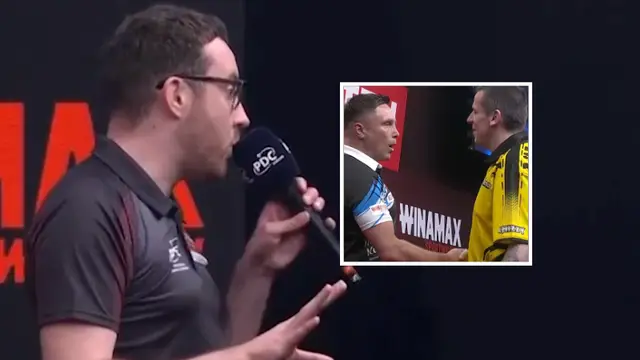
In the vibrant and often raucous atmosphere of the Glaspalast arena in Sindelfingen, Germany, the European Darts Grand Prix delivered another unforgettable night of high-octane action. The second-round encounter between Welsh powerhouse Gerwyn Price and English stalwart Dave Chisnall was shaping up to be a classic battle of styles, but it was momentarily overshadowed by an all-too-familiar disruption: persistent whistling from sections of the crowd. Stepping into the fray with characteristic authority was referee Huw Ware, whose firm intervention not only restored order but also earned him widespread praise across the darts community for his no-nonsense approach to safeguarding the integrity of the game.
The match kicked off with the kind of intensity that has made darts one of the fastest-growing sports globally. Price, affectionately known as the Iceman for his cool demeanor under pressure, entered the contest in strong form, boasting a potent combination of aggressive scoring and clinical finishing. Chisnall, or Chizzy as he is fondly called, brought his usual unflappable consistency and smooth technique to the oche. From the very first leg, the pair exchanged heavy artillery, with maximum 180s flying and tense checkout battles keeping the packed venue on tenterhooks. The early exchanges were closely contested, and as the score reached 3-2 in favor of Chisnall, the momentum seemed to be swinging slightly toward the Englishman.
It was at this critical juncture that the unwelcome noise began to build. Whistling and jeering erupted intermittently from parts of the crowd, timed deliberately to coincide with the players’ setups and throws. In a sport where concentration is everything, such distractions can prove devastating. A missed double or a rushed throw can swing a leg, and ultimately a match, in an instant. The whistling was not the light-hearted banter that darts fans are famous for; it felt targeted and malicious, threatening to derail what should have been a pure celebration of skill and precision. Both Price and Chisnall visibly struggled to maintain their rhythm as the disruptions grew louder, testing their mental fortitude in an already high-stakes environment.
Sensing the growing issue, Huw Ware took decisive action. The experienced Welsh referee, known throughout the Professional Darts Corporation for his commanding presence and commitment to fair play, marched purposefully to the edge of the stage. Dropping to one knee for added emphasis, he first consulted briefly with security personnel before addressing the entire arena through his microphone. In a clear, authoritative tone that cut through the noise, Ware delivered a stern warning: Ladies and Gentlemen, I just told security if you carry on whistling please do, but you will be thrown out the venue immediately. It is just so you know, OK?
The message was direct and left no room for ambiguity. Ware was not issuing a polite request; he was drawing a firm line in the sand, making it abundantly clear that unsportsmanlike behavior would result in immediate ejection. The arena responded with a resounding round of applause, signaling that the overwhelming majority of fans supported the intervention and wanted to see the match proceed without interference. The whistling subsided almost immediately, allowing the players to regain their focus and the contest to resume its natural flow.
With order restored, Price demonstrated why he remains one of the most formidable competitors on the circuit. Drawing on his renowned resilience and experience, the Iceman mounted a determined comeback. He broke Chisnall’s throw at a pivotal moment and powered through the remaining legs with impressive authority. Price posted an average of 99.71, hammering home five maximum 180s in the process. His finishing was clinical when it mattered most, securing a hard-fought 6-4 victory and advancing him to the last 16, where he would face Chris Dobey. Chisnall had played his part admirably, pushing Price all the way with solid scoring and moments of brilliance, but the Welshman’s superior finishing under pressure proved decisive. The win kept Price firmly in contention for the £30,000 top prize and underlined his ability to thrive even when external factors tried to unsettle him.
Huw Ware’s handling of the situation was not an isolated incident but part of a consistent pattern that has defined his refereeing career. Time and again, he has stepped forward to confront disruptive elements in the crowd, particularly the growing problem of whistling at European Tour events. Just weeks earlier, during the European Darts Trophy in Göttingen, Ware had intervened in a tense final-leg decider between Stephen Bunting and Niko Springer. In that match, he had addressed the crowd politely yet firmly: I have asked politely once and I will say it politely, shut up please. We are trying to have a game of darts up here, make this sound better please. Bunting later expressed his frustration publicly, highlighting how a small minority could tarnish an otherwise excellent contest despite the immense dedication players invest in their preparation and performance.
These repeated interventions highlight a broader challenge facing professional darts as the sport expands internationally. Crowds at overseas venues can bring incredible energy and passion, filling arenas with colorful shirts, chants, and singalongs that create an electric atmosphere. However, a vocal minority engaging in deliberate distractions crosses the line from enthusiastic support into unsportsmanlike conduct. Players train for countless hours to perfect their technique and mental game, only to have that focus undermined by tactics designed to put opponents off. Referees like Ware play a crucial role in maintaining balance, ensuring that the oche remains a stage for skill rather than sabotage.
Social media erupted with admiration for Ware’s actions following the Price-Chisnall clash. Fans from across the globe took to various platforms to voice their support. One enthusiast captured the prevailing sentiment by stating that Huw is the only ref with a set of stones on him, got to stand up to these idiots. Another praised him as the best referee, good at his job but consistently tries to do something about the whistlers. Comments poured in emphasizing his unique status: This is why he is the best ref in the sport by a mile, and As he should, it seems to be every week no matter the venue. He is the only one that speaks up. Such reactions underscore a growing consensus that Ware’s willingness to confront issues head-on is vital for the sport’s continued appeal and fairness.
Ware himself has spoken in the past about the difficulties referees face in addressing crowd disruptions. While security plays a key supporting role, the ultimate responsibility often falls on officials to set the tone and protect the players. His approach varies depending on the venue and the severity of the issue, sometimes involving a quiet word off-mic or a gesture, but when the problem persists, he does not hesitate to use the microphone. This consistency has solidified his reputation as one of the most respected figures in the PDC, having officiated some of the biggest matches, including high-profile world championship stages.
Beyond the immediate drama, the incident served as a reminder of the unique pressures on modern darts professionals. Traveling across continents, competing in intense back-to-back events, and performing in front of passionate but sometimes unpredictable crowds demands exceptional mental strength. Price’s ability to overcome the disruption and secure the win exemplified this resilience, turning a potentially tainted contest into a showcase of top-class darts. As the European Darts Grand Prix progressed, with other top stars advancing through their respective brackets, the focus shifted back to the thrilling on-stage action, but Ware’s intervention remained a talking point that highlighted the human element underpinning the sport.
In many ways, Huw Ware embodies the spirit of fair play that darts aspires to uphold. His commanding yet fair demeanor ensures that matches are decided by talent and nerve rather than external noise. By taking a stand during the Price versus Chisnall encounter, he not only allowed the game to breathe but also reinforced the message that genuine fans come to celebrate the artistry of the arrows, not to spoil it for others. As the tournament unfolded toward its climax, the night in Sindelfingen stood as a testament to the enduring appeal of professional darts, where moments of authority off the oche can be just as memorable as the spectacular finishes on it.
Ultimately, the real victory belonged to the players who could concentrate on their craft and the supporters who appreciated a contest free from unnecessary interference. Ware’s swift and decisive action ensured that the evening remained focused on the skill, drama, and excitement that make darts so captivating. In an era where the sport continues to attract larger and more diverse audiences, officials like him play an indispensable role in preserving its integrity and charm. His efforts remind everyone involved, from players to fans, that respect for the game and its participants is fundamental to its ongoing success and global growth. The European Darts Grand Prix may produce many highlights in the coming days, but Huw Ware’s stand against the whistlers will linger as a shining example of leadership and dedication to the purest form of the sport.
Leave a Reply