
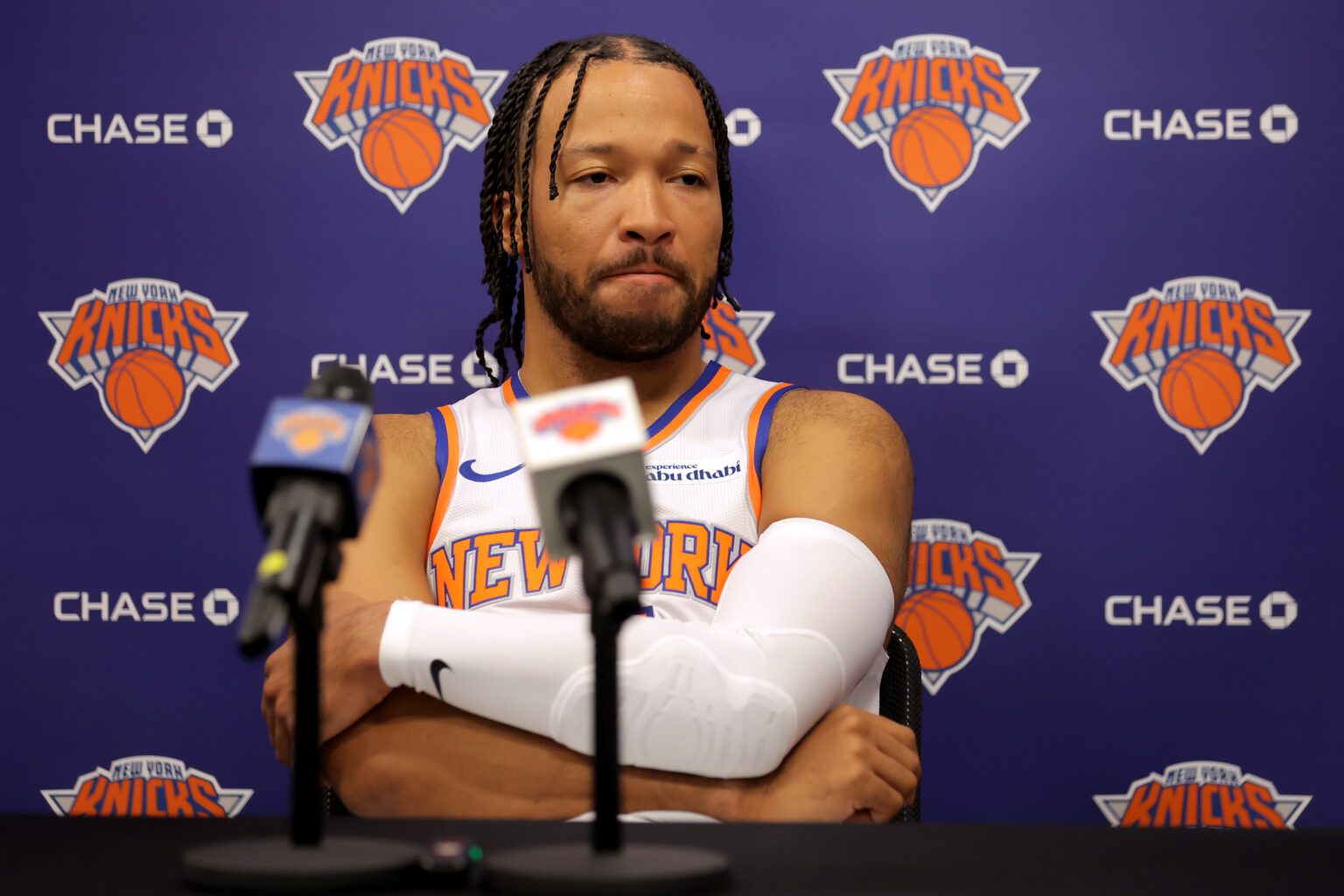
Jalen Brunson gave up a staggering amount of potential money when he signed his Knicks extension in 2024. Two years later, that decision looks very different — because Brunson is now an NBA champion, a Finals MVP and the undisputed face of a New York team that finally reached the mountaintop.
That is exactly why Draymond Green’s view of Brunson’s decision is so interesting. Green believes Brunson essentially followed a strategy he had used himself: take less money now, secure your future, and give your team more room to build around you.
But there is another side to the story that deserves attention. Brunson’s sacrifice did not just help the Knicks construct a championship roster. After seeing what happened in New York, other teams and owners now have a powerful example they can point toward when negotiating with their own stars.
And that could become very uncomfortable for players across the NBA.
Draymond Green Says Brunson Did the Draymond
Green discussed Brunson’s contract on the Club 520 Podcast and immediately recognized something familiar.
“He did the Draymond Green,” Green said.
Green was referring to his own decision to sign a four-year, $100 million extension with Golden State in 2023 rather than wait for potentially more money.
“Because I signed that four for $100 (million) and if I waited, I could’ve got like four (years) for $180 (million). But I needed to lock my money in.”
Green’s argument was essentially about security. Taking the bigger potential payday required accepting additional risk, while signing immediately guaranteed a huge amount of money.
He believes Brunson made a similar calculation, although the numbers involved were dramatically different.
Brunson signed a four-year, $156.5 million extension in July 2024. Had he waited until the following summer, he would have been eligible for a five-year deal projected at around $269 million — creating the headline-grabbing $113 million difference.
That is an enormous number.
But Green also made another point that now looks particularly interesting after everything Brunson has accomplished in New York.
“He’s the No. 1 option on the New York Knicks.”
Green continued by pointing out the unique position Brunson held in the city.
“And by the way – not only are you the No. 1 option on the New York Knicks, and that’s cool, but the city of New York loves you. You’re gonna get that $250 (million) regardless.”
At the time, that sounded like a prediction.
Now it looks much more plausible.
Brunson Bet on the Knicks — and Won
The easiest way to judge Brunson’s decision is to look at what happened next.
The Knicks used the financial flexibility created by his extension to help keep their roster together and make major additions. The team re-signed OG Anunoby to a massive extension and acquired Mikal Bridges from Brooklyn, while the eventual roster also included Karl-Anthony Towns.
Then came the payoff.
In June 2026, the Knicks defeated the San Antonio Spurs 4-1 in the NBA Finals to win their first championship since 1973. Brunson scored 45 points in the deciding Game 5 and was named Finals MVP.
That completely changes the conversation around his contract.
If Brunson had taken the biggest possible deal in 2025, there is no guarantee the Knicks would have built exactly the same roster. Nobody can honestly say the championship would have been impossible, but the financial flexibility clearly mattered.
Brunson himself was asked about the decision after winning the championship.
“100 percent worth it. 100 percent worth it,” Brunson said.
He added that even without winning the championship, he would still have considered the journey worthwhile.
That is an important distinction.
Brunson was not simply saying he would sacrifice money because championships are nice. He was betting that the organization could turn the flexibility into a genuine contender.
The Bet Paid Off in the Biggest Possible Way
There is also a technical wrinkle that gets lost whenever the $113 million figure is discussed.
The $113 million represents the difference between Brunson’s four-year extension and the maximum five-year contract he could have been eligible for by waiting. It does not mean Brunson literally lost $113 million in cash compared with the most likely alternative over the same period.
CBS Sports has pointed out that the practical difference over the first three new seasons was closer to $37 million.
That is still a huge amount of money.
But Brunson also structured his career to potentially reach another massive payday later. His extension includes a player option that gives him flexibility before he becomes eligible for the NBA’s highest maximum salary tier after reaching 10 years of service.
So this was not necessarily Brunson choosing poverty over wealth.
It was more complicated.
He chose security, flexibility and a championship opportunity while leaving himself another route to maximize his earnings later.
Now the Knicks Have Something Other Stars Don’t
This is where Green’s comments become even more relevant.
Brunson’s decision has created a precedent.
After the Knicks won the championship, reports emerged that some players eligible for major extensions were hearing Brunson’s name during contract discussions. ESPN analyst Jay Williams said he had spoken with players who could become eligible for supermax deals and claimed owners were asking them, essentially, why they could not make a similar sacrifice.
That is where the situation becomes complicated.
Brunson’s circumstances were unusual. He trusted the Knicks, had strong relationships within the organization and was convinced that the roster could be built into a contender.
But not every superstar has that situation.
A player taking a massive pay cut also takes on the risk that management might fail to spend the savings effectively. Brunson got the dream outcome: the Knicks became champions and he became Finals MVP.
Another player could sacrifice millions and still watch their team struggle.
That distinction is crucial.
Brunson’s Example Can Help Players — and Owners
There is a legitimate argument that Brunson has given stars more leverage, not less.
Why?
Because he demonstrated that a team-friendly contract can actually work when the organization follows through.
But there is also an argument that his success could be used against players.
Owners can now point to Brunson and say, “Look what happened when a superstar took less.”
That does not mean another star should automatically do the same thing.
The salary-cap situation, the roster, the player’s injury history, the organization’s track record and the player’s own financial priorities all matter.
Brunson’s decision worked because several pieces fell into place.
The Knicks built a contender, Brunson stayed healthy, he became an elite player and the team ultimately won the championship.
That is a lot to ask.
The Bottom Line
Draymond Green’s comparison between himself and Brunson makes sense, but Brunson’s story has now gone far beyond a simple contract negotiation.
He took less, the Knicks used that flexibility to build, and two years later the franchise had its first championship in more than five decades.
Brunson also won Finals MVP.
That is about as powerful an argument for his strategy as anyone could possibly make.
But the biggest lesson may not be that every superstar should sacrifice $100 million for a championship.
It may be that Brunson understood his situation better than almost anyone else.
He trusted the Knicks, believed in the direction of the franchise and protected his future while giving New York room to chase something bigger.
Now every NBA team can point to his story.
The question is whether that makes it easier for other stars to sacrifice money — or gives teams an uncomfortable new bargaining tool when the next big contract negotiation begins.