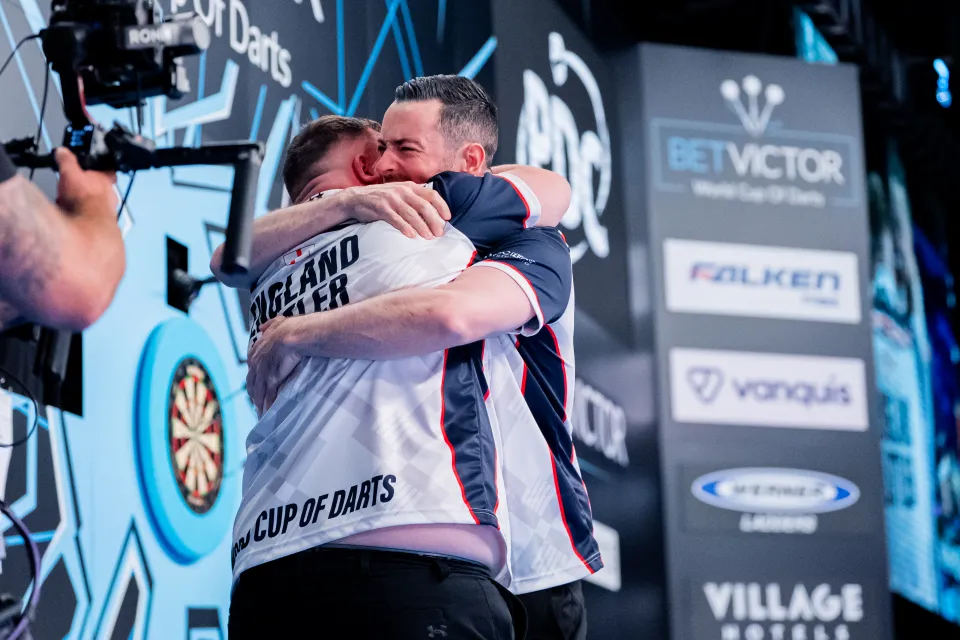
England are back on top of the darts world and they did it in ruthless fashion, dismantling the Netherlands to seize the World Cup of Darts crown in a performance that felt less like a final and more like a statement to the entire sport.
Under the brightest lights in Frankfurt, the new dream pairing of Luke Littler and Luke Humphries delivered exactly what the hype machine had promised and then some. The duo produced a display of power scoring, icy finishing, and relentless pressure to blow away the Netherlands darts team and claim the £100,000 winner’s prize. By the time the final dart landed, there was no debate left, no tension remaining, just the reality that England had once again conquered the global stage.
From the very first leg, England looked locked in. Littler set the tone with explosive scoring bursts that immediately put the Dutch on the back foot, while Humphries brought the calm, controlled finishing that has made him one of the most reliable players in the sport. It was a partnership that felt almost unfair at times: one player capable of blowing the board open in a single visit, the other capable of closing it down with surgical precision.
The Netherlands arrived with belief, as they always do in major finals, but they were quickly dragged into a pace they could not sustain. Every time they tried to build momentum, England responded with something heavier. A maximum here, a clinical checkout there, and suddenly the pressure wasn’t just on—it was suffocating.
What stood out most wasn’t just the scoring power, but the timing. England never allowed the Dutch a comfortable moment. Even when the legs looked close, even when a swing felt possible, Littler and Humphries found another gear. It’s the kind of composure that separates good pairs from great ones, and in this final it was on full display.
By the mid-session break, the scoreboard already told a brutal story. England had established a commanding cushion, and the Netherlands were left searching for answers that never really arrived. The Dutch duo had flashes—moments where their experience and resilience showed—but they were too brief, too scattered, and too often followed by another English surge.
Littler, still only in the early stages of what already looks like a generational career, played with the fearlessness that has defined his rise. There were no signs of pressure, no hesitation on big finishes, just a player who seemed to thrive in the biggest moments. Every time the crowd tried to shift momentum, he shut it down with something louder.
Humphries, meanwhile, was the metronome. If Littler was the storm, Humphries was the structure holding it together. His finishing under pressure was relentless, turning Dutch pressure into English celebrations in seconds. It is this balance—raw firepower paired with cold efficiency—that has made England’s pairing so difficult to live with in this tournament.
As the match moved deeper, the gap only widened. The Netherlands tried to change rhythm, slowing the pace, attempting to disrupt England’s flow, but it had little effect. The English pair were locked in, communicating constantly, switching seamlessly between scoring roles and finishing duties without ever losing momentum.
The final legs felt almost inevitable. England weren’t just winning them—they were controlling every dart, every visit, every bounce of momentum. The Dutch challenge, once hopeful, gradually faded into resistance rather than threat. And when the winning double finally landed, the reaction said everything: relief mixed with satisfaction, but also the sense of a job completed with authority.
This victory wasn’t just about one match. It was the culmination of a tournament where England steadily built confidence, learned from earlier scrappy moments, and peaked exactly when it mattered most. Their path to the final wasn’t always perfect, but by the time they reached the title match, they looked like a team that had figured everything out.
For Littler and Humphries, this triumph adds another layer to their growing legacy as a partnership. Both are already established stars individually, but together they bring something even more dangerous: unpredictability for opponents and complete clarity in execution. When one fires, the other supports. When pressure arrives, neither panics.
The £100,000 prize is significant, but the statement is bigger. This is England reaffirming their dominance in a format that demands chemistry, communication, and nerve under pressure. And with this duo, they appear to have found a combination that could define the next era of the competition.
The Netherlands will leave with frustration, knowing they were second best from early on but also aware that few teams in the world could have handled England at that level. They were simply overwhelmed by a side operating at full capacity in a final where every mistake was punished instantly.
As celebrations began, attention quickly turned to what this could mean going forward. Littler continues to rise at a staggering pace, stacking titles and breaking expectations with every tournament. Humphries remains the experienced backbone, the world-class closer who ensures no opportunity is wasted. Together, they are more than just a pairing—they are a problem for every nation in darts.
England’s win here won’t just be remembered as another title. It will be remembered as a warning shot. Because when these two are in sync, there is very little anyone can do to stop them.
And on this night in Frankfurt, there was no stopping them at all.
Leave a Reply