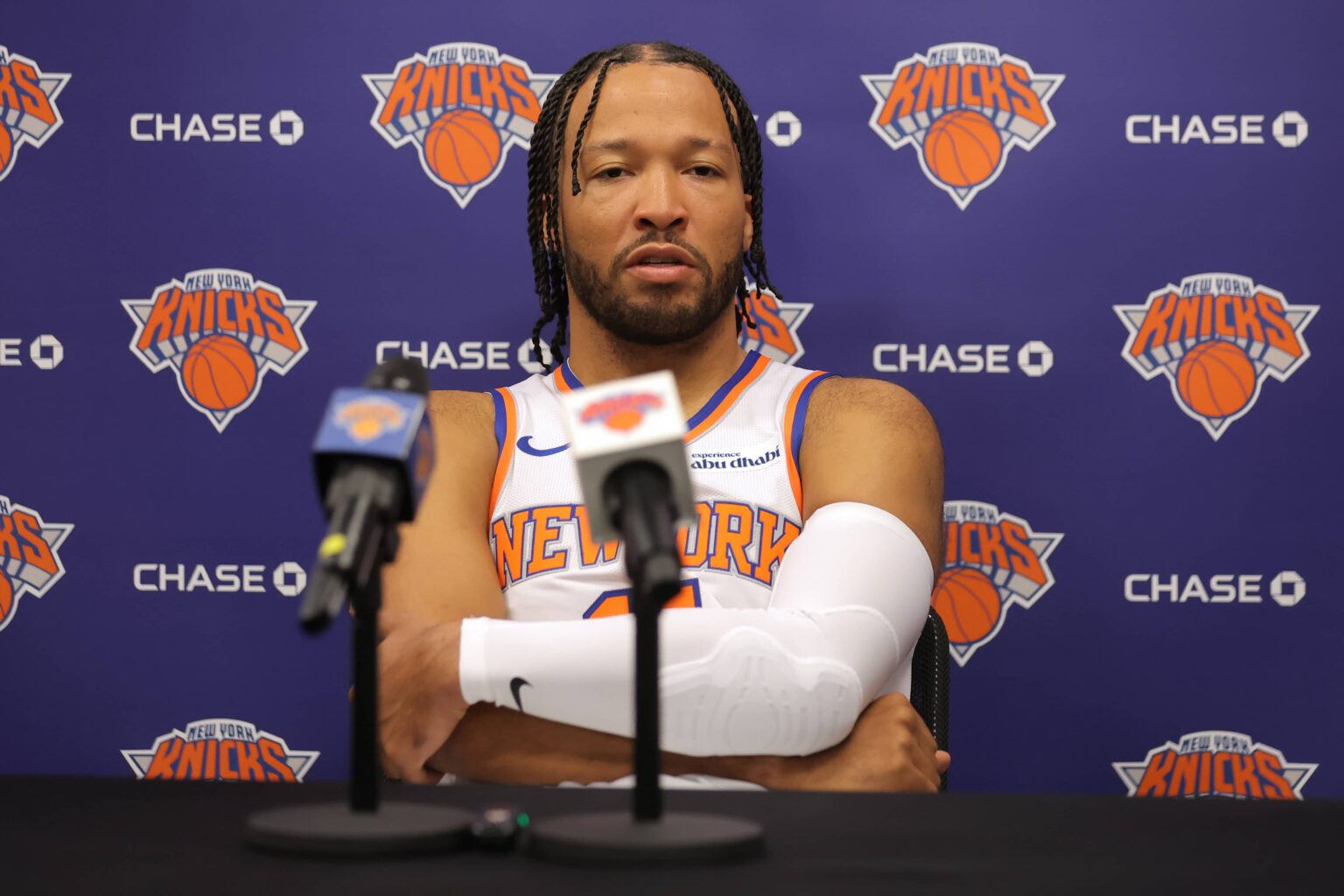
New York has spent half a century waiting for a basketball parade, and the man who finally delivered it is about to get paid like it. Jalen Brunson is not shopping himself. He is not leaking demands. The Athletic’s Fred Katz simply wrote what the rest of the league already assumes: when Brunson’s next contract begins in 2028-29, all signs point to the NBA Finals MVP earning a significant raise, a projected $290 million over four years.
That is more than $70 million a year for a 6-foot-2 guard who arrived in 2022 on a deal plenty of people called an overpay. Four years later he is a champion, a Finals MVP, and the reason the Knicks can talk about a window instead of a rebuild. The money is enormous. Given what he left on the table to build this roster, it is also the bill coming due.
The number is not a signed contract. It is a projection tied to the rising cap, and it lands in the same conversation as Karl-Anthony Towns’ stalled extension talks. Brunson’s current deal still has him at about $40.5 million in 2027-28. Katz estimates that figure jumping to roughly $64.7 million the following season once the new contract starts. That spike is already shaping how Leon Rose handles everyone else.
Brunson took the discount once. In July 2024 he signed a four-year, $156.5 million extension instead of waiting a year for a five-year deal projected at $269.1 million. The gap in guaranteed money was widely described as $113 million. He chose security and cap flexibility over the max available the following summer. The Knicks used that room. OG Anunoby got paid. Towns arrived. The supporting cast that beat San Antonio in June does not exist if Brunson waits and takes every dollar in 2025.
He has not forgotten it. Back in February he told Sports Illustrated, “Obviously we’d love for them to do right by me. I think anyone would. I feel like I sacrificed.” That is not a threat. It is a reminder, and the $290 million projection reads like the franchise answering it.
The championship is the receipt. Brunson averaged 26.0 points, 6.8 assists and 3.3 rebounds across 74 games in 2025-26, then raised the volume when it mattered. In the Finals he put up 32.6 points, 4.2 rebounds and 4.6 assists in a five-game win over the Spurs. Game 5 in San Antonio was the one that will get replayed for decades: 45 points, 14 of 27 from the field, 13 of 15 at the line, in a 94-90 win after New York had trailed by 16. He limped off after landing on Victor Wembanyama’s foot and still closed the series. First title since 1973. Fifty-three years, ended by a guard whose father was on the 1999 Finals team that lost to those same Spurs.
That is why the extension talk feels different from a normal max negotiation. Brunson is already a three-time All-Star and the best Knick of this era. Paying him at the top of the market in 2027 is not a debate inside the building. The debate is what the rest of the roster looks like once that money hits.
Towns is the immediate problem. He is eligible for as much as $276 million over four years, and the two sides are far enough apart that a deal could drag into the regular season. Shams Charania said negotiations have stagnated, and as it stands right now, a deal going into training camp is considered unlikely. He added that both sides have been discussing a deal extensively all offseason, with no movement of late. Towns has been clear about the destination if not the dollars. “I’ve made it known I wanna play here,” he said. He also said, “I think in this situation, there is no comfortability to be had.”
Owner James Dolan has called it “suicidal” to operate in the second apron. That one word explains the hardball. Katz notes that a conventional Towns extension could leave him and Brunson combining for about $113 million in 2028-29, roughly 64 percent of that season’s projected cap. Right now the pair sit closer to 58 percent, which is why the Knicks can still surround them with Anunoby, Mikal Bridges and Josh Hart. Front-loading Towns, or getting him to accept less in the Brunson spike year, is the cleanest way to keep that balance. Towns does not appear interested in the discount being asked.
Hart is in a similar holding pattern, hoping for a resolution and not expecting one tomorrow. Bridges and Anunoby are already on big money. Add a $290 million Brunson deal and the championship core gets expensive in a hurry. Rose can keep the band together. He cannot keep every band member on a max and stay out of the apron Dolan wants to avoid.
There is a counterargument worth hearing. Former NBA player Anthony Tolliver recently pushed back on the sacrifice narrative, saying the real money Brunson left behind is closer to $15 or $20 million once you account for the earlier extension he unlocked by signing short. “Jalen Brunson, no disrespect to that situation, but if y’all do the math, looking at the actual math of what he gave up, not even close to 100 million dollars. Not even close,” Tolliver said. “It’s more like 15 to 20, which is a lot of money.” The shorter deal also put Brunson in line for this raise sooner than a five-year max would have. He did the Knicks a favor. He also did his own next contract a favor.
Even if the headline number was inflated, the basketball case is not. A Finals MVP who just dropped 45 in a road clincher, on a contract that still looks team-friendly for two more seasons, is not taking another haircut. Chris Mannix has reported Brunson has been clear that there will not be a discount on this one. He wants the back end. After a title, that is a reasonable ask.
The risk is what $70 million a year does to the margins. Brunson will be 32 when the new deal starts. Guards that size do not usually age like wings, and the Knicks have already seen him gut out playoff series on a bad ankle and a tender wrist. The organization let Mitchell Robinson walk to Boston rather than chase him into the apron. That tells you how they plan to manage the books. Stars stay. Role players get replaced. If Towns walks in 2027 because the numbers never met, Brunson’s raise will be remembered as the contract that forced the choice.
None of that changes the simple read. The Knicks are going to pay their point guard. They owe him for 2024, they owe him for June, and the cap is going up whether they like it or not. A projected $290 million over four years is the cost of keeping the guy who ended the drought.
Whether Towns is still next to him when that money kicks in is the argument worth having. Does New York find a structure that keeps both, or does the Finals MVP’s next deal quietly decide the roster around him? Drop your take. The checks are not written yet. The direction is.