
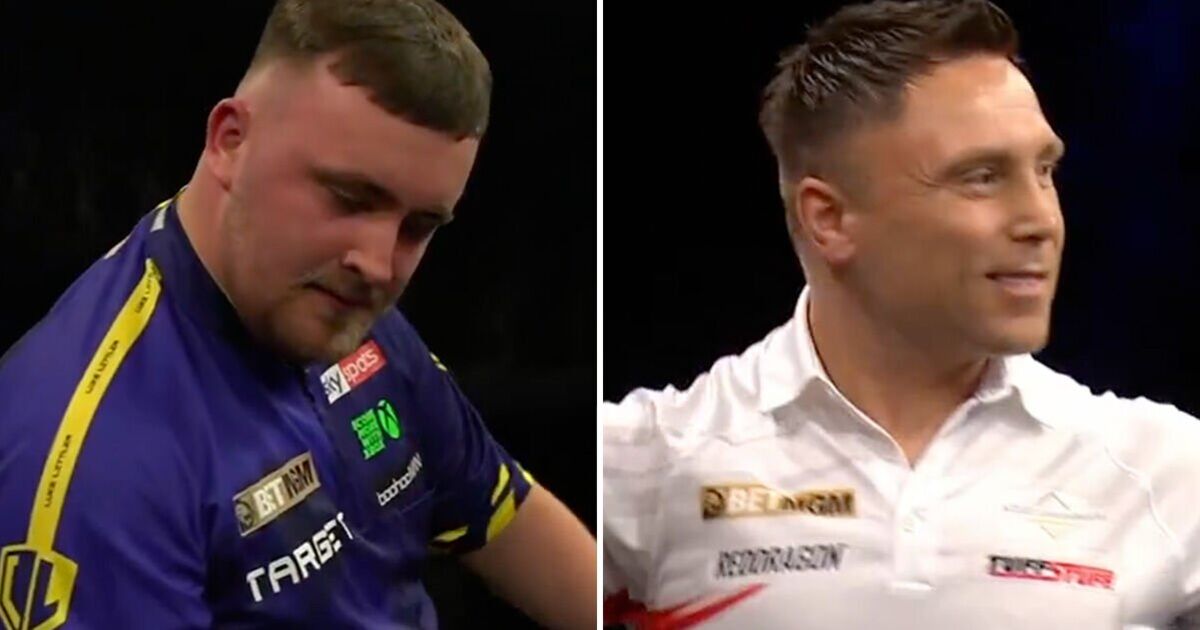
Luke Littler has never been short on drama, but what happened during his tense showdown with Gerwyn Price took things to another level as the teenage darts sensation suddenly walked off stage mid-match, leaving fans stunned and social media in meltdown. At first glance it looked like frustration boiling over in the heat of battle, another explosive reaction from a player under pressure. But the real reason behind Littler’s sudden exit is far more revealing than anger or bad blood with Price. It was a calculated reset, a mental escape button pressed in the middle of one of the most intense nights of his career, where every dart felt heavier and every roar from the crowd seemed louder than usual.
The incident came during a high-stakes clash between Littler and Gerwyn Price, a match already loaded with tension before a dart was even thrown. Price’s trademark intensity, loud celebrations and aggressive energy turned the arena into a pressure cooker, with Littler visibly struggling to settle into his rhythm. At one key moment, Price’s celebration after a big checkout triggered a brief interruption in play, with Littler clearly frustrated and momentarily thrown off his game. It was in that emotional spike that he made the decision to step away from the oche, heading off stage to regroup rather than let the moment spiral further out of control.
What looked like storming off in anger was, according to Littler himself, something very different. He later explained that he needed to reset his head, cool down, and regain control of his emotions before returning to finish the job. He admitted he “just had to get himself up for it,” describing how he took a drink, sat down, and told himself he could still win the match. Rather than walking away from pressure, it was actually a way of surviving it, a brief escape from the intensity of the stage so he could return sharper and more composed.
That moment has since become one of the most discussed scenes of Littler’s recent career, not because it showed weakness, but because it revealed just how mentally demanding top-level darts has become. The sport may look calm on the surface, but inside arenas packed with noise, expectation, and psychological pressure, even the smallest disruption can feel massive. For Littler, who has been dealing with constant attention since his rapid rise, those pressures have been building for months, and the Price clash was simply the latest flashpoint.
The teenager has previously admitted that the emotional weight of competition has affected him more than people realise. He has spoken about moments where constant scrutiny and hostile crowds began to wear him down, with pressure sometimes becoming overwhelming for someone still so young. In some instances, he has even hinted at how difficult it can be to cope with the demands of elite competition while still developing as a player and a person.
That context helps explain why the Gerwyn Price moment hit differently. It wasn’t just about one celebration or one leg of darts. It was the accumulation of pressure, noise, and emotion finally spilling over in real time. Price, known for his explosive presence on stage, only amplified that atmosphere. His animated reactions and physical intensity have often divided fans, and against Littler, it created a charged environment where every point felt like a confrontation rather than just a game.
But instead of collapsing under that pressure, Littler used a rare coping mechanism for someone his age in such a spotlight: stepping away completely. In modern elite sport, mental resets like that are becoming more common, but seeing it happen so visibly in darts is still unusual. What made it more striking is that he didn’t leave the match entirely or lose focus long-term. He returned, reset, and ultimately regained control of the contest, showing the kind of resilience that has defined his rise.
After the match, Littler was honest about what happened, explaining that it was not about disrespect or walking out, but about survival in the moment. He described how he needed to calm himself down and mentally reset, especially after falling behind during key phases of the game. Once he composed himself, he was able to refocus on the task in front of him and finish strongly. That ability to self-correct mid-match is part of what has made him one of the most dangerous players on the circuit despite his age.
The reaction from fans and pundits has largely shifted from confusion to understanding. Many now see the moment not as a meltdown, but as evidence of how much pressure Littler carries every time he steps onto the stage. At just 19, he is already competing like a seasoned veteran, but moments like this show he is still learning how to manage the emotional extremes that come with being at the top of the sport.
There is also a wider conversation forming around how young athletes in darts are handled under the spotlight. The combination of intense crowds, psychological gamesmanship, and constant travel can take a toll even on experienced professionals. For Littler, who has gone from teenage prodigy to world contender in a short space of time, that adjustment period is still ongoing.
Gerwyn Price himself has often been part of high-tension encounters throughout his career, and matches involving him are rarely calm affairs. His aggressive style is part of what makes him such a formidable competitor, but it also raises the emotional temperature of any contest he is involved in. Against Littler, that dynamic was fully on display, creating the kind of atmosphere where even top players can briefly lose their balance.
In the end, Littler’s walk-off moment is less about controversy and more about coping. It is a reminder that behind the scoring averages and highlight reels, there is still a young player learning how to handle pressure on the biggest stages in darts. And if anything, the fact he was able to step away, reset, and still perform shows a level of mental strength that may prove just as important as his talent with a dart in his hand.
What looked like frustration was actually control. What looked like walking away was actually coming back stronger. And in the high-pressure world of elite darts, that might be the most important skill of all.