
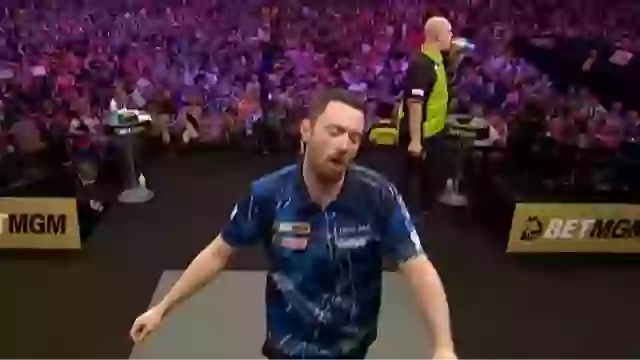
Luke Humphries was in complete control against Michael van Gerwen in Cardiff. He had raced into a 4-1 lead, broken the Dutchman’s throw and looked to be heading towards another Premier League victory.
Then everything changed.
Van Gerwen fought back brilliantly, winning four consecutive legs to move 5-4 ahead. Suddenly, Humphries was fighting simply to keep the match alive, and the deciding leg looked within reach.
But with the pressure at its highest, Humphries produced a moment that left darts fans scratching their heads — and Wayne Mardle could barely believe what he was watching.
Humphries Had The Chance To Level
The match took place during Night Seven of the 2025 Premier League Darts campaign at the Utilita Arena in Cardiff on March 20.
Humphries entered the night knowing that a strong run could help him move back above Luke Littler at the top of the Premier League table. Instead, his night ended in another quarter-final defeat.
And for a while, it looked as though things were going perfectly.
The reigning world champion opened up a 4-1 advantage against Van Gerwen, putting himself in an excellent position to reach the semi-finals. His scoring was strong and his finishing had been good enough to give him control of the contest.
Van Gerwen, though, refused to disappear.
The Dutchman gradually dragged himself back into the match before taking four legs in succession. That turnaround completely changed the atmosphere.
Suddenly, Humphries had no room for error.
Then Came The Bizarre 80 Checkout Attempt
With Van Gerwen sitting on 124, Humphries had left himself 80.
On paper, this was a perfectly manageable position.
A conventional route would have been to attack a single 20 with the first dart, leaving 60 and potentially giving himself another opportunity to set up or finish the leg.
Instead, Humphries attempted something far more aggressive.
He tried to hit two double 20s.
The thinking was clear enough. If he could hit the first double 20, he would leave himself another shot at double tops. It was an attempt to manufacture two opportunities at the same target rather than taking the conventional route.
The problem?
The first dart completely missed the board.
Humphries then hit double five with his second dart, leaving himself on 70 rather than a finish.
The opportunity had disappeared.
And Mardle was stunned.
“That… I cannot believe what I’ve just seen. That, he knows that is ridiculous.”
John Part, alongside Mardle on commentary, agreed with a simple response: “Yeah… silliness.”
It was the sort of moment that makes darts so fascinating.
One second, you’re analysing a world-class player trying to find an inventive route to victory. The next, you’re wondering why he didn’t simply take the percentage option.
Was Humphries Trying To Be Too Clever?
This is where the debate becomes interesting.
It would be easy to look at the decision afterwards and say Humphries made an obvious mistake.
But professional darts isn’t played with the benefit of hindsight.
Humphries knew Van Gerwen was sitting on 124. He also knew that he needed to win the leg immediately if he wanted to take the match to 5-5.
The temptation to try something different was understandable.
The problem was that the risk didn’t pay off.
Rather than giving himself two chances at double tops, the first dart missed completely and the second dart left him with no immediate finish.
Van Gerwen then stepped in and took out 25 to win the match 6-4.
That made Humphries’ decision look even worse because the match was suddenly over.
There was no deciding leg.
No chance to recover.
No opportunity to respond.
Van Gerwen Showed Why Experience Matters
For Van Gerwen, the comeback was arguably the biggest story of the night.
He had been 4-1 down and looked vulnerable, but instead of allowing Humphries to pull away, he gradually turned the match around.
His eventual 6-4 victory came after he averaged 104.04, while Humphries averaged 101.93.
Those numbers tell their own story.
This wasn’t a case of Humphries completely collapsing or Van Gerwen producing an outrageous statistical performance. It was a competitive match in which the Dutchman simply found a way to win the crucial moments.
And once Humphries handed him another opportunity, Van Gerwen didn’t need asking twice.
The Bigger Problem For Humphries
The defeat also mattered because it was part of a difficult spell for Humphries during that stage of the Premier League.
The Cardiff loss represented his third consecutive quarter-final exit in the competition. He had already lost to Luke Littler in Nottingham the previous week, while Rob Cross had beaten him in Brighton.
That made the defeat to Van Gerwen particularly frustrating.
Humphries wasn’t being blown away every week. He was regularly competitive, but the results weren’t matching the quality expected from a player of his status.
And against Van Gerwen, he had actually put himself in a winning position.
That is what made the bizarre 80 decision so memorable.
It wasn’t simply a strange dart.
It came at precisely the moment when Humphries needed composure.
Van Gerwen’s Night Wasn’t Finished There
Interestingly, Van Gerwen’s victory over Humphries was only the beginning of his Cardiff run.
He followed the quarter-final comeback by defeating Chris Dobey 6-1 in the semi-final, setting up another meeting with Littler in the night’s final.
That final eventually belonged to Littler, who defeated Van Gerwen 6-4 and produced a nine-dart finish along the way.
So while Van Gerwen didn’t leave