
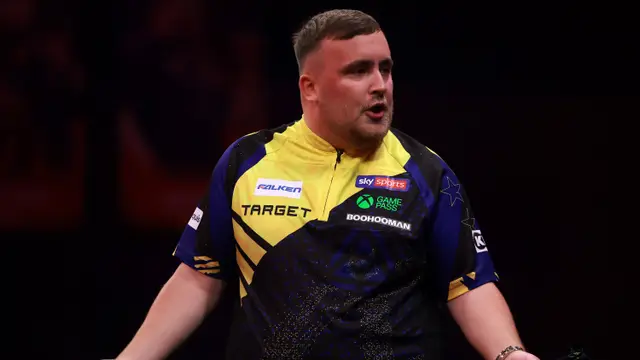
Luke Littler’s frustration with Dutch darts fans has now become much more than a heated moment on stage. What began with boos and whistles in Amsterdam has developed into a genuine question over whether the world’s biggest darts star will simply stop visiting the Netherlands altogether.
And there is already evidence that Littler is serious. After threatening to avoid Dutch Euro Tour events if the treatment continued, the 19-year-old subsequently withdrew from the Dutch Darts Championship in Maastricht, scheduled for October 16-18.
Now former world champion Glen Durrant believes Littler could continue down that path, raising an uncomfortable point for Dutch darts fans: if the hostility continues, they may be the ones who miss out most.
The Amsterdam Fallout
The controversy erupted during September’s World Series of Darts Finals at AFAS Live in Amsterdam.
Littler faced home favourite Danny Noppert before taking on Nathan Aspinall, and sections of the crowd repeatedly booed and whistled while he was playing. During the Aspinall match, the atmosphere became serious enough for the referee to intervene.
Despite everything happening around him, Littler managed to beat Aspinall 10-9 in a deciding leg.
But the atmosphere clearly left an impression.
After eventually losing 10-4 to Jonny Clayton in the quarter-finals, Littler made his position clear when discussing whether he would return for Dutch Euro Tour events.
“If the Dutch stay like this, then I’m not going to do any Euro tours over there. There’s just no point in me travelling, wasting my time whilst I’m getting booed.
“I just want to play my darts, obviously sign autographs and stuff. Because the past two nights I’ve done nothing. I’ve just walked off stage, not thanked anyone.”
Those words were initially viewed as an angry response to a difficult weekend.
The subsequent withdrawal from Maastricht made them considerably more significant.
Littler Has Already Taken Action
There is an important distinction here.
Littler has not announced that he is permanently banning himself from every darts tournament held in the Netherlands. However, he has already withdrawn from the Dutch Darts Championship, which is exactly the kind of Euro Tour event he was talking about when he made his threat.
He also withdrew from the Players Championship events in Den Bosch.
That decision needs some context, because the Den Bosch withdrawal was not simply a continuation of the crowd controversy. Sky Sports reported that Littler’s decision to pull out of those events came after his hopes of completing a clean sweep of the year’s major titles ended in Amsterdam, and it also affected his chances of qualifying for the Players Championship Finals.
So it would be wrong to suggest every Dutch withdrawal is directly because of the crowd.
But Maastricht is different.
That withdrawal came after Littler specifically spoke about refusing to play Dutch Euro Tours if the reception remained the same.
Durrant’s Warning
That is why Glen Durrant’s latest comments are so interesting.
Speaking to Daily Star Sport via OLBG, Durrant suggested Littler could stick to his position because he has already demonstrated that he is willing to skip certain European Tour events.
“He’s done it before. Obviously, he doesn’t play in the Euro Tours in Germany.”
Durrant also pointed out that Littler continues to prioritise major competitions, the World Cup and the European Championship.
“It wasn’t very pleasant. He’s at this point now where he’s just so big in the game. I think the biggest loss to the Dutch fans would be having no Littler.”
That final point is hard to ignore.
Littler is not some fringe player who needs every tournament appearance to build his reputation. He is the world No. 1, a two-time world champion and one of the biggest attractions darts has produced in years.
If he decides a particular event is not worth the aggravation, he has considerably more freedom than most players to make that decision.
The Bigger Problem for Darts
This is where the story becomes bigger than Littler.
Darts has always had passionate crowds, and hostile atmospheres are hardly new to the sport. Players such as Phil Taylor, Gerwyn Price and Peter Manley have experienced intense reactions from supporters during their careers.
Phil Taylor has since advised Littler to learn to deal with the boos, while Barry Hearn has also encouraged him to embrace the attention rather than allow it to affect his performances.
There is certainly an argument that a superstar has to learn how to handle an unfriendly crowd.
But there is another side.
There is a difference between passionate support for a local player and behaviour that repeatedly disrupts a match. When a referee has to step in because of crowd behaviour, the conversation changes.
And Littler’s case is particularly interesting because he has already decided to avoid German Euro Tour events following previous experiences there.
If the Netherlands becomes another country where he chooses not to play regular Euro Tours, that would represent a significant change in how one of darts’ biggest stars approaches the international circuit.
Littler’s Recent Results Add Another Layer
The timing is also fascinating because Littler’s form has taken a couple of unexpected blows.
His defeat to Clayton in Amsterdam ended his remarkable run of winning the first six premier events of the season.
Then came another surprise.
Littler’s defence of the World Grand Prix title ended in the first round when Luke Woodhouse recovered from losing the opening set to beat him 2-1 in Leicester. Woodhouse narrowly out-averaged Littler 82.51 to 82.41 in a match that saw the reigning champion fail to produce his best.
That does not suddenly make Littler vulnerable or erase everything he has achieved.
If anything, it shows just how brutal professional darts can be. Even the world’s best can have an ordinary night, and Littler has already shown throughout his career that he can respond to setbacks.
But it does make the Netherlands situation more intriguing.
Will he return and attempt to silence the critics, or simply decide that his time and energy are better spent elsewhere?
The Dutch Fans Could Lose Out
From Littler’s perspective, the calculation is fairly straightforward.
He wants to compete, perform and enjoy his darts. If an event repeatedly becomes more about dealing with hostility than playing, he can choose another tournament.
For the Dutch fans, however, the equation is different.
Littler is one of the players most likely to attract attention, sell tickets and create memorable moments. Durrant’s argument is that removing him from Dutch Euro Tours could ultimately hurt the supporters themselves.
There is an irony here.
A section of fans may believe they are making Littler uncomfortable, but the potential consequence is that they make themselves less likely to see him at all.
That is exactly why this story deserves more thought than simply deciding whether booing is part of darts.
What Happens Next?
For now, Littler remains committed to major competitions, and his schedule shows that he is not walking away from international darts altogether. He is still expected to compete at the European Championship in Dortmund, while the Grand Slam of Darts begins in November.
The bigger question is whether the Netherlands can change the atmosphere enough for Littler to reconsider his position.
Durrant’s prediction that Littler could continue avoiding Dutch events now looks less speculative because the player has already taken the first step.
Littler has made his feelings clear. The Netherlands has now seen what happens when the hostility goes too far.
Whether fans agree with his stance or believe he should simply ignore the boos, one thing is undeniable: darts is better when its biggest stars actually want to be on the stage.
And if Littler continues to stay away from the Netherlands, the Dutch crowd may eventually have to ask whether the reaction was worth losing one of the sport’s most extraordinary talents.
The debate is far from over — and darts fans will certainly have their say.