
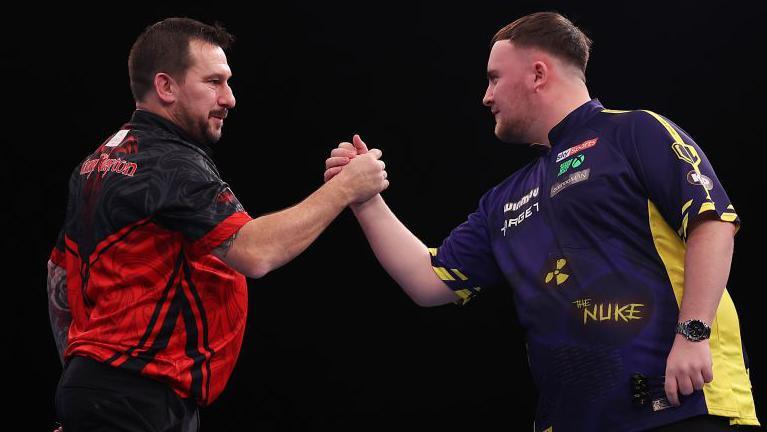
Luke Littler is one of the biggest reasons darts has become such a huge attraction, but there is an uncomfortable question hanging over the sport right now: why should its biggest star have to deal with spectators deliberately trying to put him off while he is competing?
The debate has taken another turn after Jonny Clayton proposed a controversial solution to the growing problem of crowd disruption at PDC events. And with Littler recently finding himself at the centre of another heated crowd controversy, the timing could hardly be more significant.
For me, this is about more than whether Littler reacts too strongly to the people in the stands. It is about protecting the integrity of the competition and making sure the players who entertain thousands of fans are actually allowed to do their jobs.
Clayton Has Had Enough of Crowd Disruption
According to SPORTbible, Clayton believes the PDC needs to consider tougher measures against spectators who whistle at players during matches.
The Welshman suggested that officials could consider removing an entire table of spectators if they cannot identify the individual responsible for disrupting play. He acknowledged that the idea could create problems, but clearly believes the situation needs to be addressed.
Clayton’s argument is straightforward. Fans pay good money to watch professional darts, so why deliberately interfere with the players attempting to produce their best performances?
He also made an important distinction between supporting a favourite and deliberately distracting an opponent. Cheering for a player is part of the atmosphere, but whistling while someone is throwing is an entirely different matter.
And honestly, it is difficult to argue with that.
Darts thrives on its atmosphere. The singing, the noise and the rivalry are part of what make the sport entertaining. But there has to be a line between creating an incredible atmosphere and deliberately interfering with a player’s concentration.
Why Luke Littler Should Not Be Blamed for Everything
Littler has attracted plenty of criticism for his reactions to hostile crowds, with some arguing that the teenager needs to learn how to handle the pressure.
There is a reasonable argument that every elite player must learn to perform under difficult circumstances. However, that does not mean spectators should get a free pass when their behaviour crosses the line.
At the World Series of Darts Finals in Amsterdam, Littler’s matches against Danny Noppert and Nathan Aspinall were overshadowed by hostile reactions from sections of the crowd. His match against Aspinall was interrupted, and referee Charlie Corstorphine intervened during the contest.
Littler subsequently expressed his frustration and threatened to boycott future tournaments in the Netherlands.
Critics were quick to focus on his response, but I think the bigger question is why the conversation so often becomes about how Littler reacts rather than what caused the disruption in the first place.
Should he remain calm? Absolutely, if possible. Could he handle certain situations better? Perhaps.
But expecting a player to absorb deliberate distractions without showing frustration is an unrealistic standard, particularly when the same behaviour could affect the outcome of a crucial leg.
Littler is not asking for opponents to be treated unfairly. He should be asking for the same basic conditions that every professional deserves: the opportunity to compete without spectators deliberately interfering with his throw.
The PDC Must Find a Fair Solution
Clayton’s proposal to remove an entire table is certainly controversial.
Imagine paying for a ticket, behaving perfectly and then being ordered to leave because somebody sitting beside you decided to whistle at a player. That would hardly feel fair.
Collective punishment should not become the automatic response to every incident.
Instead, the PDC should consider stronger enforcement, better identification of offenders and clear consequences for spectators who repeatedly disrupt matches. Referees and security staff also need the authority to respond quickly when behaviour crosses the line.
The challenge is distinguishing normal sporting passion from deliberate interference.
Booing a player is not the same as producing a sharp whistle just as they are attempting a crucial double. As former professional Paul Nicholson explained in Sky Sports’ coverage of the controversy, whistling can be particularly distracting because it is sudden and piercing.
That distinction matters.
Darts should not become a silent sport, and nobody is suggesting that spectators must sit quietly throughout an entire match. However, there is a difference between making noise and attempting to influence the result by disrupting a player’s concentration.
The PDC needs rules that protect the atmosphere without allowing a small number of spectators to ruin the experience for everyone else.
Littler Is Too Important to Ignore
There is another reason why this issue deserves serious attention.
Littler has become one of the sport’s biggest attractions, and his performances have helped bring enormous attention to professional darts. That does not mean he should receive special treatment, but it does mean the sport should take concerns about the playing environment seriously.
Sky Sports’ Mark Webster has previously said that Littler remains a major draw for darts and expressed confidence that he would bounce back from the controversy.
That is encouraging, but the PDC should not simply rely on Littler’s ability to overcome difficult situations.
Other players have complained about crowd disruption too. Ross Smith was booed during his Swiss Darts Trophy clash with Mensur Suljovic, particularly during a crucial stage of the match. His experience shows that this is not exclusively a Littler problem.
If the authorities fail to address it properly, more players could find themselves dealing with the same distractions.
And that would be a terrible outcome for a sport that depends on both its competitive quality and its entertainment value.
The Bottom Line
Clayton deserves credit for speaking openly about a problem that has become increasingly difficult to ignore. His proposed solution might need refining, but the underlying message is right: deliberate crowd interference should not be accepted as an unavoidable part of professional darts.
As for Littler, he can certainly learn from how experienced players manage hostile audiences. Remaining composed can prevent a difficult situation from becoming an even bigger distraction.
But the responsibility cannot rest entirely on his shoulders.
Fans should be free to celebrate, sing and support their favourites. They should not be allowed to deliberately interfere with a player’s throw and then hide behind the argument that it is simply part of the atmosphere.
Littler has helped make darts a bigger spectacle, and he deserves to be judged on his performances rather than constantly being dragged into arguments about crowd behaviour.
The PDC now has an opportunity to show that protecting the integrity of the game matters more than allowing a few disruptive spectators to become the main attraction.