
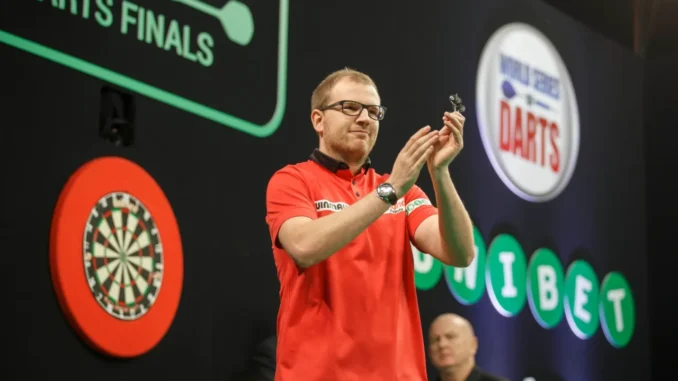
Former world darts champion Mark Webster has revealed he is currently battling a rare form of blood cancer, explaining the real reason behind his sudden disappearance from Sky Sports coverage and major darts events in recent months.
The former BDO world champion, who has become one of the most respected voices in darts broadcasting since retiring from professional play, confirmed he was diagnosed with hairy cell leukaemia earlier this year after initially suffering from unusual fatigue and ongoing health concerns.
Webster, 42, admitted the diagnosis came as a huge shock, particularly as he had been continuing his busy schedule around the darts circuit before doctors discovered the illness following a series of medical tests. Fans had begun questioning why the Welshman had been missing from television coverage during several major events, with many noticing his absence from Premier League Darts broadcasts and other televised tournaments.
The popular pundit has now spoken publicly about the health battle for the first time, revealing that although doctors are optimistic about his long-term prognosis, the recovery process has proven slower and more frustrating than he initially expected.
“On January 8, I was diagnosed with a rare form of blood cancer called hairy cell leukaemia,” Webster explained. “It sounds bad when you say leukaemia, but it’s got a good prognosis. Ninety-five per cent of cases are successful.”
While the diagnosis itself was frightening, Webster said specialists quickly reassured him that this particular form of cancer responds well to treatment in most cases. However, despite the encouraging outlook, the former world champion admitted the physical recovery following treatment has not progressed as quickly as he had hoped.
“I will be put into some sort of remission at some point,” he said. “But the recovery at the minute is not going to plan in terms of the speed of it.”
The Welshman has undergone chemotherapy treatment since the diagnosis, but lingering problems with low white blood cell counts have weakened his immune system significantly. Doctors have therefore advised him against returning to packed indoor environments such as darts arenas and sporting venues, where the risk of infection remains high.
“My white blood counts are still not recovering,” Webster admitted. “So therefore my immune system is not great at the minute, hence why I can’t go back to work.”
For somebody who has spent most of his adult life travelling, competing and later covering tournaments around the world, adapting to life away from darts has been one of the toughest parts of the experience.
Webster last appeared on Sky Sports coverage during the Premier League Darts night in Newcastle back in February. At the time, few people outside his close circle were aware of the seriousness of the situation. Since then, his absence has become increasingly noticeable as major events continued without one of the sport’s most familiar pundits.
The former Lakeside champion revealed he genuinely believed he would be back working far sooner after beginning treatment. Instead, repeated blood tests have shown his body still needs more time to recover before he can safely return to the demanding environment of live television and crowded arenas.
“I thought I’d be back pretty quickly,” Webster explained. “But it hasn’t happened like that.”
The retired darts star admitted the situation has been mentally difficult because he is used to living a busy lifestyle filled with constant travel and weekly tournaments.
“It’s frustrating because I’m used to being busy,” he said. “I miss being involved.”
Webster also explained that while he is technically well enough to meet people in smaller settings, the large-scale atmosphere surrounding major darts events remains too risky while his immune system stays weakened.
“I can work with people, but just in sensible environments,” he added. “The environments I normally work in aren’t ideal right now.”
Hairy cell leukaemia is a rare cancer affecting the blood and bone marrow. It develops slowly compared to other forms of leukaemia and is generally considered highly treatable. Even so, recovery times can vary greatly depending on how patients respond to chemotherapy and how quickly their immune systems recover afterward.
Webster revealed that extreme tiredness was one of the first warning signs that something was wrong. Initially, he believed it could simply be exhaustion from work and travel, but the fatigue gradually worsened before further tests uncovered the underlying issue.
Doctors eventually carried out blood tests and additional examinations, including a bone marrow biopsy, before confirming the diagnosis.
The news stunned many within the darts community, where Webster is regarded as one of the sport’s most respected figures both on and off the stage.
During his playing career, Webster established himself as one of Wales’ greatest darts players. His biggest triumph came in 2008 when he won the BDO World Championship at the Lakeside Country Club, defeating Simon Whitlock in the final to lift the famous trophy.
That victory transformed Webster into one of the biggest names in the sport and later led to his switch to the Professional Darts Corporation. He went on to enjoy several memorable runs at Alexandra Palace, reaching the semi-finals of the PDC World Championship twice and competing against some of the greatest players of his generation.
Known for his calm temperament and clinical finishing, Webster earned admiration from fans and fellow professionals alike throughout his career. Even after retiring from competitive darts in 2019, he remained heavily involved in the sport through television work and punditry.
His move into broadcasting proved highly successful, with viewers praising his detailed analysis, tactical insight and honest opinions. Webster quickly became one of the most recognisable faces on Sky Sports darts coverage and developed a strong reputation as one of the game’s leading pundits.
Now, however, the focus is entirely on recovery.
Webster revealed he currently attends regular hospital appointments and undergoes weekly blood tests while doctors continue monitoring his progress carefully. He is also receiving booster treatments designed to strengthen his immune system and help his body recover from chemotherapy.
“I’ve got to trust the people looking after me,” he explained. “They’ve been brilliant.”
The former world champion admitted there have been moments when he became overly optimistic about returning to work, only for medical results to force another delay. He revealed he hoped to return for one of the Premier League nights earlier this year before doctors advised him against it due to his blood counts still being too low.
“I got a bit carried away thinking I might be able to come back,” Webster admitted. “But the blood counts just weren’t ready.”
Despite the setbacks, Webster continues trying to remain positive throughout the process. The overwhelming support from fans, fellow players and broadcasters has also helped him during the difficult period, with many inside the darts world sending messages of encouragement since his diagnosis became public.
For now, the former champion remains focused on regaining his strength and allowing his body the time needed to heal fully. Although there is no official timetable for his return to television, Webster remains hopeful he will eventually be back doing what he loves.
“It’s just about trusting the process,” he said. “Hopefully it won’t be too much longer before I’m back involved again.”
Leave a Reply