
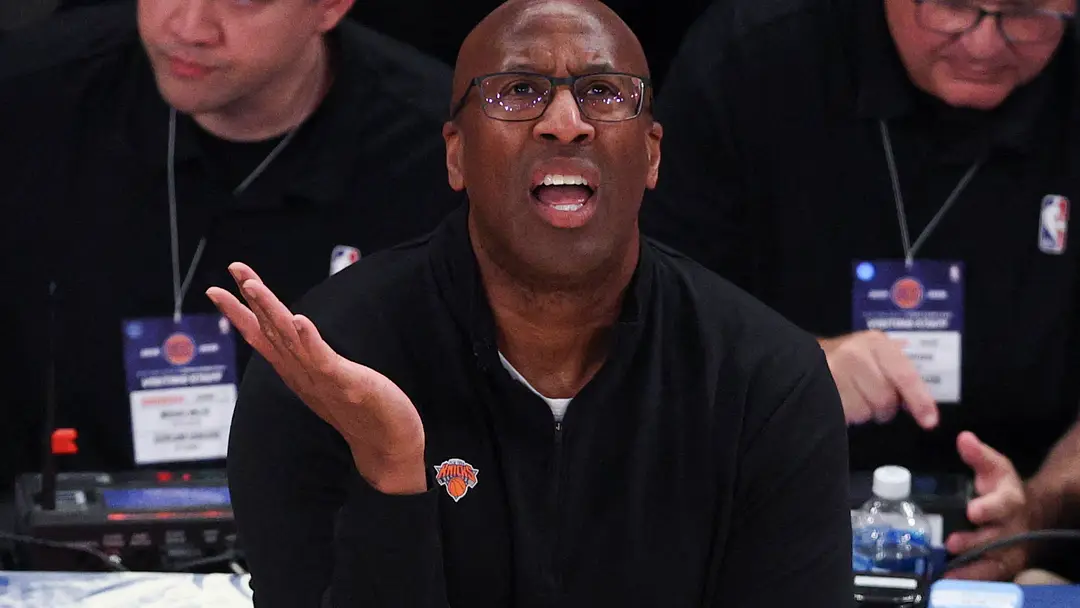
Mike Brown is quickly discovering that coaching the New York Knicks comes with a difficult problem: finding the right moments to rest Jalen Brunson and Karl-Anthony Towns without allowing the offense to fall apart.
The Knicks have enough talent to compete with the NBA’s best teams, but their opening games have exposed a rotation issue that Brown cannot afford to ignore. When New York takes both of its biggest offensive weapons off the floor, creating reliable scoring opportunities becomes a serious challenge.
And after another disappointing result against the Boston Celtics, the defending champions have an important question to answer. Is Brown’s attempt to manage his stars’ minutes hurting the team more than it helps?
The Celtics Expose a Problem Brown Cannot Ignore
New York’s 107-103 defeat in Boston on Friday, October 23, offered another reminder of how difficult it can be to keep the offense functioning when the rotation loses its main creators.
The Knicks fell behind by as many as 12 points in the fourth quarter before mounting a late comeback. They eventually cut Boston’s advantage to one, but Jayson Tatum delivered the decisive scoring plays to secure the victory.
Tatum finished with 36 points, nine rebounds and seven assists. For New York, Towns recorded 22 points and 10 rebounds, while Brunson added 19 points and four assists.
Those performances show why both stars remain so important. Towns can stretch the floor and punish defenders inside, while Brunson is the player New York trusts to manufacture a good shot when the offense gets stuck.
However, the bigger issue goes beyond their individual numbers. Brown needs to find a rotation that keeps at least one of them available to organize the offense during almost every important stretch.
Why Sitting Both Stars Is Such a Risk
Brown has experimented with lineups that allow Brunson and Towns to rest simultaneously. The idea is understandable, particularly over a long season when managing workloads can make a difference later in the playoffs.
It also gives other players opportunities to develop chemistry, take on responsibility and prove they can contribute without the team’s leading offensive options.
But there is a difference between testing a lineup and relying on one that struggles to generate points against quality opposition.
Against Boston, New York went a little over four minutes without either Brunson or Towns on the floor. During that stretch, the Knicks scored just three points and were outscored by seven.
That is a worrying return for a team trying to defend its championship.
The problem is not necessarily that the reserve players lack talent. Instead, the lineup can struggle to find someone capable of consistently creating an advantage, forcing defenders to react and generating high-quality shots when the first option disappears.
Brunson excels at creating opportunities with the ball in his hands. Towns offers another dimension through his shooting, size and ability to score around the basket.
Remove both, and the responsibility falls on players who may be more effective as complementary pieces than as primary offensive creators.
Brown’s challenge is making sure his bench groups have a clear identity rather than simply hoping somebody finds a way to score.
The Supporting Cast Must Do More
Of course, this situation cannot be blamed entirely on Brown’s substitutions. The Knicks need more consistent offensive contributions from the rest of their roster, particularly their perimeter players.
Mikal Bridges endured a difficult night against Boston, missing all eight of his field-goal attempts. When a player expected to provide scoring and spacing cannot find his rhythm, opposing defenses have more freedom to concentrate on the main threats.
OG Anunoby offered a much stronger contribution, finishing with 20 points, 10 rebounds and eight assists. Miles McBride also provided a major spark, scoring 23 points and knocking down six three-pointers.
Those performances illustrate both the opportunity and the problem facing Brown.
McBride demonstrated that New York has players capable of stepping up, while Anunoby showed he can contribute across several areas. But expecting those players to replace everything Brunson and Towns provide is a different proposition.
The Knicks need Bridges to rediscover his shooting touch and their other rotation players to become more comfortable creating opportunities when the stars sit.
Jordan Clarkson could also provide individual shot creation, while Jose Alvarado brings energy and defensive pressure. However, Brown must find combinations that allow those strengths to complement one another.
The goal should not be to eliminate experimentation altogether. It should be to avoid experiments that leave the offense without a dependable leader during crucial stretches.
Brown’s Original Rotation Plan Still Makes Sense
There is an important distinction here: Brown does not necessarily need to play Brunson and Towns together for the entire game.
In fact, staggering their minutes remains a sensible strategy. It allows New York to keep one star on the floor while the other rests, giving the second unit access to an established offensive option.
The Knicks have previously used this approach, with Brunson handling much of the first-quarter workload and Towns leading different groups when the point guard takes a break.
That arrangement can make the team more difficult to defend because opponents must account for a major scoring threat throughout the game.
The alternative is to keep both stars together for longer stretches, which could improve their chemistry but leave the bench groups struggling when they eventually come off.
For me, the best solution is a balance between the two approaches. Brown should continue exploring combinations that help Brunson and Towns play together, but he should be reluctant to rest both simultaneously unless foul trouble, injuries or the game situation leave him with little choice.
That is not a sign of weakness from a coach. It is an acknowledgment of what his roster currently does best.
The Knicks have enough options to build different lineups, but flexibility only matters when those combinations can actually compete.
A Long Season Leaves Room for Adjustments
It would be premature to panic after two regular-season defeats. New York lost 106-100 to Philadelphia in its opener before falling to Boston, and both results came against opponents capable of testing a championship-caliber team.
There is plenty of basketball left to play, and Brown still has time to learn which combinations work best.
Nevertheless, the opening games have highlighted an issue worth addressing before it becomes a recurring problem. The Eastern Conference will not make life easy for the defending champions, and stretches without reliable scoring could prove costly against stronger playoff opponents.
Brown must also consider the physical demands of a long season. Playing Brunson and Towns together more frequently might improve the offense, but their workloads still need to be managed intelligently.
That is why staggered substitutions remain so important. The Knicks should aim to preserve their stars’ energy without sacrificing the offensive structure that makes the team dangerous.
If the supporting cast improves, Brown could eventually revisit more ambitious lineups. Until then, keeping at least one of his two leading offensive players on the floor appears to be the safer approach.
The Knicks Need Their Stars on the Floor
Mike Brown has plenty of decisions to make, but the early evidence points toward one clear priority: New York cannot afford to leave its offense without Brunson and Towns for extended stretches.
Both players bring different qualities, and neither needs to dominate every possession for the partnership to work. Their combined presence gives the Knicks a much stronger foundation for creating shots, controlling the tempo and responding when opponents go on a run.
The answer is not to abandon every rotation experiment after two losses. It is to recognize which experiments are producing the wrong results and adjust before they become a habit.
Brown has a talented roster and a championship to defend. Now he must make the substitutions work for his stars rather than allowing the rotation to expose the team’s biggest weakness.
Do you think Brown should always keep either Jalen Brunson or Karl-Anthony Towns on the court, or should he continue experimenting with both stars resting together?